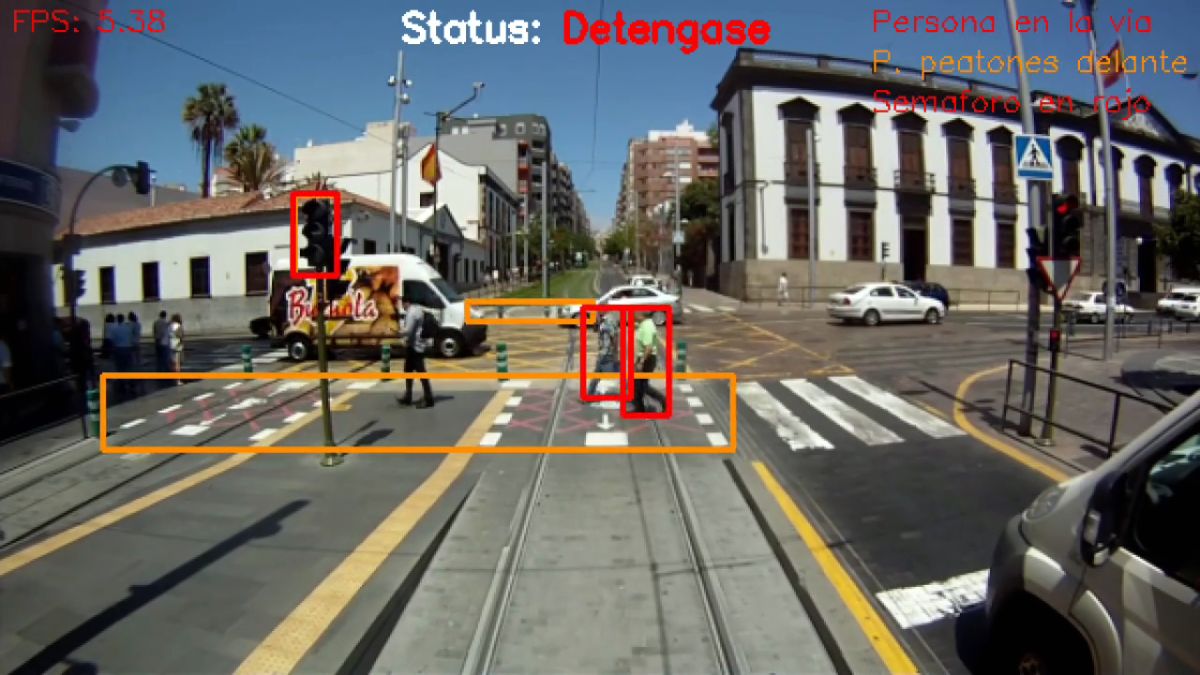
A study conducted by a group of researchers from the Department of Computer and Systems Engineering at the University of La Laguna and technical staff from the Tenerife Metropolitan Transport Company (Metrotenerife) has developed an artificial intelligence-based system capable of detecting obstacles and recognizing traffic lights in real time on Tenerife's tram network. This initiative aims to improve public transport safety, reduce the number of incidents, and optimize the overall operation of the service.
The research, published in the journal IEEE Transactions on Intelligent Transportation Systems, It arises as a response to one of the main challenges of urban transport today: ensuring safety in complex environments where pedestrians, vehicles, and various elements that can affect traffic flow interact. In this context, traditional monitoring systems have proven to have some limitations, especially in dynamic situations or under conditions of reduced visibility.
The team responsible for this advance has been made up of a multidisciplinary group of experts: Jorge Luis Díaz Acosta, Sonia Díaz Santos, Pino Caballero Gil, Cándido Caballero Gil and Rubén Franco Villa.
The core of the project is an intelligent assistant based on deep learning models, using a computer vision system. By processing images captured by cameras installed on the tram, the environment is analyzed instantly to automatically recognize pedestrians, other vehicles, and the status of traffic lights in milliseconds.
This information is processed in real time, allowing for immediate alerts to be generated for the operator when a potential risk is identified. In this way, the system acts as an additional driving aid, helping to anticipate dangerous situations that might otherwise go unnoticed or be detected too late.
The project was developed using deep learning techniques, a branch of artificial intelligence that allows machines to learn from vast amounts of data. To achieve this, the research team trained the algorithm with thousands of real-world scenarios recorded on the streets of the metropolitan area, enabling the machine to accurately distinguish between an everyday object and a potential hazard that could encroach on the vehicle's path.
One of the main tools used in the investigation is the YOLO algorithm (You Only Look Once), recognized for its ability to detect objects quickly and accurately. This feature is key in an environment like public transport, where decisions must be made in fractions of a second. Furthermore, it employs transfer learning, which allows previously trained models to be adapted to the specific context of the Tenerife tram, thus improving the system's efficiency.
On the other hand, one of the great advantages of this innovation is its ability to operate on small, low-power electronic devices, which facilitates its installation in the current fleet. It runs on a compact device called Jetson Nano, A small computer designed for artificial intelligence applications. Despite its small size, this device is capable of processing images and running advanced models in real time. In any risky situation, the device generates immediate audible and visual alerts in the cabin, allowing the driver to react more quickly.
The study results show that this type of system can have a direct impact on tram safety. By detecting obstacles more quickly and accurately, it reduces the risk of accidents and improves drivers' reaction time. Furthermore, the system contributes to improved operational efficiency. Fewer incidents mean fewer service disruptions, resulting in greater punctuality and a better user experience.
Despite the progress, the study also points out some remaining challenges. These include detecting partially hidden objects and identifying signals under adverse lighting conditions, such as at night or in bad weather. The researchers believe that the evolution of artificial intelligence models will allow for improvements in these areas in the future, incorporating more precise and robust systems.
The research team also points out that another key aspect of this tool is its remarkable adaptability. The system has been designed not only for use on Tenerife's tram network, but also with the potential for implementation on other public transport networks, significantly expanding its application potential beyond the local context. In this way, the project becomes an example of how artificial intelligence can be integrated into existing urban mobility systems, contributing to making them safer, more efficient, and more sustainable.
The publication in the prestigious scientific journal IEEE Transactions on Intelligent Transportation Systems, considered a benchmark for intelligent mobility globally, endorses the quality of a technological solution created entirely from the collaboration between academic talent and the public sector of Tenerife to transform the interaction of vehicles with the urban environment.

 Spanish
 English
 French