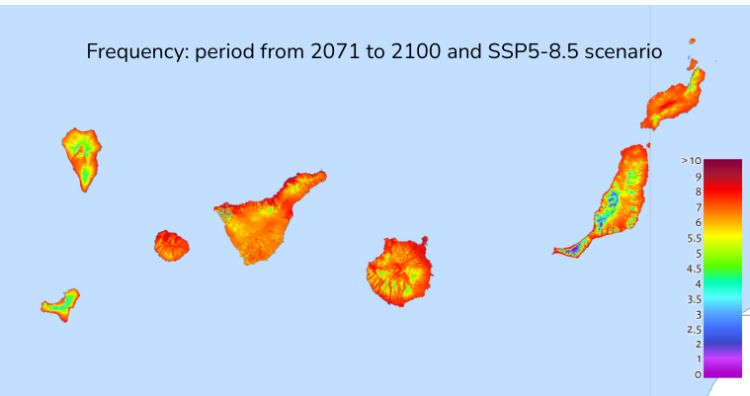
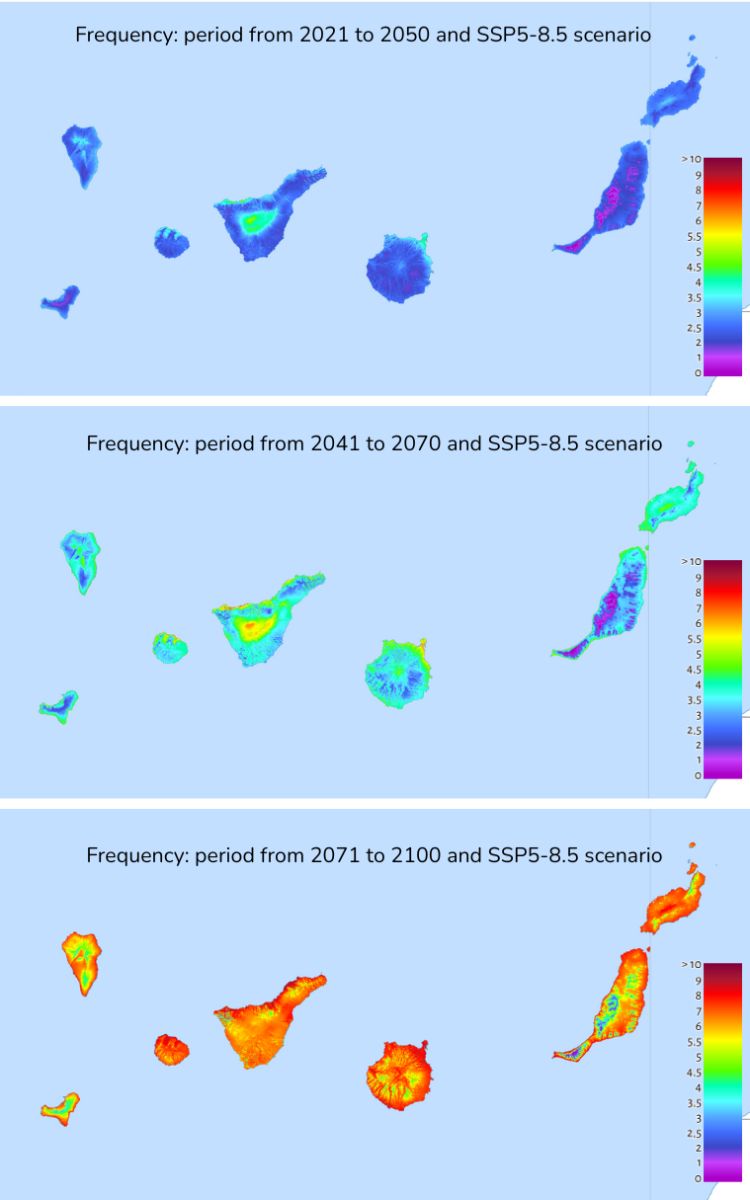
One of the figures in the study shows the evolution of the frequency of heat waves up to 2100.
A study Researchers from the University of La Laguna have analyzed the evolution of heat waves in the Canary Islands, using historical data (1985-2014) and generating regionalized climate projections up to the year 2100 using a statistical approach based on the FICLIMA method, a two-step downscaling technique that generates local climate change scenarios from global models. The results show a trend toward a significant increase in the frequency, duration, and intensity of these heat waves in the archipelago throughout the 21st century, with variations between the different islands due to orographic and climatic factors.
According to the Spanish State Meteorological Agency (AEMET), a heat wave is a prolonged period of abnormally high and extreme temperatures for a region, sustained for at least three consecutive days. In recent decades, and as a consequence of climate change, this phenomenon has increased in frequency, duration, and intensity across the Iberian Peninsula and the Canary Islands.
In the study “Climate projections of intensifying heat waves in the Canary Islands by 2100 (Spain)”, published in the magazine Regional Environmental Change and led by Juan Carlos Santamarta Cerezal, Researchers from the Department of Agricultural and Environmental Engineering at the University of La Laguna evaluated four key indicators of these events: frequency, average duration, average intensity, and maximum intensity. The results project a potentially drastic increase in heat waves across the Canary Islands until 2100 and predict up to 6.5 extra episodes per year in eastern islands like Fuerteventura, in the most critical scenarios, with average durations of 10 days and more than 60 days per year in extreme cases.
According to this research, the Canary Islands represent a particularly sensitive environment for the analysis of heat waves. The archipelago's position on the boundary between temperate and subtropical climates makes it especially vulnerable to the intrusion of warm air masses from the African continent, particularly the Sahara Desert.
To this, the researchers add, must be considered the complex island topography and the influence of the cold Canary Coast Current, whose interaction modulates the spatial variability, intensity, and persistence of heat waves in the archipelago. Furthermore, the regional economy depends heavily on climate-sensitive sectors such as tourism and agriculture. Consequently, these events represent a growing socioeconomic risk for the islands.
In terms of frequency, the study shows a notable increase in the annual number of heat waves across all the islands, with differences depending on location and proximity to Africa. The eastern islands, particularly Fuerteventura, are the ones that could experience the greatest increases, reaching up to 6.5 additional events per year in the most pessimistic scenarios. While the initial frequency of heat waves across all the islands is relatively low, currently less than one event per year, the projected increases indicate a substantial shift in regional climate patterns.
On the other hand, this study shows that these episodes will be considerably longer in the future. Currently, the average duration of a heat wave in the islands ranges from 4.4 to 5.5 days, depending on the island. However, projections indicate that, by the end of the century, up to 10 consecutive days of extreme temperatures could be recorded in the worst-case scenarios, with a total accumulation that, in the case of La Palma, could exceed 60 days of extreme heat per year. This projected increase will have significant repercussions for public health, water resource management, and economic activity, especially in sectors such as agriculture and tourism.
Finally, regarding the intensity of heat waves, the results show that while the average temperature during these events will not increase significantly, the maximum intensity could experience a notable rise. In particular, the western islands such as El Hierro and La Palma could register increases of up to 1.4ºC in the maximum temperature of these episodes, in the most critical scenarios.
These projections, according to the research group, show a greater maximum intensity in the western islands, and this is due, at least in part, to the fact that in territories with a more complex orography, the relief interacts with atmospheric factors, such as thermal inversion, which can intensify the temperature increases.
The study concludes that the intensification of heat waves in the Canary Islands throughout the 21st century poses a significant challenge to the region's climate change adaptation. Based on these findings, the research team believes it is necessary to develop appropriate mitigation and adaptation strategies, including optimizing urban planning, improving water management, and implementing protective measures for the most vulnerable sectors of the population.
This research is part of the European project ARSINOE, through which the platform has been developed. SICMA Canary Islands, ...as a viewer for consulting local climate change scenarios in the Canary Islands, where you can find more information and view the results. project has recently received the 2026 Chris Binnie Award for Sustainable Water Management.

 Spanish
 English
 French