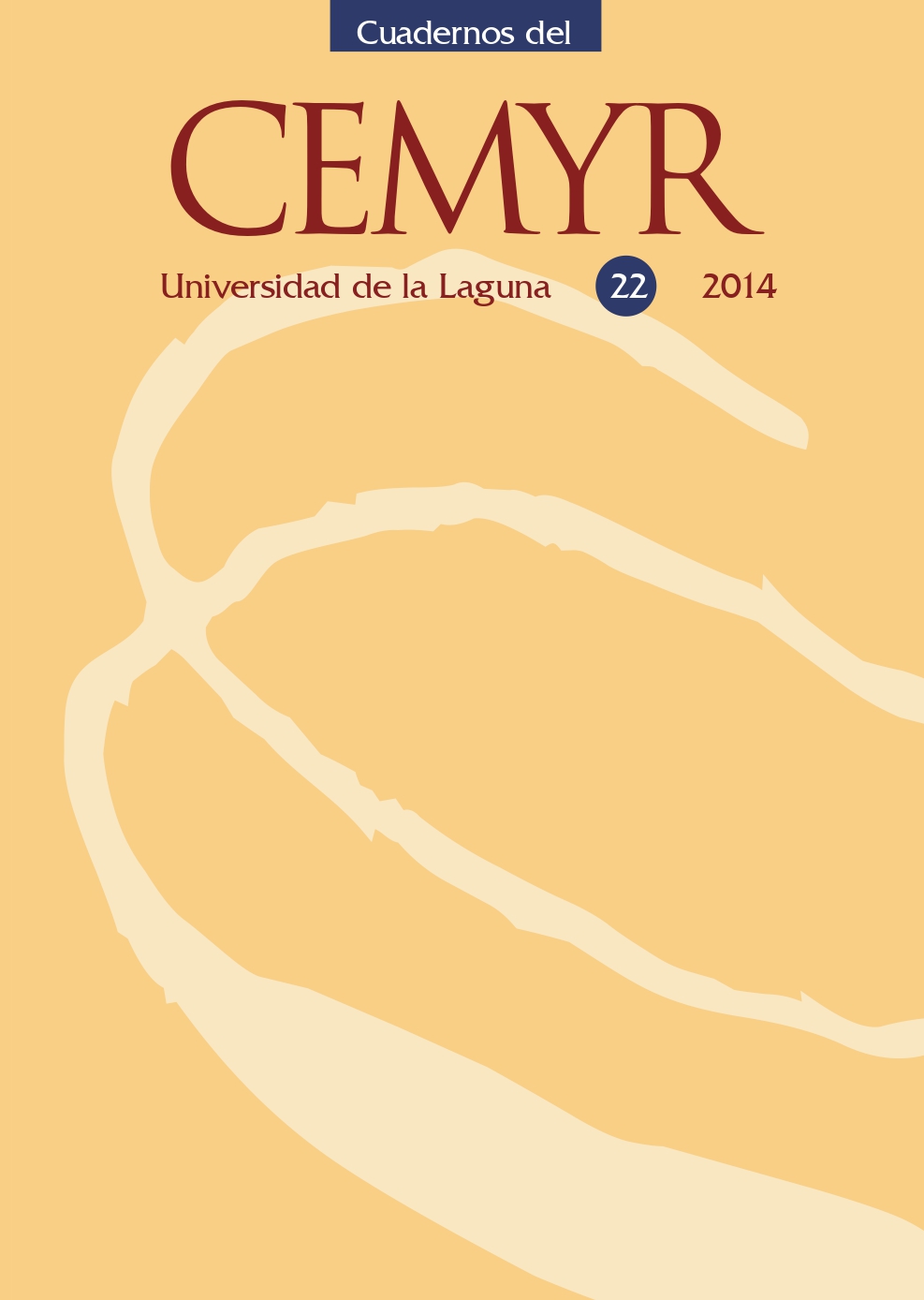
La cuaderna vía castellana del siglo XIII y los límites de la enunciación: fronteras de una poética sustancialista
Keywords:
alterity, enunciation, cuaderna vía, substantialism, poeticsAbstract
This paper investigates how the Castilian cuaderna vía is articulated from the thirteenth century onwards. We think that such enunciation cannot be explained by the action of a supposed autonomous self-speaking subject, in the manner of an eighteenth-century Kantian apriorism, given the fact that it is formed from a series of categories that should be analyzed in the light of Aristotelian substantialism. In this sense we speak of a substantialist Poetics, and to this end we set forth the concepts of substantial time and substantial space. Finally, taking into account the principles of such Poetics, we shall deal with the opposition between juglaría and clerecía in the Libro de Alexandre’s second stanza.
Downloads
Published
Issue
Section
License
The articles published in Cuadernos del Cemyr are distributed through the web portal of the Publications Service of the University of La Laguna and are freely accessible under a Creative Commons Attribution-NonCommercial-ShareAlike 4.0 International license (CC BY-NC-SA 4.0).
Authors retain the copyright and grant the journal the right of first publication of the work, as well as a Creative Commons license that allows others to share the work with an acknowledgement of the authorship of the work and its initial publication in this scientific journal.
Authors may separately establish additional agreements for the non-exclusive distribution of the version of the work published in Cuadernos del Cemyr (for example, publishing it in an institutional repository or in a book), with acknowledgement of its initial publication in this journal.