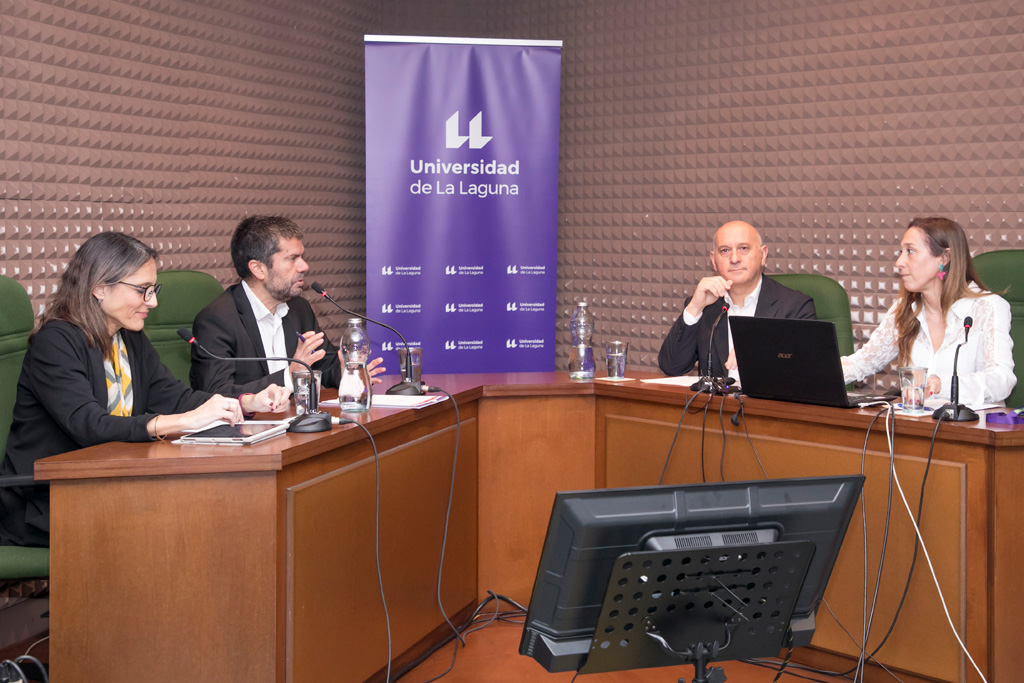
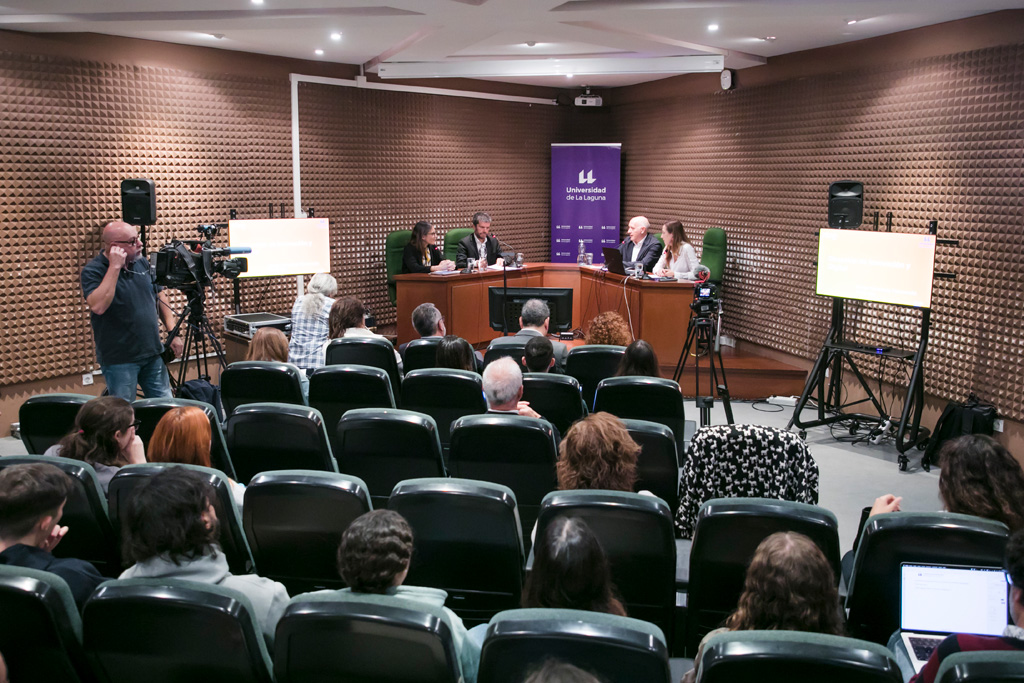
The University of La Laguna and Ratio Televisión Española, through its Institute via the Haz project, have created the Master's Degree in Continuing Education in Transmedia Narratives, The course, for which pre-registration is now open and which will begin on September 24, is the first postgraduate program on this topic offered by a Spanish public university. It was presented today, Wednesday, February 21, at an event held in the Faculty of Social Sciences and Communication.
The presentation was attended by the rector of the University of La Laguna, Francisco García; the head of the sub-directorate of the Area of Studies and Knowledge Transfer of RTVE Institute, Mireia Pi; the director of Innovation and Digital RTVE, Urbano García; the co-director of the Master's program, the professor of the Department of Communication Sciences and Social Work and co-director of the Master's program, Patricia Delponti; and the director of the RTVE Canarias Production Center, José María García Mediano.
The rector emphasized that the university's relationship with RTVE is "a natural partnership" given that both are public institutions. He noted that, just as the broadcaster is undergoing a reinvention, of which this master's program is a part, the academic institution is in a similar process. "We must remain true to our values and continue responding to society's challenges, but in a different way.".
He explained that they are exploring new teaching formats to reach a wider student body, and that a Center for Continuing Education will soon be created to develop these new qualifications in collaboration with the various departments. He also expressed his confidence that the micro-credential system, which will begin to be implemented experimentally in some degree programs, will help streamline this new type of educational approach. “Students need to continue learning continuously, and we, as an organization, must too.”.
Urbano García, Director of Innovation and Digital at RTVE, spoke about the need for traditional media to evolve in order to reach new audiences who no longer use television as their primary screen if they don't want to become irrelevant. He also emphasized that those working in media must be more versatile and capable of using different tools and formats in an environment he called omnimedia, which is closely related to the transmedia concept at the heart of the master's program. "Artificial Intelligence isn't going to take their jobs; someone else who knows how to use it will.".
Mireia Pi, head of the Haz project at RTVE Instituto, explained that her organization is responsible for training professionals joining the public broadcaster through courses and postgraduate programs. Within this offering, she highlighted that this will be the first online 100% master's program organized by the institute, and emphasized the importance of having transmedia professionals who understand that they operate within a media ecosystem where interacting with the audience is essential.
José María García Mediano, from the RTVE production center in the Canary Islands, reiterated the idea that media consumption habits have changed and it is essential that new Journalism students learn about new technologies and adapt to changes in the audiovisual sector.
The master's program co-director, Patricia Delponti, highlighted the role of her colleague in coordinating this postgraduate degree, Juan Manuel Cuéllar, head of the Innovation and New Narratives Laboratory at RTVE, with whom there has been excellent rapport despite working entirely online. She also acknowledged the work of the Vice-Rectorate for Teaching, headed by José Manuel García Fraga, for making the program's creation possible.
Focusing on the master's program content, she explained that it consists of five online modules, with sessions that can be attended in person if desired. She explained that, upon enrollment, each student will receive technological equipment that will allow them to develop projects from the outset to the expected quality standards. Since the master's program is open to both recent graduates and working professionals who wish to expand their knowledge, internships will be optional. She explained that the ten students with the best academic records will complete their internships at RTVE's network of regional centers, which will allow them to be included in the corporation's job pool.
 More information about the master's program
In today's communication ecosystem, transmedia journalism has become a crucial way to address the complexities of communication. Audience demand for active participation in narratives has led to the creation of news stories designed for different media and platforms. This has given rise to new communication models that leverage a combination of channels to disseminate content and audience engagement to amplify the reach and impact of messages and media.
This training program aims to offer a comprehensive view of transmedia storytelling, that is, storytelling across multiple platforms. This advanced approach will not only provide students with technical skills such as multimedia content creation, but will also develop a strategic understanding of how to build and manage cohesive narrative universes to stand out in an increasingly diversified and digital media landscape. It will feature a teaching team comprised of renowned national and international professionals.
The master's program will be delivered online synchronously, from Tuesday to Thursday, 4:00 PM to 8:00 PM. Students will also have the opportunity to attend lectures in person at the University of La Laguna or virtually. The training is primarily practical, with the main objective of enhancing employability and professional development.
This is the sixth master's program offered by RTVE Instituto through Haz, an RTVE Instituto initiative funded by the European Union as part of the Spanish Government's Recovery, Transformation and Resilience Plan. For this reason, the master's program includes a flat subsidy of €600 as a study aid for European citizens. The total cost is €5,500.

 Spanish
 English
 French