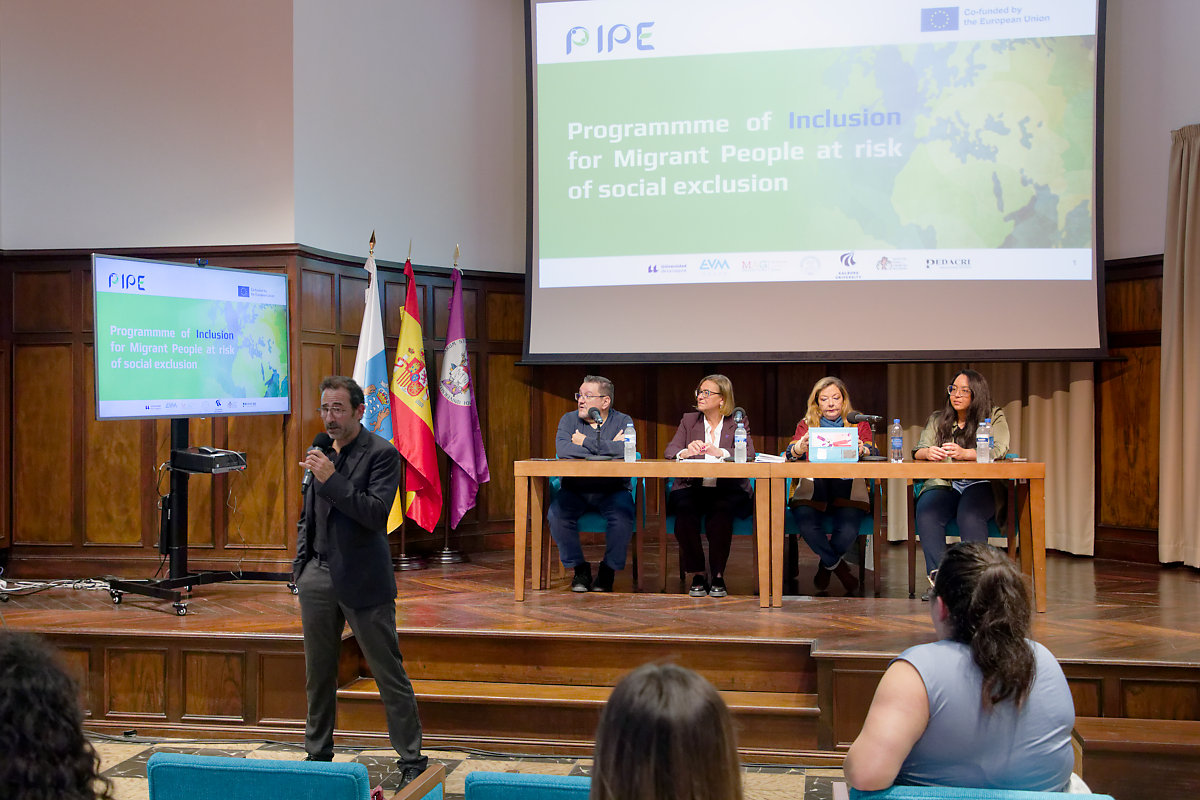
The University of La Laguna is one of the six European partner institutions of the “Inclusion Program for Migrants at Risk of Social Exclusion (PIPE code: 2023-1-ES01-KA220-ADU-
The presentation, held in the Aula Magna of the Central Building, was attended by the Vice-Rector for Internationalization and Cooperation, Inmaculada González; the head of Grupo EVM, the entity leading the project, José María Estévez; and the director of the Critical Pedagogy Research Group of the University of La Laguna (PEDACRI)., María Lourdes González Luis; the professor in the area of Theory and History of Education who has been responsible for the platform presented, Daniela Martín Hurtado; the professor specializing in the challenges of pedagogy for interculturality Daniel Buraschi; and another member of PEDACRI, Andrés González Novoa, who acted as presenter
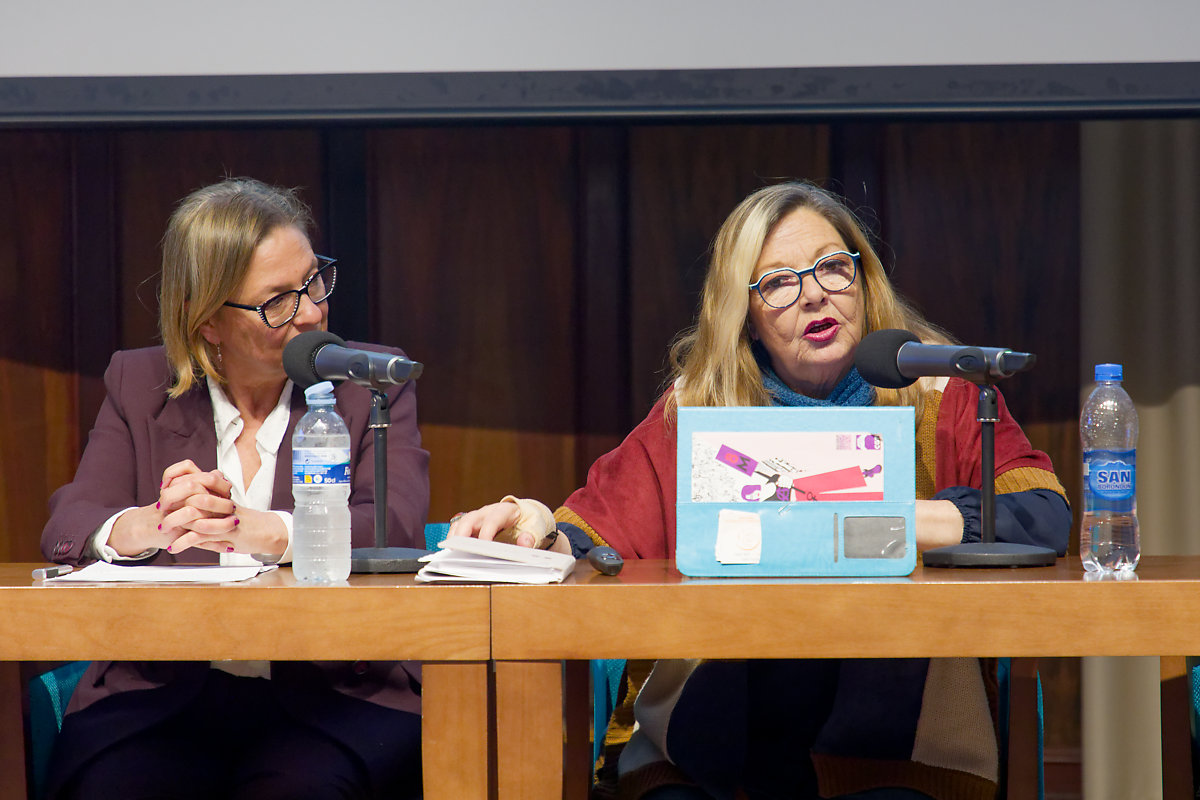
The Vice-Rector for Internationalization and Professor Lourdes González, speaking.
Inmaculada González stated that the objectives of this project, focused on facilitating the integration of migrants through various training tools, are “urgent and essential.” In her opinion, the challenge of social inclusion must begin with the recognition that “a world without diversity is not possible,” since humanity's history is one of migration, and every society “that has learned from those who arrive from other horizons has emerged stronger.” For this reason, she emphasized the importance of PIPE in helping to achieve these goals.
José María Estévez explained that the project's origins date back to 2020, when the Municipal Institute of Social Services of the Santa Cruz de Tenerife City Council contacted his company to find solutions to alleviate the situation of immigrants during the pandemic. The next step was to apply for a European project, which involves the participation of the University of La Laguna, as well as academic centers and organizations from Germany, Denmark, Greece, and Italy.
He described PIPE as an initiative with a “high probability of success” because, although there are numerous actions at the national level to assist migrants, there are no known general protocols that bring together tools and methodologies capable of generating competencies in both the migrant population and those who assist them on certain aspects of integration.
Pedagogy of mestizaje
Lourdes González delivered a much more theoretical presentation, outlining the spirit of the project, which centers on the idea of a pedagogy of cultural fusion that seeks the integration of all people on equal terms—that is, respecting their independence and without any process of assimilation. To achieve this more just society, it is necessary to equip all the groups involved with innovative tools and methodologies, which is precisely the project's objective.
For her part, Daniela Martín explained that the PEDACRI group at the University of La Laguna was primarily responsible for developing this "toolbox," which includes the two guides and the platform itself, and she explained each of them in detail. Daniel Buraschi then gave a brief presentation focusing on the educational challenges in multicultural environments.

 Spanish
 English
 French