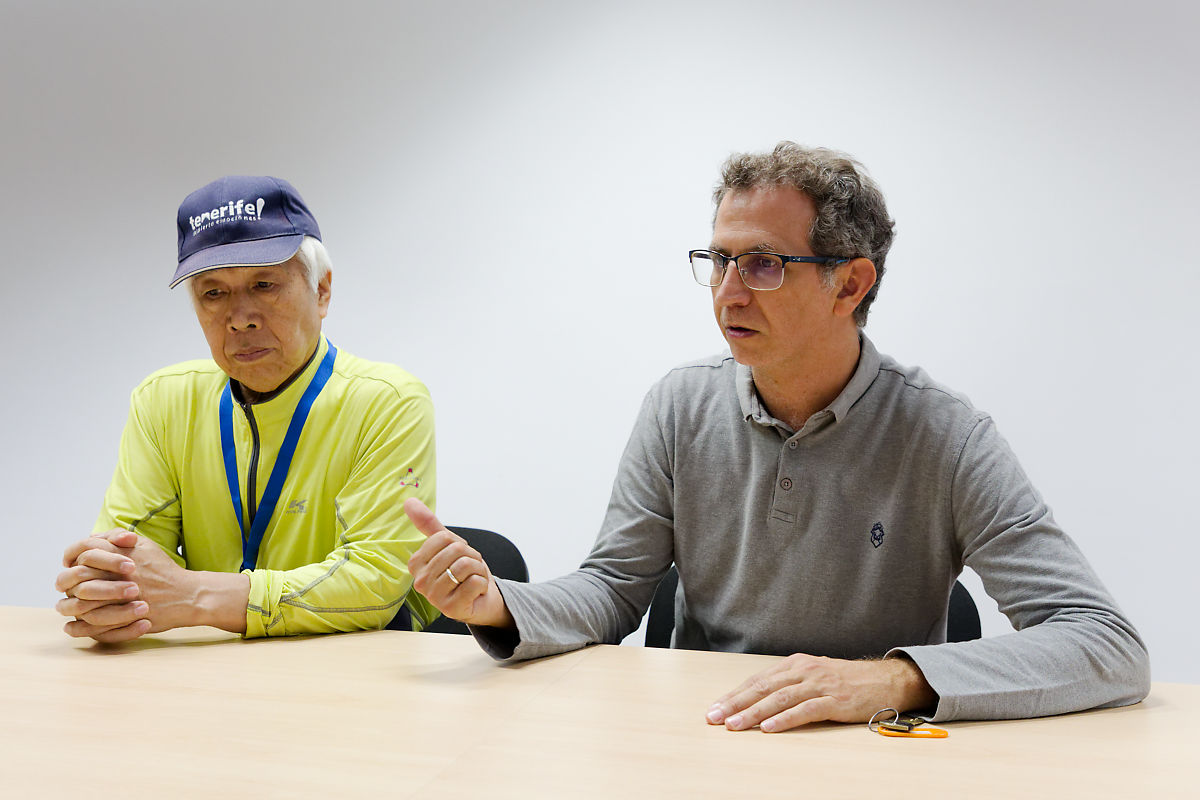
Professor Jung Young Son of the Konyang University (South Korea) recently visited the University of La Laguna on its fifth trip to the island to continue collaborating on the advancement of the WFPI (Wave Front Phase Imaging) sensor. This technology is already being used in ophthalmology and silicon metrology with remarkable success and is much more precise than the Shack-Hartmann sensor, used by Korean engineers in the development of holographic technology, where they are leaders.
The higher-resolution WFPI sensor is patented by the technology-based company. Wooptix, Originating from the University of La Laguna, which has been at the international forefront of adaptive optics for several years since its creation in 2016. The contribution of the ULL in the research being carried out in the Asian country consists of being able to measure light waves with the WFPI sensor in order to perfect three-dimensional images, but also the utilization ratio of lithographic processes that are key in the advancement of Artificial Intelligence.
At the request of the tenured professor of the Department of Industrial Engineering at the University of La Laguna José Marichal Hernández, Young Son, with whom he has collaborated since 2013, has attended the Higher School of Engineering and Technology within the framework of the program of grants for visiting professor stays aimed at research staff financed by the Vice-Rectorate for Research and Transfer of this academic center.
The Korean professor congratulated Wooptix, an organization with which Marichal collaborates through a partnership agreement, on its significant technological progress in its nearly ten years of existence. The company is improving quality control of the lithographic process on silicon wafers, the semiconductor material on which chips are printed, by analyzing the wavefront. “The goal is to measure the regularity of the topographic or relief map so that the lithographic process can adapt and perceive it as perfectly smooth, thus improving the ratio of usable chips on the wafers. This is especially problematic now that we have reached nanometric dimensions, enabling us to create the 'highways'—the information that flows within the silicon,‘ explained the professor of Industrial Engineering.
These technical advances are used by South Korean companies to build HBM memory—Hyperband Memory. “It's based on vertically stacking chips so that the transfer speed is higher than with conventional memory layouts,” Son explained. This type of memory is used by major technology corporations like NVIDIA, which designs hardware Optimized for artificial intelligence. Meanwhile, the South Korean multinational conglomerate Samsung is manufacturing devices that also adhere to these Wooptix quality procedures, in which it is, in fact, a shareholder.
Wavefront sensors measure the curvature of light rays, not their intensity, allowing for a more precise determination of the surface topography where the light has been reflected. Marichal indicates that, in recent years, technological progress has been such that measurements have gone from five nanometers to one nanometer, attempting to solve problems at the molecular level.
This race to achieve the finest detail for processing data at top speed, which has also been developed to meet the enormous computing demands of next-generation video games, is part of the race toward Artificial General Intelligence (AGI). “That’s why technology companies are investing huge amounts of money in the process we’re working on, to see who gets there first,” Marichal pointed out.
A world-renowned figure in his field, Professor Jung Young Son also gave a talk at the International Congress SHIFT2025, recently held at the University of La Laguna. It addressed how to manufacture nanoscale structures lattice, of lattice or trellis, with moiré color patterns, with which the combination of colors changes according to the direction of the light.
It's a physical phenomenon similar to mother-of-pearl, useful in creating holograms on banknotes. "It's a very inexpensive process applied to bank security measures that, without the right machine, would be very difficult to counterfeit, substantially improving the security of banknote production," Son explained. The expert confessed that his scientific interest lies in serving as a link between universities and companies to achieve these technological advancements, but he focuses on the theoretical aspects, remaining outside the commercialization of the products developed to achieve this progress.

 Spanish
 English
 French