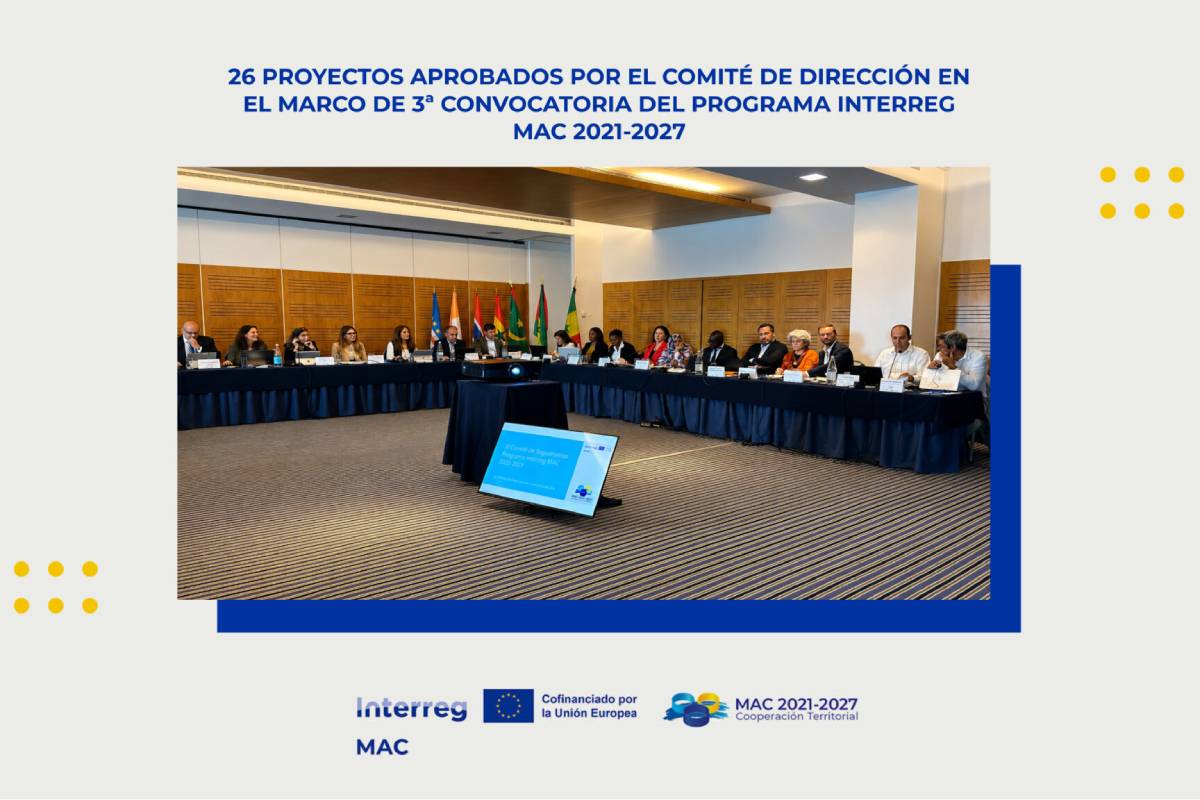
The University of La Laguna is participating in eight projects recently approved by the steering committee of the INTERREG Madeira-Azores-Canary Islands (MAC) Program 2021-2027 in its third call, framed in three areas: smart MAC, on research and innovation, implementation of advanced technologies and competitiveness; green MAC, referring to ecological transition and blue economy, fight against climate change and prevention and management of risks and disasters; and mobility MAC, to improve the management of migration at origin and destination.
The University of La Laguna's participation has been made possible through the collaborative work of the Vice-Rectorates for Internationalization and Research, via the Knowledge Transfer Office. Interreg-MAC is a territorial cooperation initiative approved by the European Commission for the period 2021-2027 that promotes projects between Macaronesia and West Africa, fostering research, innovation, and sustainable development.
Valorize marine biowaste
The University of La Laguna is leading the “Development of Circular Circuits for Blue Biowaste (BLUELOOP)” project, which aims to circularize organic waste flows from the blue economy in ports and aquaculture in the Canary Islands, the Azores, Madeira, Cape Verde, and Senegal. It has a budget of over €1.5 million to develop applied R&D&I in advanced anaerobic digestion, biogas and biomethane for port use, digestate valorization, and the identification and extraction of high-value-added compounds. The project also includes training for technical staff, companies, and collaborating associations.
Forest fire anticipation
The project “Unified Risk Analysis and Remote Sensing for Fire and Threat Reduction (AURORA),” led by the University of Las Palmas de Gran Canaria (ULPGC) and funded with nearly €1.5 million, aims to improve the prevention and management of forest fire risk through the use of advanced technologies and artificial intelligence. It will integrate meteorological, topographic, and biophysical data obtained by satellite to generate information that facilitates decision-making. It will develop a technological platform for public administrations, emergency services, and environmental management entities.
Valorization of algae from Macaronesia
“The ”MAR, Tradition and Biotechnology of Algae in Health (MARTAS)” project, endowed with over €3 million and led by the Canary Islands Science and Technology Park Foundation of the University of Las Palmas de Gran Canaria (ULPGC), focuses on the valorization of native algae, emphasizing their potential therapeutic applications to transform them into high-value-added biotechnological products that contribute to social well-being and sustainable economic development. It also aims to strengthen the region's position as a leader in marine biotechnology R&D&I and to promote business opportunities, particularly in the healthcare sector.
Impact Entrepreneurship
“The Regional Alliance for Innovative and Sustainable Entrepreneurship (RAISE), whose main partner is the Technological Institute of the Canary Islands (ITC), has over two million euros to strengthen the entrepreneurial ecosystem by creating a transregional framework that improves support services, fosters entrepreneurial talent, and facilitates access to networks and funding, with a special focus on women, young people, and other underrepresented groups. To achieve this, it will develop various tools and training, mentoring, and innovation programs.
Innovative AI-based solutions
“The ”AI & Innovation for Local Economy and Public Policy (AI-LEaP²)” project, with the University of Las Palmas de Gran Canaria (ULPGC) as its main partner and a budget of nearly two million euros, aims to promote the responsible adoption of Artificial Intelligence (AI) to improve the competitiveness, digitalization, and innovative capacity of businesses and educational institutions. It fosters strong collaboration with universities in West Africa and combines training, educational laboratories, technology pilot projects, and a transnational digital platform for sharing resources.
Energy sustainability through marine innovation
“The ”Sustainable Energy and Marine Innovation for MACaronesia (SEAMAC)” project, led by the Government of the Canary Islands and funded with over three million euros, aims to consolidate a scientific and technological ecosystem for marine renewable energies and new fuels. It seeks to promote the creation of a new blue energy industry with a regional reach that can be expanded to West Africa. This strengthening of R&D&I capabilities will be fostered through public-private collaboration and the implementation of advanced marine technologies.
Energy transition and decarbonization
“The ”Decarbonization, Energy Efficiency and Resilience of Energy Systems in Macaronesia and West Africa (DeeRaMAC)” project, led by the ITC with a budget of four million euros, promotes energy efficiency and decarbonization through new tools, technologies, and pilot projects in collaboration with public institutions and energy companies in Senegal, Cape Verde, and Ghana. It fosters energy communities with smart management and control systems and promotes renewable energy for heating and cooling and thermal storage.
Climate adaptation in biosphere reserves
“The ”MAC-Africa Biosphere Reserves: Living Labs for Climate Adaptation and Territorial Resilience (BIOSPHERE Living Lab)” initiative, led by the Government of the Canary Islands and with a budget exceeding three million euros, promotes a joint response to the challenges of climate change adaptation in the biosphere reserves of Macaronesia and West Africa. It will drive nature-based, territory-specific actions and foster citizen participation and collaborative governance.

 Spanish
 English
 French