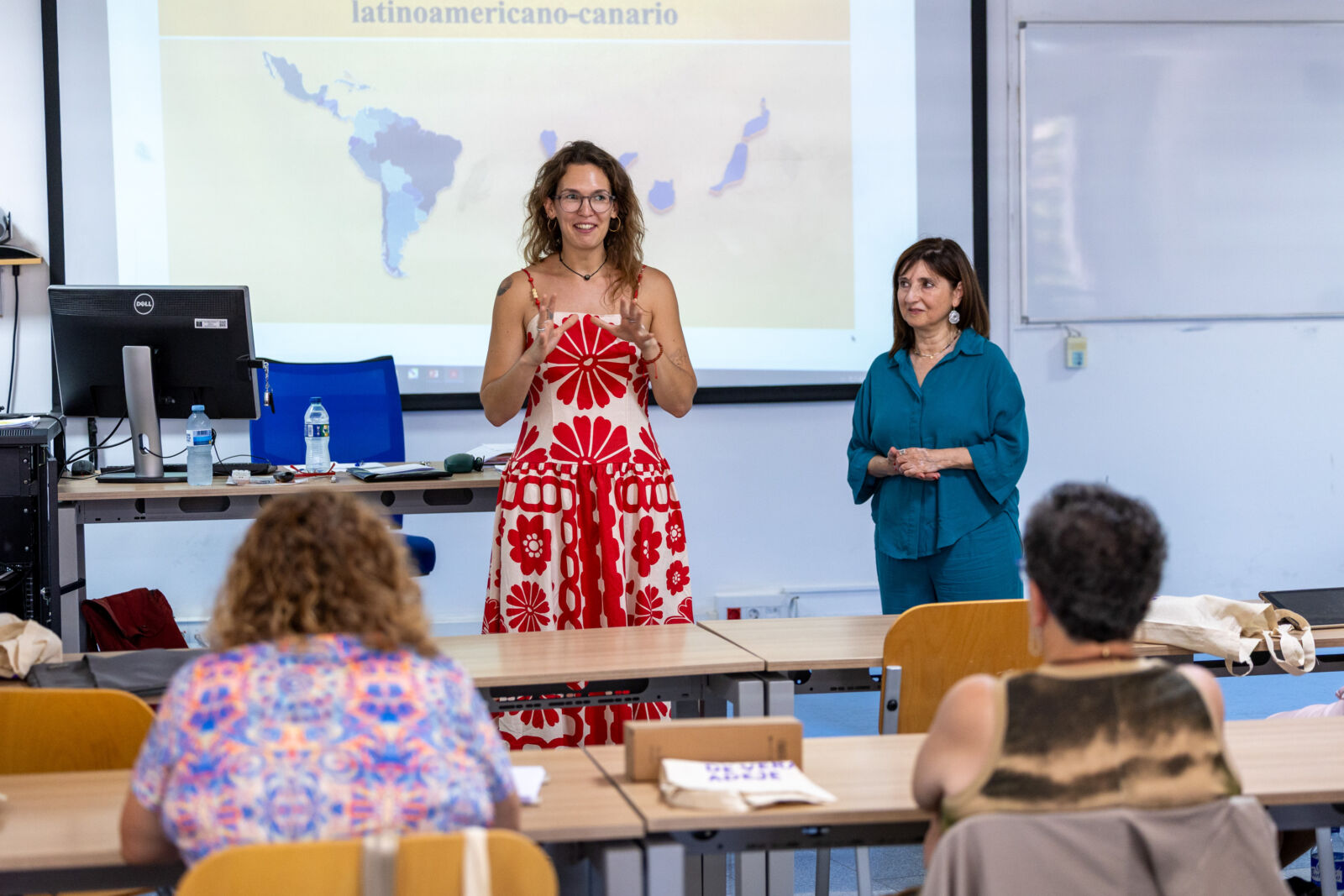
The humanities have played a prominent role in this year's program at the Adeje Summer University, with a workshop and a course focused on literature. The second of these initiatives, "Territories of Transatlantic Literature: From One Shore to the Other," was held on July 6 and 7 under the direction of Nieves Concepción Lorenzo, a tenured professor in the Department of Spanish Philology at the University of La Laguna, and her objective has been to trace some thematic coincidences between the literature produced in the Canary Islands and that conceived in various parts of America: thus, territory, memory or the figure of the grandmother as a matriarchal archetype are recurring themes on both sides of the Atlantic.
The course analysis has focused on writers from the Canary Islands who are connected to Latin America through their biography or the themes of their work, and on Latin American authors whose work shares these same themes. For example, Nieves Concepción herself has focused on the work of Antonio López Ortega, a Venezuelan writer who lives in the Canary Islands and has produced some of his work there, and on Elena Correa, a Tenerife-born author based in Madrid. Another of the course instructors, a philologist from the University of La Laguna, has also contributed to this discussion. Katya Vázquez Schröder,It has focused on migration with Cuba and Venezuela through authors such as the Canary Islander Óscar Liam and the Chilean Nona Fernández.
The course also included presentations by the teachers. Paula FernáHernández y Sabina Reyes de las Casas, Both are also linked to the Spanish Philology area of the University of La Laguna and, in addition, the Ecuadorian writer Yuliana Ortiz Ruano participated online, with a presentation in which she explained the themes developed in her poetic work, as well as in her first novel, "Fiebre de Carnaval" (2023), which merges the worlds of music and literature to address the experience of communities going through economic crises.
One of the lessons learned from this analysis of different literary practices on both sides of the ocean is that, although each of them can be framed in a very specific geographical and social environment, the experiences and problems have common features, regardless of that context.
As Katya Vázquez explains, there is “this duality between globalization and the hyper-ultralocal, and we see the same problems whether we're in Santiago, Chile, Tacoronte, or Las Galletas.” Among these problems, she cites “the violence inflicted on the land, such as extractivism and tourism, which produce changes. And also what a fragmented territory means, the issue of the island: the distances, the silences, the outermost regions, how an island connects with the rest of the continent.” Obviously, these common themes evolve over time. “The Canary Islands of 50 years ago are not the same as they are now, the same is true in Chile or Venezuela; a territory of half a century ago is not the same as it is today.”.
Although the course content may seem dense, the instructors have been mindful that it's a summer course, held in the afternoons, and, to top it all off, during a heatwave. "So it's quite different from what's usually done at the university, but it maintains the same rigor," Vázquez explains. "We're interested in approaches to texts that go beyond simply reading and analyzing, and instead employ writing techniques, which is a key focus of this course. We believe the best way to understand the content is by relating it to our own experiences, since these are topics that connect us all.".
Therefore, throughout the sessions, techniques have been applied not only for writing, but also for purely physical manipulation of the page with collage techniques to intervene in the texts. “We ask the students to address their own experiences, but in a somewhat guided way, because there is a fear of the blank page, and here you don't necessarily have to know how to write. That's why we provide guidance on how we can imitate those authors who inspire us. Based on reading these texts, the aim is to imitate those formats to talk about our own experiences. And then we can expand and modify it so that it becomes something completely different. But it starts with imitation to understand what resources these authors are using to talk about their experiences.”.
Vázquez expressed her satisfaction with the number of students who attended and their willingness to work. “It’s a very short course, just two days. So, there’s not much more we can do than share our passion for Latin American literature. We want them to engage with magnificent works that are building bridges with our local context, with our own homes, our own neighborhoods… They may be hundreds of kilometers away, but there’s still a whole summer ahead of them. We encourage them to go to their libraries and explore all these books from both continents.”.

 Spanish
 English
 French