
Ecuador is the guest country of Campus America 2024 Therefore, it features the participation of specialists from the Latin American country in various fields, including literature. Mónica Ojeda and Natalia García Freire are two of the most prominent contemporary Ecuadorian writers, both nationally and internationally, and they participated yesterday, Thursday the 10th, in a seminar where they reflected on their creative concerns. Each from a very personal perspective, both agreed on the need to liberate language from its rigidity in order to achieve greater expressiveness that, even by denying logic, can more accurately reflect difficult or elusive feelings, such as the telluric complexity of the landscape.
The seminar Contemporary Ecuadorian Women Writers It is coordinated by the professor from the Department of Spanish Philology Javier Rivero Grandoso In addition to the presentations by the two writers, there were two more theoretical interventions by philologists Yolanda Pesch, who spoke about the work of one of the guests, Mónica Ojeda, and Paula Cabrera Castro, with an intervention about two other Ecuadorian writers, María Fernanda Ampuero and Yuliana Ortiz Ruano.
Music and monstrosity
Mónica Ojeda is a writer whose work has been described as “extreme” for addressing uncomfortable, even taboo, topics, and for her disdain for generic categorizations. In her presentation, she advanced a reflection she is currently working on about the creative impulse behind music, which is related to writing and which, for centuries, has been linked to the monstrous and the terrible in different cultures around the world.
He began by pointing out that the earliest known musical instrument is a 30,000-year-old flute made from mammoth bone. From that prehistoric time onward, many instruments for creating music were made from animal bones and even human bones. Thus, there is a connection between music and death dating back to the beginnings of humanity, a connection that would later be incorporated into myths.
Thus, in classical antiquity, the greatest of musicians, Orpheus, visits the underworld to try unsuccessfully to free his beloved Eurydice and ends up dismembered by the Maenads. A similar fate befell the nymph Echo, killed by the will of the god Pan, who created a flute that imitated the voice of this fallen woman. And there is also the double case of Apollo, who on the one hand created the first guitar from the wood of the tree into which Daphne transformed herself to escape him and avoid being raped, and on the other hand flayed Marsyas alive for daring to compare himself to him as a musician.
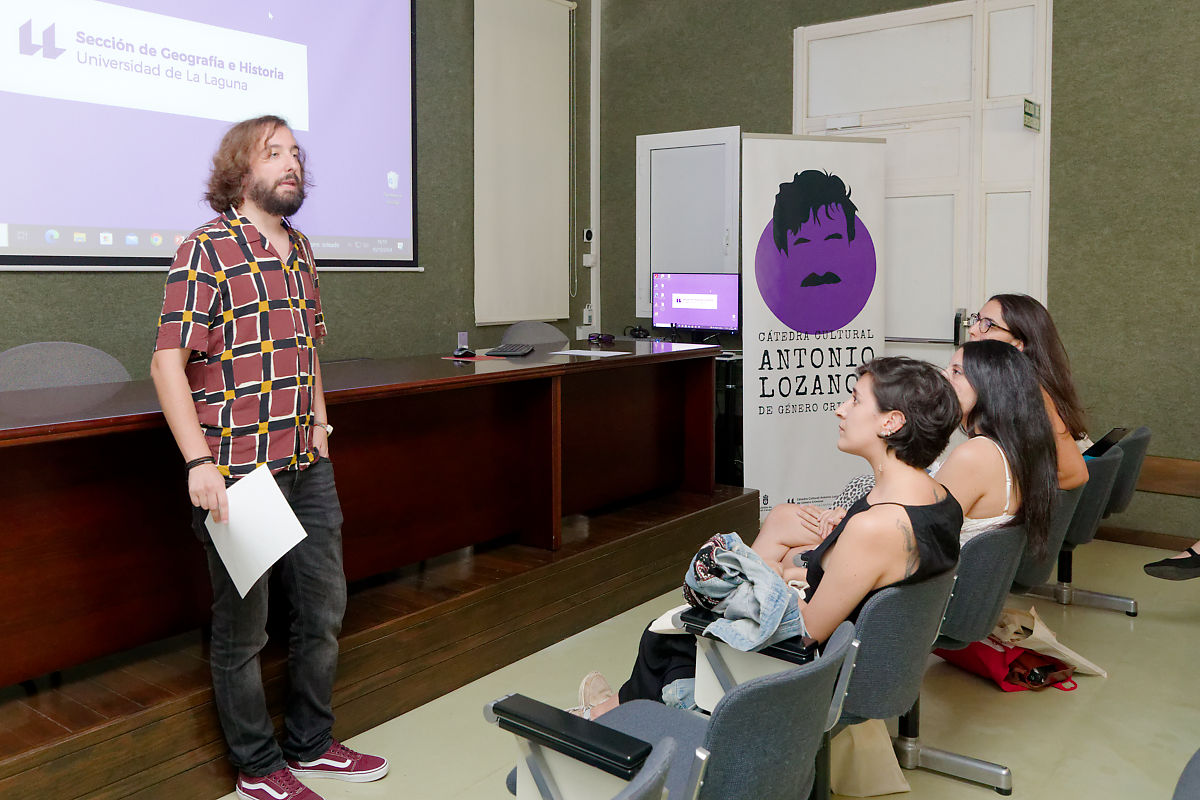
Javier Rivero Grandoso.
The connection between music and death isn't limited to classical mythology; there's the story of Lamech, who, according to Hebrew tradition, created the lute inspired by the shape of his own son's decaying corpse; or the Andean god who crafted the quena flute from the femur of the deceased Virgin Sun, with whom he was enamored. Underlying this relationship between death and music is the notion that loss is necessary to create a haunting melody.
Ojeda also addressed the connection between music and the demonic, recalling the tritone, a particularly dissonant chord that was outlawed in the Middle Ages for being considered the musical expression of Satan. He also mentioned the long-standing relationship between the violin and the devil, citing figures like Paganini and his supposed malevolent pact to achieve his virtuosity, or Scriabin, who claimed that his sixth sonata was inspired by evil.
The speaker meticulously detailed the vast bestiary of sinister creatures linked to music. Among the female figures, the sirens stand out with their seductive and fatal song, a myth with many similar variations in numerous cultures. Among the male figures, there is the Esmeraldas patacoré, a sinister figure in Ecuadorian folklore who brings ruin to dances when the marimba plays.
This link between music and terror relates to the idea of music as an irrational element that awakens the body and leads it to sensuality, which provokes rejection because there is a fear of desire common in many cultures. Bringing this idea to literature, the speaker recalled the reflection of writer Pedro Lemebel, for whom the logic of the alphabet constrains rhythm, and to liberate it, one must seek the irrational. This ideal of writing that stirs the senses, not the rational, would thus be related to the idea of the monster, according to Ojeda.
The expression of the landscape
For her part, Natalia García Freire also referred to the need to transcend all logic in order to reach emotion when writing—not describing—the landscape. Because it is an entity laden with connotations of all kinds, from historical to identity-related, including those obviously connected to nature, which, according to the author, human language is incapable of fully expressing.
García Freire makes this aesthetic and almost poetic reflection, acknowledging her own inability to express the Andean landscape of her birthplace. It's a landscape with a series of codes that have not been revealed to her, leading her to consider how to grasp what is foreign to her in her creative process. This inability is also inherent to civilization, which has lost that connection with nature, now that the time has passed when these "telluric codes" were more prevalent.
The writer gave some examples of works that, in her opinion, had managed to overcome these language barriers to achieve the expressiveness she advocates. One of them is the poem “Sollozo por Pedro Jara” (Sobbing for Pedro Jara), an elegy by the Ecuadorian poet Efraín Jara Indrovo to his own son, in which human pain is expressed in a way that brings it closer to the physicality of the mountains, which García Freire described as “a language of metamorphosis,” which is dismantled “so that the landscape can emerge.”.
Another example is that of the Spanish poet Ce Santiago in “The Unprovable Sea,” with its extensive use of maritime language and, above all, its lament for the loss of the ocean's mystery and evocative power due to “the atheism of sonar and radar.” This realm, like the mountain range, was once a territory of the supernatural, displaced by civilization, and now the language to evoke it once more is lacking.
“The landscape carries a history; it is permeated by violence and emotions. To access that history, one must also be willing to experience the pain that has passed through those landscapes,” reflected the author, who at another point also explained the need to escape logic to reach emotion in writing: “It doesn’t matter if what is narrated is not plausible; what matters is that one manages to reach the emotional through the hallucination of memory.”.
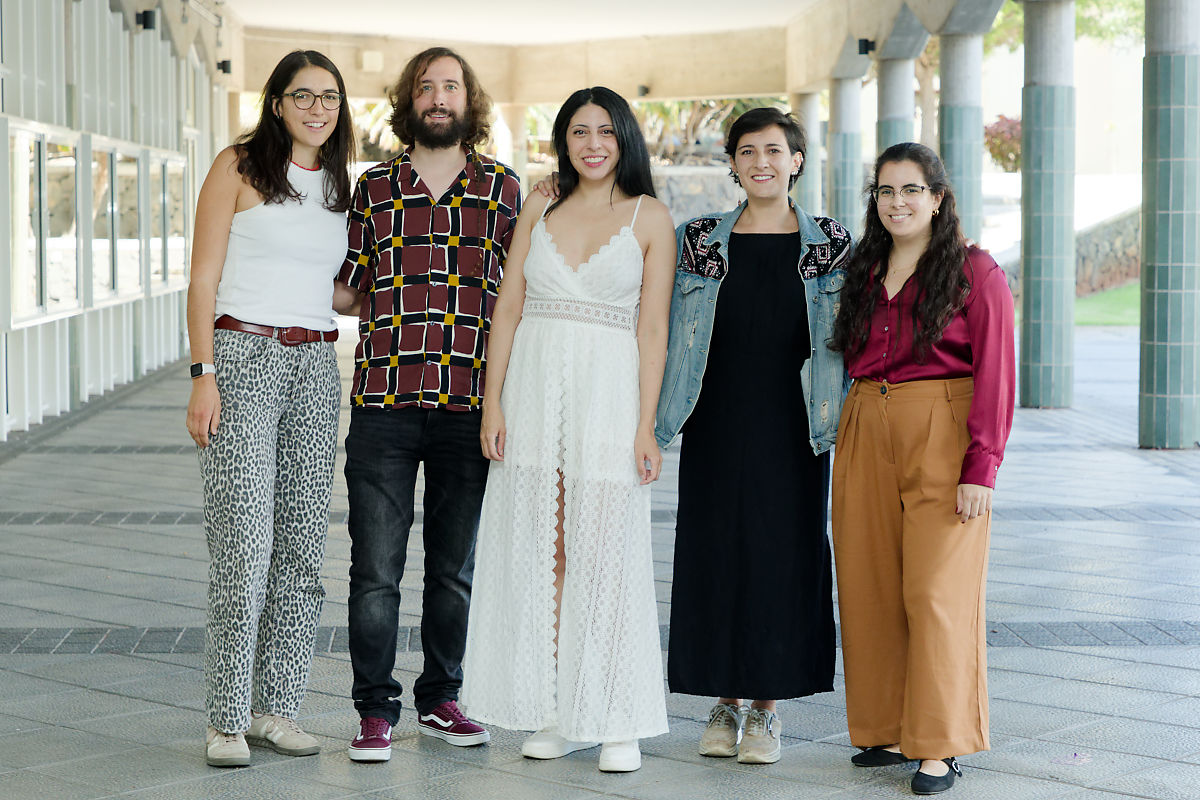
Yolanda Pesch, Javier Rivero, Mónica Ojeda, Natalia García Freire and Paula Cabrera.
Philological presentations
During yesterday's session, philologist Yolanda Pesch gave a brief overview of the work of Mónica Ojeda, an author with whom she is very familiar because her final degree project a few years ago was precisely about her, and since then she has continued to delve into her work, framed within what she has called "Andean Gothic" and characterized by an unusual duality: on the one hand, she focuses on lurid, even abject, topics such as child pornography and domestic violence and violence against women, but on the other hand, she does so seeking the greatest possible beauty in language.
This violence is a widespread characteristic among contemporary Ecuadorian women writers, as Paula Cabrera Castro explained in the third presentation of the day, analyzing the work of María Fernanda Ampuero and Yuliana Ortiz. It is the literary reflection of a terrible social situation for women in a country where, so far this year, 111 femicides have been officially recorded, though some organizations believe the actual number could be more than double that. The authors' literature reflects the terror of this patriarchal society and the strategies women employ to escape its violence, which range from trying to make themselves "undesirable" to even resorting to death.

 Spanish
 English
 French