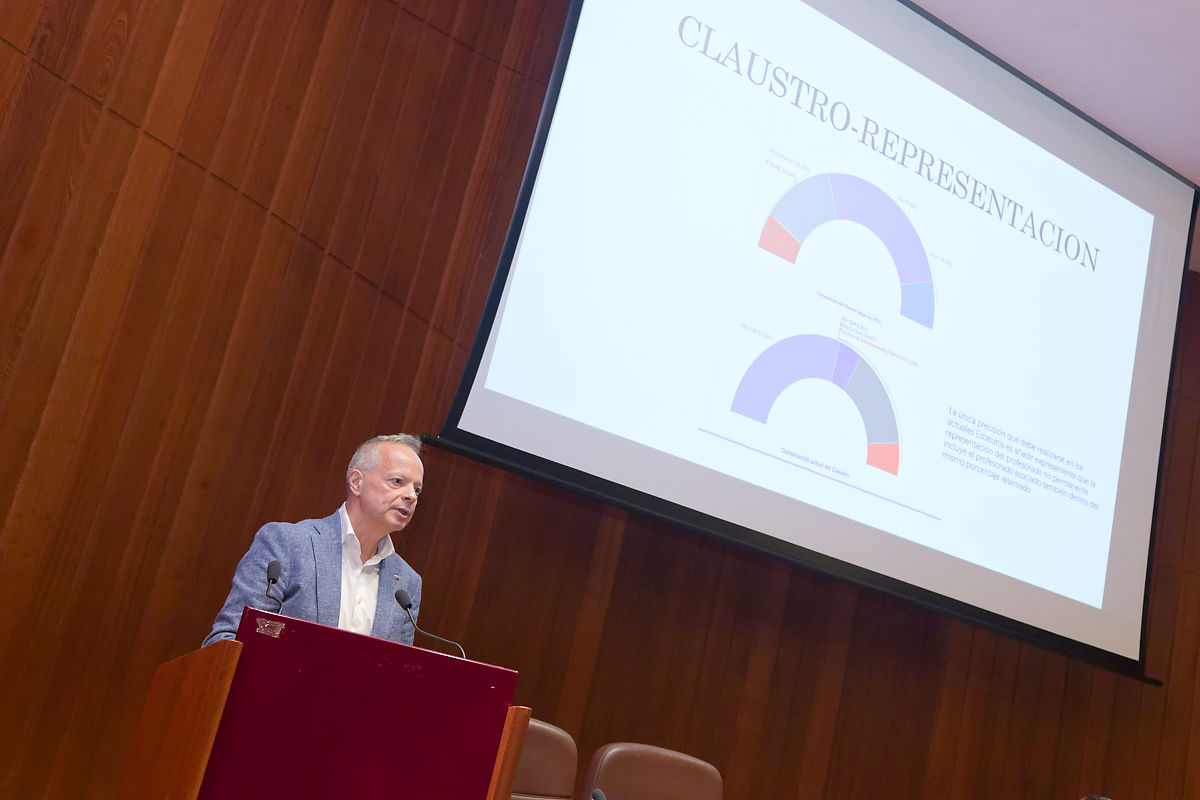
The University of La Laguna's governing body held an ordinary session today, October 15th, to debate, among other matters, its position on the proposed regional law that modifies the functions of the social councils. Its response was clear: outright rejection of a text that, in the opinion of all participants, undermines university autonomy and grants the body subject to the proposed legislation powers that far exceed those stipulated in the Organic Law of the University System (LOSU).
The initial report on this matter was presented by the general secretary of the academic institution, Juan Antonio García, who explained that the admission for processing of this proposal to modify law 11/2003 was accepted by all the parliamentary groups of the Canary Islands parliament, except Vox, and that it is currently in the phase of presenting amendments.
“No one would think that a regional law could impose a particular form of governance on universities, because it has no authority to do so,” the Secretary General stated in his opening remarks on the matter. He added that the Social Council does not represent university autonomy, which belongs solely to the university community itself.
Among the controversial aspects of the text now being debated by the regional Parliament is its recognition of conventional and contractual activity for the Social Council, thus calling into question the unique legal personality of the university, which is the only entity with the capacity to enter into contracts, García explained. Furthermore, regarding governance, it influences the position of the university's Governing Council, as it proposes that the Social Council must issue a favorable report on many matters before they are submitted to the institution's ordinary governing body.
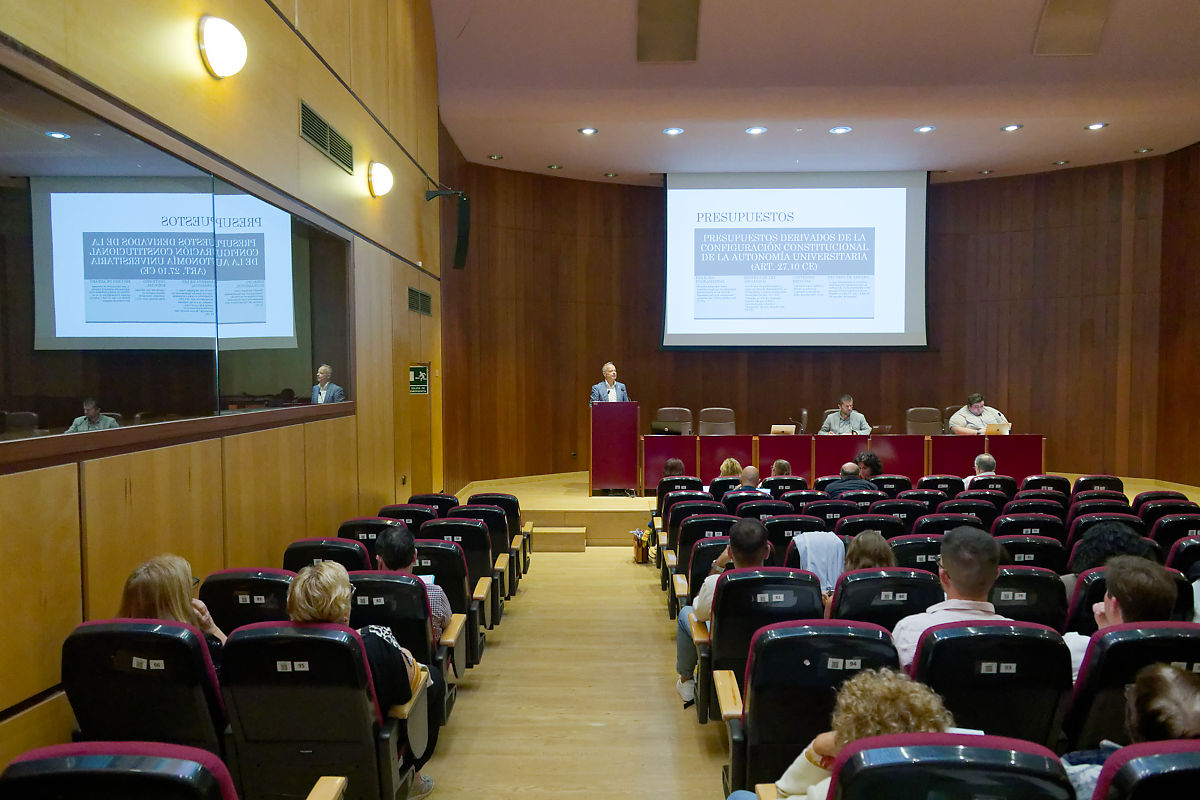
Image from the session, which could also be followed online.
Furthermore, the proposed regional legislation halts administrative procedures in many matters until the Social Council issues its opinion. Likewise, in the opinion of the Secretary General, it excessively broadens the scope of this body's decision-making authority, in some cases exceeding the limits established by the Organic Law of Universities (LOSU), and undermines the Governing Council as the supreme governing body of the university.
“The Social Council is the body that approves the university's budgets, but in this proposal it is deployed as a third party in the negotiation of many financial instruments, getting involved in the economic management of the university, far beyond what the organic law itself authorizes, and slowing down the daily decision-making of the university itself,” argued the general secretary in his explanation on this matter.
The text also grants the Social Council the power to approve all public prices for activities of all kinds and imposes an intervention model not included in the LOSU (Organic Law on Universities). “If approved, the Social Council would become a parallel body to the university itself, organizing courses, proposing training, etc. This proposal is not merely maximalist, which it is, but it blatantly violates university autonomy,” he concluded.
The rector himself, Francisco García, stated that “university autonomy is not a privilege, but rather a space of freedom and neutrality from economic powers, which is violated by this proposed law, further hindering decision-making within the institution.” He also indicated that “one of the key dimensions of university autonomy is financial autonomy,” an aspect that remains pending in the Canary Islands due to the lack of a program contract to provide stability to the two public universities, a requirement also included in the Organic Law on Universities (LOSU). Along the same lines, the university law also mandates increasing university funding to 1.1% of GDP, with the Canary Islands universities currently receiving barely half of that target.
A firm 'no'
The student groups had the opportunity to speak on this matter, and they did so with strong criticism of the proposed law, which in many respects exceeds university autonomy. Student Freedom stated that this proposal causes them “deep concern.” “Our right to decide cannot be taken from us,” they affirmed, while maintaining that “university autonomy is non-negotiable.” The students pointed out that “the university does not belong to the governing boards; it belongs to its students, its faculty, and its technical and administrative staff.”.
The Canary Islands Student Association (ACE) shared this view, again seeing university autonomy—described as an unshakeable legacy—threatened by this proposed law, which would "introduce external agents into the university's governance to subjugate its interests to foreign ones." This group asserted that university autonomy is what enables critical thinking and the institution's independence.
The University Participation Network, representing the faculty sector, expressed its “surprise and displeasure” that the proposal was presented by almost all parliamentary groups, which, in its view, demonstrates a profound ignorance of the university system. “The social councils have failed to fulfill their mission since their creation, and this proposal does not align with providing them with genuine functions, because what it does is further the encroachment on university autonomy,” which is not its intended purpose, they indicated, instead of focusing on improving university funding or their integration with society. “It is not only a threat, it is a missed opportunity to do things better.”.
For their part, the student group Nexo also expressed their opposition, calling on parliamentarians to actively listen. The faculty group Renovación Convergente echoed this sentiment. “We are a university, and we will defend it,” they declared. “Keep your political hands off the university and take care of it,” they added.
Finally, the Alternative Program for Faculty also argued that this proposal undermines the university's capacity for critical thinking and innovation within higher education institutions. They pointed out that universities with greater levels of independence achieve better results in academic and research excellence, given that well-balanced self-governance generates social wealth. This text usurps powers granted by the organic law, which is legally contradictory, they added. "No body external to the university can govern it, therefore we urge the Parliament of the Canary Islands to consider the opinion of the universities to guarantee university autonomy.".
Statutory reform
The University of La Laguna's governing body also reviewed a draft proposal at today's session, which would serve as the starting point for the necessary statutory reform to adapt it to the Organic Law on Universities (LOSU). Presented by the Secretary General, in response to a request from the governing body's Committee on Institutional Affairs, the text was designed as a minimum requirement to comply with the regulations.
This proposal, while receiving majority support, was not broad enough to reach the qualified majority required to proceed with the process now. Therefore, given that the University Council will be holding elections to renew its composition in the coming days, it was decided to wait until after those elections to undertake this task. This decision was made in accordance with the regulations, which stipulate that the deadline for completing this reform is April 2026.

 Spanish
 English
 French