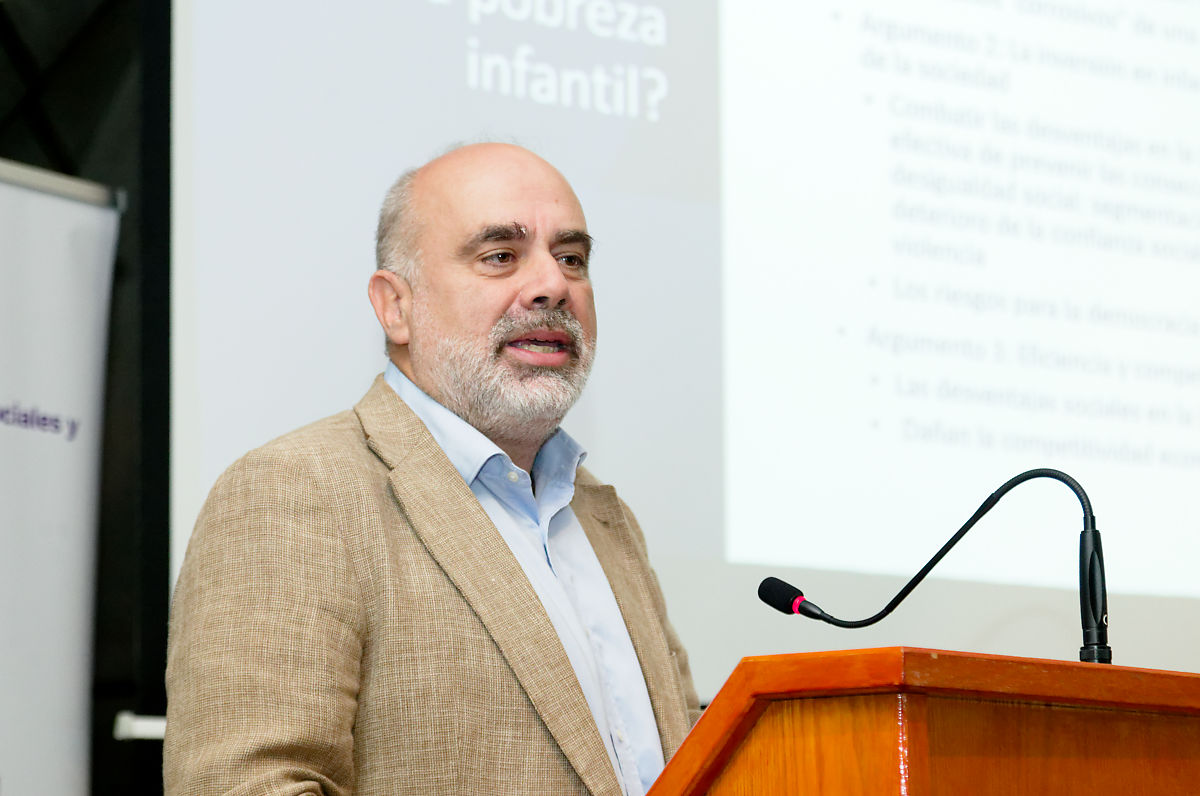
Sociologist Pau Marí Klose, from the University of Zaragoza, spoke today, Monday, October 21, at the University of La Laguna about the policies needed to combat child poverty. Given that this is a complex and multifaceted problem, the response must be equally varied. Therefore, the expert believes it is necessary to implement measures that go beyond those directly addressing child poverty itself and focus on contributing factors such as education, housing, employment, and family income.
Marí Klose was the opening speaker of the day“Analysis of child poverty: challenges and implications”, which has been organized by the Center for Inequality and Governance Studies (CEDESOG) and the Institutional Chair of Childhood and Adolescence, With the collaboration of the Vice-Rectorate for Research. At the opening, the Vice-Rector for Culture and University Extension, Isabel León, emphasized the importance of generating knowledge that goes beyond mere diagnosis and provides resources for decision-making and concrete actions. “As a progressive society, we cannot allow our children to grow up in a situation of inequality.”.
The island councilor for the Area of Social Action, Inclusion and Volunteering of the Island Council of Tenerife, Águeda Fumero, referred to the “harsh reality” of poverty in the Canary Islands, which according to a report by the European Anti-Poverty Network, has 341% of the population at risk of poverty, 65% with difficulties making ends meet and 53% unable to cope with unforeseen expenses, data that also affect the population under 18 years of age.
The island official explained that her administration addresses the needs of this population when the system has failed, recognizing the dangers of these inequalities affecting children and adolescents at a crucial stage of their lives that will shape their future. To this end, the Island Plan for Children and Adolescents has been approved, a tool that provides a roadmap and lines of action with corresponding budgetary allocations to implement specific measures.
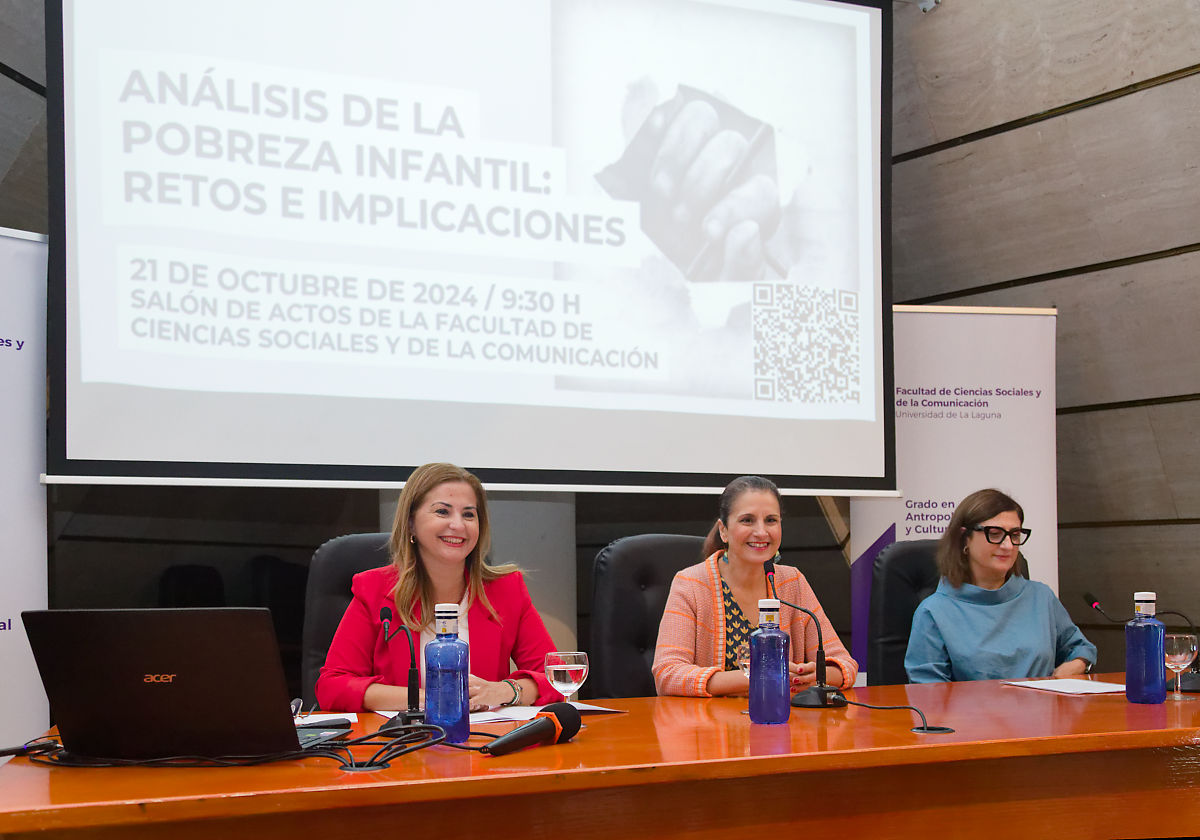
Águeda Fumero, Isabel León and Sara Darias.
Finally, Sara Darias, director of CEDESOG, explained that the purpose of the conference was to bring together experts from different fields to address this complex phenomenon, which requires an integrated approach. It not only involves a lack of economic resources but also affects children's health and opportunities. Therefore, she advocated for the involvement of everyone so that each person, within their respective areas of responsibility, can contribute to solving the problem.
Public policies against child poverty
Pau Marí Klose began by asking why it was necessary to combat child poverty. Beyond the obvious reasons of justice and equity that compel us to not tolerate this problem affecting such a vulnerable group, there is also the obligation to comply with Article 27 of the Convention on the Rights of the Child, whose precepts have been incorporated into the Spanish Constitution. Another argument is that this is a reality that will have consequences for the entire population, as studies show that unequal societies are more polarized, tense, and violent, which has consequences for democracy itself, given the difficulty in reaching agreements that all of this entails. And it also has economic costs, as it means wasting talent and depleting human capital.
The speaker pointed out that Spain's poverty reduction programs are very limited in their effectiveness, as their financial assistance programs are only partially effective and do not reach all those who need them. Furthermore, this is a problem that has been largely overlooked until now: despite the availability of data, many people are unaware of it, and it has been slow to be debated in Parliament itself.
She explains that combating poverty requires addressing poverty and inequality in general: chronic unemployment, low wages, and intermittent work contracts are factors that affect families and can contribute to child poverty. At this point, Marí Klose specified that while unemployment is often perceived as the primary cause of poverty, the reality is that most people in this difficult situation are employed.
Therefore, he stated that measures related to housing and energy must be supported to help alleviate the expenses of impoverished households. Obviously, specific aid programs must also be created for households with children: financial assistance for families, and aid for transportation and school supplies.
The expert reflected that it is often difficult to incorporate a problem into the political agenda, which is the first step for it to be addressed institutionally, since public policies tend to operate on inertia and it is difficult to change major political programs. Furthermore, other issues compete for institutional attention, such as dependency or homelessness. On the other hand, there are measures to solve this type of problem.
Marí Klose broke down the four major approaches to public policy: the neo-institutionalist approach, according to which organizations incorporate institutional elements legitimized in their environment; the “policy communities”These four processes reflect the discursive and moral frameworks of actors in civil society, academia, and networks surrounding political parties; innovative leadership, which requires parliamentary capacity and windows of opportunity to implement measures; and the "garbage can" model, which solves problems chaotically, without a linear process. The combination of these four processes has allowed for progress since this issue entered the agenda in 2014, leading to the creation of the Commission on the Rights of Children and Adolescents in Congress a year later.

 Spanish
 English
 French