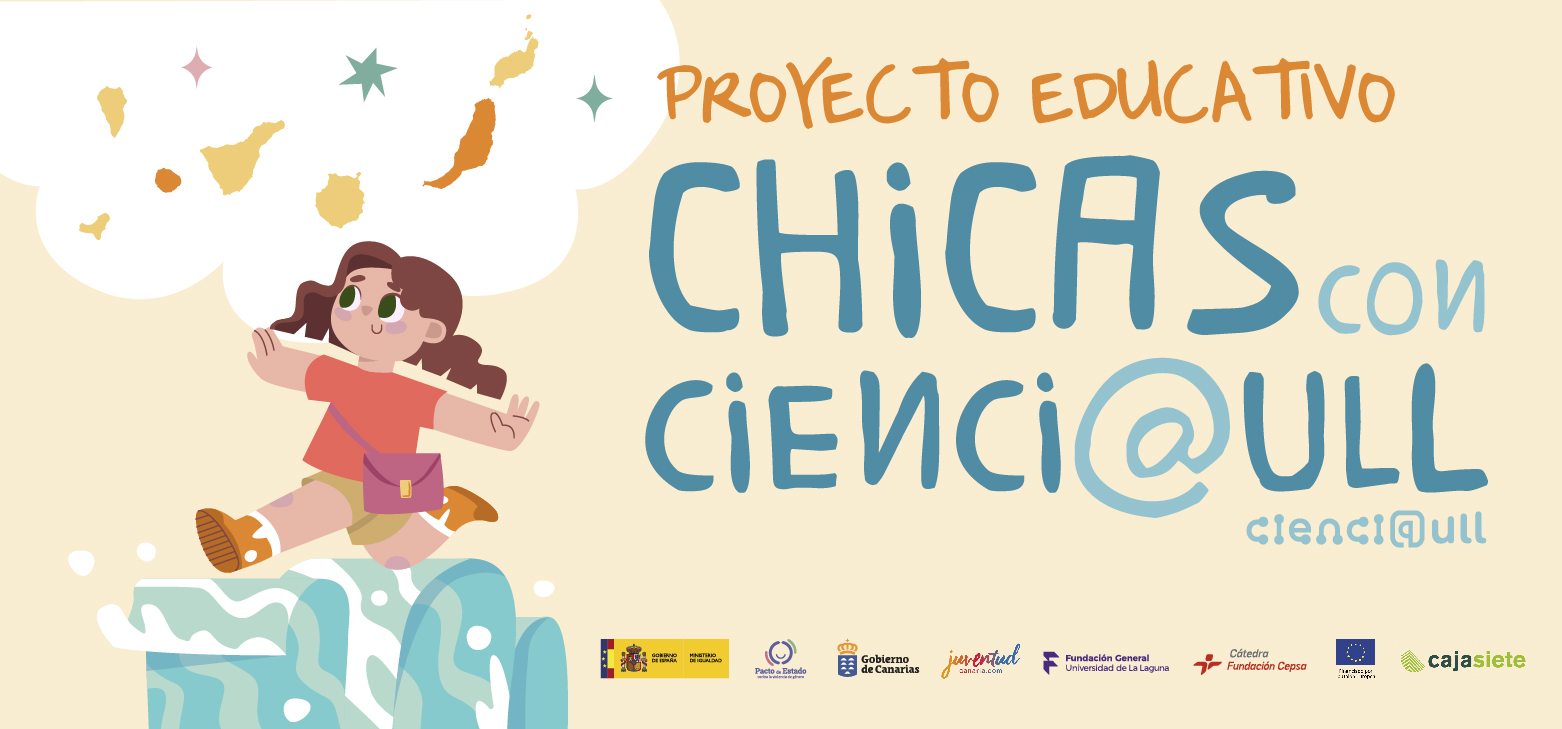
The educational project Girls with Science@ULL In November, her schedule of activities will continue, moving to Lanzarote and Gran Canaria, where she will carry out scientific outreach activities in secondary and high schools, with the participation of more than 250 students and 6 researchers from the University of La Laguna.
The main goal of the project is to encourage interest in science and technology careers among 3rd and 4th year ESO (Compulsory Secondary Education) and 1st year Bachillerato (Upper Secondary Education) students in schools in the Canary Islands. To achieve this, the project highlights the work and contributions of women in research and technology, especially those of researchers at the University of La Laguna, through a program of inspiring talks and science workshops led by young female scientists.
The project begins in Lanzarote on the 14th and 15th, with six sessions at the IES César Manrique and IES Teguise schools. There, 3rd-year ESO students from groups A, B, and C will have the opportunity to attend a talk given by the researcher. Sara González Pérez, Dr. [Name], PhD in Physics and Deputy Director of the Department of Specific Didactics at the University of La Laguna, will share her experience and knowledge in this presentation to motivate students to pursue science and technology degrees. She will use her episode from the video series [title missing] as a visual aid. All with Cienci@ULL.
At the César Manrique High School, approximately 90 third-year ESO students will participate in a practical workshop given by Dr. Laura Ezama, a researcher in Health Sciences and Neuroscience at the University of La Laguna. This workshop will focus on understanding the basic structure and function of the brain, identifying the main parts of the nervous system and their functions, as well as recognizing the importance of mental health along with practices that contribute to its maintenance.
At IES Teguise, another 90 third-year ESO students will attend Sara González Pérez's talk again. After her presentation, they will participate in an archaeology workshop led by the researcher. Selene Rodríguez Caraballo, A graduate in History and a specialist in Physical and Forensic Anthropology, this workshop aims to familiarize students with the basic methodology of physical and forensic anthropology, exploring its application in archaeology to understand past societies.
The following week, on November 21st, the project will move to the CPEIPS Enrique de Ossó and IES Arguineguín Lidia Pulido schools, both located in Gran Canaria. The first school will have a class of 27 fourth-year ESO students participating, while the second school will have a class of 30 first-year Bachillerato students. The researcher responsible for giving the talks at both schools will be Carolina Castillo, PhD in Sciences from the University of Granada and tenured professor of Paleontology at the University of La Laguna.
At the CPEIPS Enrique de Ossó, around 27 4th year ESO students will receive a practical workshop led by the doctoral candidate Katherine Garcia Livia, A researcher at the Laboratory of Parasitic Fauna and Zoonoses at the University of La Laguna, will lead this workshop. It will focus on pathogens in our environment that can affect both wild and domestic animals, with particular attention to those found in the Canary Islands. This educational activity aims to raise awareness among young people about the risks and importance of research into diseases that can be transmitted between animals and humans.
Simultaneously, first-year high school students from IES Arguineguín will participate in science workshops exploring marine biodiversity and its challenges, including pollution, to raise awareness about conservation and the environment in the Canary Islands, guided by the doctoral candidate. Sandra Hernández Mingorance.
In December, the project will conclude its activities with a trip to the last two islands: La Palma and El Hierro, where students from the Luis Cobiera Cuevas and Garoé secondary schools will participate. A total of 603 students will take part in this initiative during 2024.
This initiative is promoted by the University of La Laguna and the General Directorate of Youth of the Government of the Canary Islands, within the framework of the State Pact against Gender Violence, with the collaboration of Cepsa Foundation Chair of Innovation and Ecological Transition y CajaSiete.
The Girls with Science@ULL Educational Program is part of the Researchers at Schools activities package of MacaroNight 2024 (European Researchers' Night of Macaronesia). This project is an initiative promoted by La Palma Research Centre, Observatorio Do Mar Dos Açores, Big Van Ciência, la University of Madeira, the General Foundation of the University of La Laguna. It is co-financed by the European Commission under the Marie Skłodowska-Curie Actions (MSCA); an initiative to promote scientific careers in Europe, which is part of Horizon Europe, European Union Framework Programme for Research and Innovation.

 Spanish
 English
 French