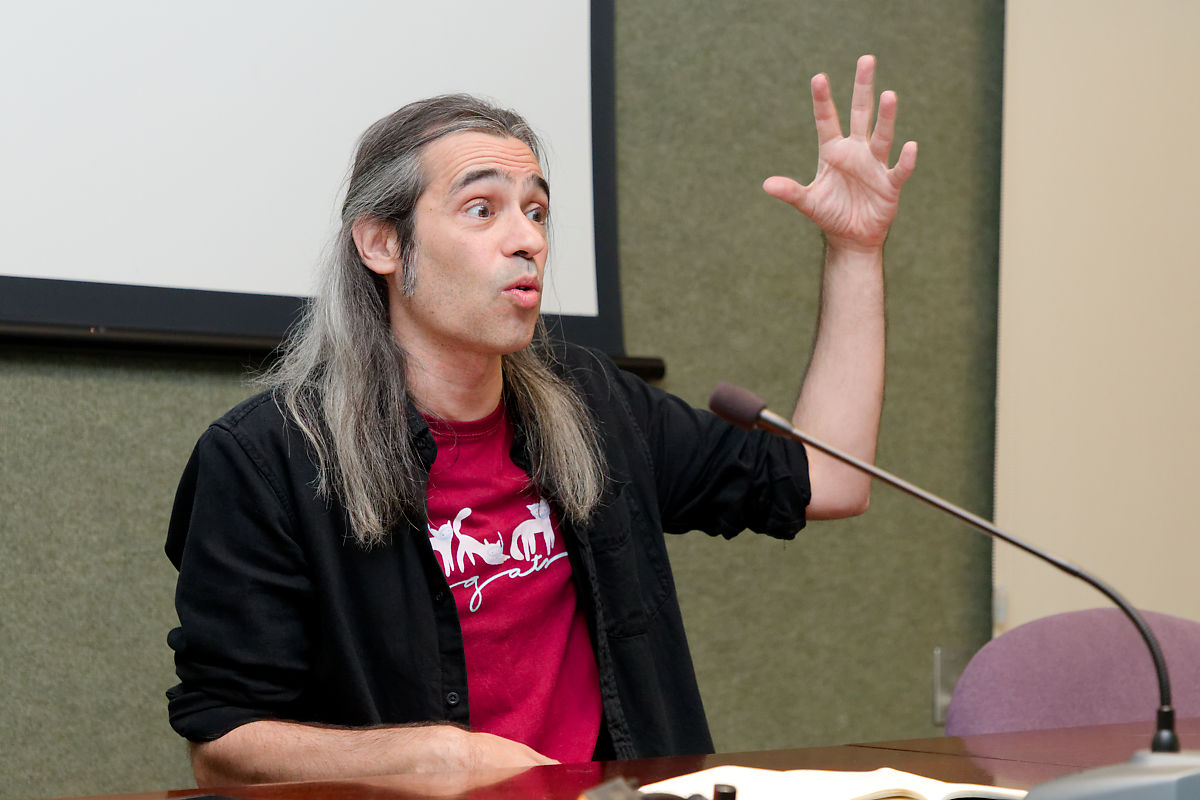
The actor, playwright, and poet Álvaro Tato, member of the theater group Ron Lalá, maintained a lively atmosphere today, Thursday, November 21st public dialogue with the professor from the Department of Spanish Philology at the University of La Laguna José Antonio Ramos, During which he reviewed the origins of his performing arts group and made a vivid defense of the value of the classics of the Spanish classical tradition, as well as the recovery of the "said" verse.
On the first point, Tato is a true authority, having collaborated for some time with the National Classical Theatre Company and, as a playwright, having adapted works by Lope de Vega and Calderón de la Barca. In his opinion, it is a very rich theatrical and literary tradition, with dozens of works of international renown that, nevertheless, Spain has not been able to universalize in the same way that the British have done with Shakespeare or the French with Molière, despite the great advantage of having hundreds of millions of Spanish speakers.
“When the French enter the Comédie-Française in Paris, they affectionately touch the bust of Molière in the auditorium and say to it affectionately…“the boss”That’s what we lack here with our authors: giving them that aura.” Another example he gave of the difference in treatment is the fact that every year thousands of tourists travel to Stratford to see Shakespeare’s house, but not to Alcalá de Henares to visit Cervantes’ baptismal font.
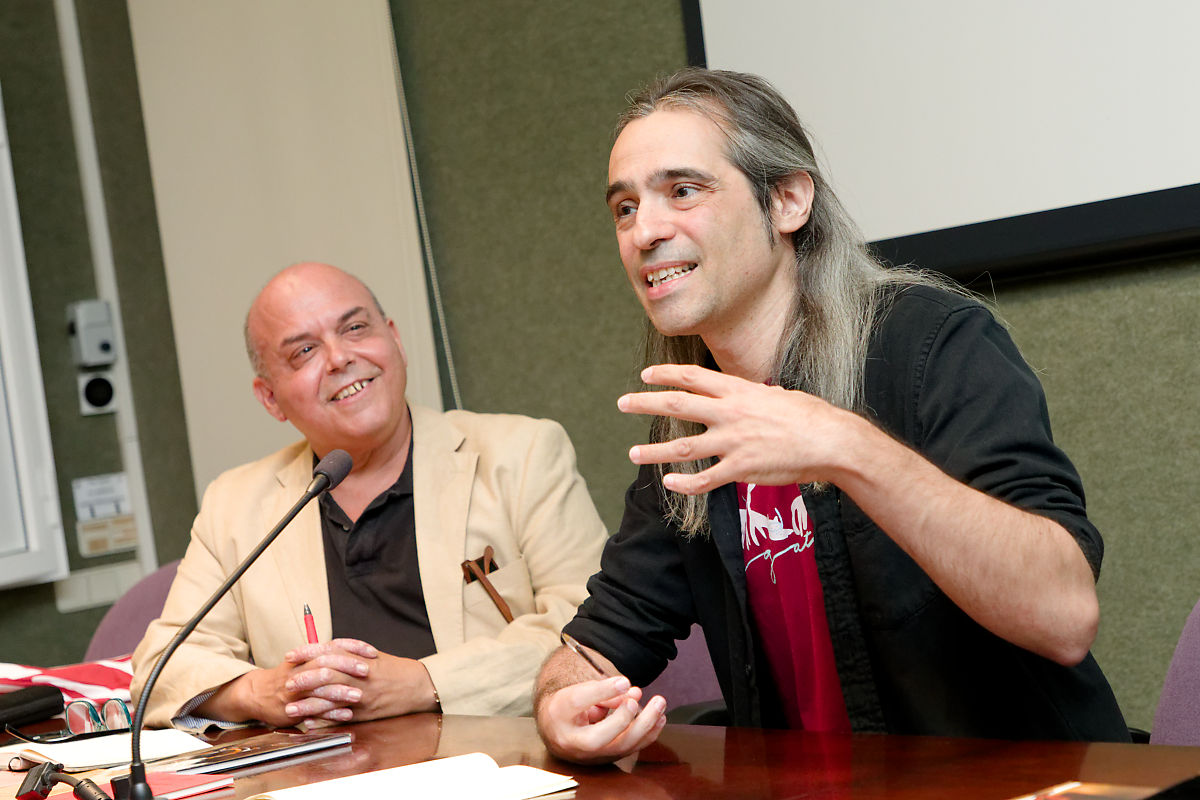
Tato with Professor Ramos.
Expanding on that argument, he recalls that while touring twenty capital cities in the Americas, Asia, and Europe with his show “In a Place of Don Quixote,” in each and every one of them, from New York to Delhi, at least one Shakespeare play was being performed, but none by authors of the Spanish Golden Age. “Shakespeare belongs to the world, Molière belongs to the world, and so does our tradition, and it is our duty to share it.”.
Regarding the revival of spoken verse, of prosody, Tato reflected that some consider it outdated and dusty, but in his opinion, it's more alive than ever. He reminded the numerous students attending the dialogue that, after the talk, many would be using headphones to listen to urban music, which is essentially verse. “I'm not saying it's as good as Lope de Vega's work, but it's exactly the same. The 21st century is the century of poetry; never before have so many verses been heard.”.
In this way, he explained with recited examples that the monorhymed quatrains that characterize "The Book of Good Love" by the Archpriest of Hita are practically the same as the "bashing" of rap battles, not only in meter but also in intention and content. "We must renew the tradition of prosody, speak the verses, because they are made for that," he said, recalling how oral tradition was, in fact, the foundation of poetry for much of its history, until the 19th century when the paradigm shifted to consider it something that should be read alone and in contemplation.
TatoTato held this meeting at the Faculty of Humanities, taking advantage of the fact that Ron Lalá will be performing tomorrow, Friday, November 22nd, in the Paraninfo of the University of La Laguna.“4 x 4”,” a montage that summarizes the main milestones of the company’s first four shows. Tickets are still available for an evening that will begin at the university grounds at 8:30 p.m.
During the conversation with Ramos, he recalled the origins of Ron Lalá, when its members were still high school students with diverse interests such as theater, music, poetry, and humor, which somehow coalesced into a project that continues to this day. He praised Yayo Cáceres, the company's director, who saw the potential of those young actors and proposed a challenge: he would take the plunge and leave the comfort of the Valencian company Imprebís to make them real actors if, in return, Tato and his colleagues committed to becoming professionals.
Needless to say, they accepted the challenge, and so the speaker addressed the young audience gathered in the Philology Department building to explain that there are moments in life when you have to be daring and take the plunge, even if the project might seem crazy. He did warn them, however, that it is not an easy path. In his case, it has demanded a great deal of work and dedication, and navigating a country like Spain, which seems to be socially and economically “hostile” to the perception of culture and poetry.
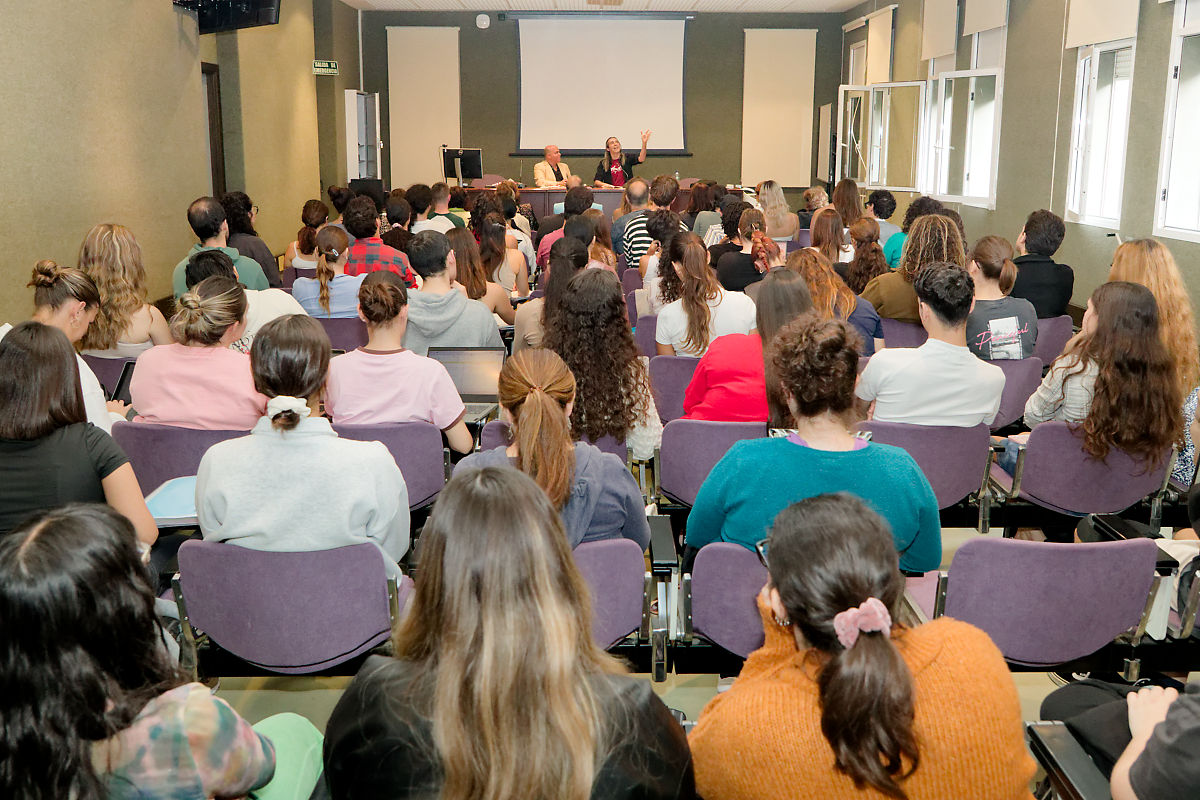 The actor and playwright explained that Ron Lalá explores humor in its purest form, delving into its mechanisms and trying to understand why some jokes become outdated while others endure. In his opinion, the result of years of stage experience, what has survived is what most closely resembles human nature, and that is why the classics remain relevant, as they address precisely that essence.
“There’s nothing older than picking up a guitar and making people laugh with verses. And that’s why it still works. You laugh in comedy at the same things you cry over in tragedy: the human condition.” I emphasize that this enduring legacy of theater should be reclaimed not as a text read aloud, but as a shared communal experience in a theater. “We need oral storytelling and being together, and the pandemic proved that. As María Zambrano explained, it’s not enough for us to know the tragedy of Antigone: we need to see it together. That’s why theater is eternal, and we don’t need to revitalize the classics: we are the ones who need to revitalize ourselves to live up to their standards.”.

 Spanish
 English
 French