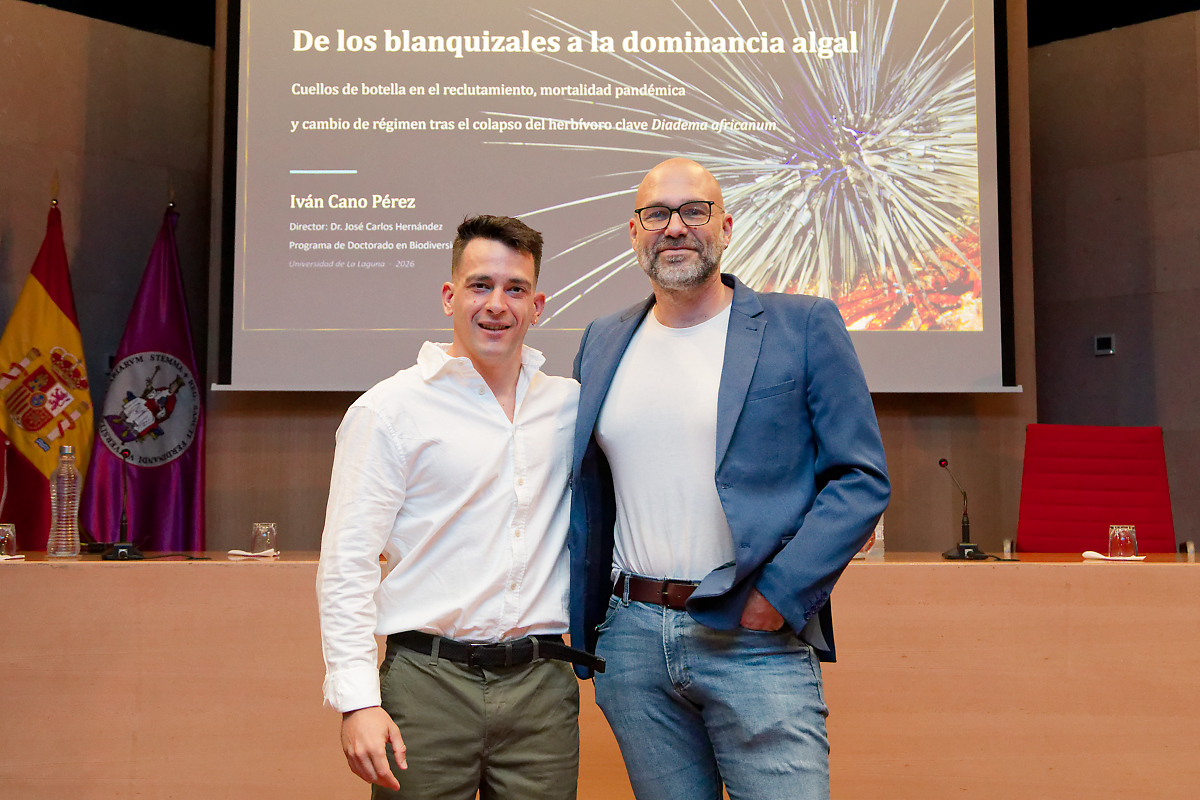
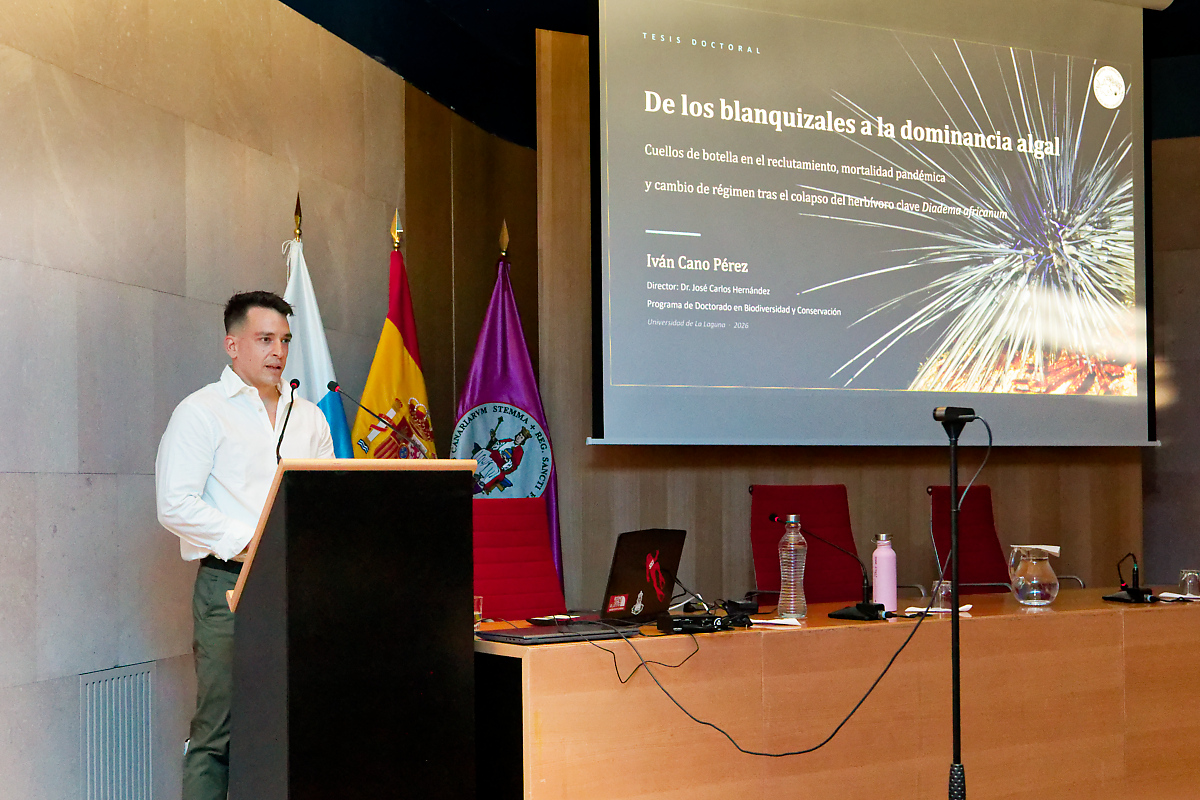
Iván Cano Pérez recently defended his doctoral thesis at the Faculty of Sciences of the University of La Laguna, which documents the unprecedented collapse of the populations of the long-spined hedgehog (Diadema africanum), a species that for decades acted as the main structuring agent of the Canary Islands coasts, cleaning the coasts of algae and generating kilometer-long stretches of white sand, and identifies a definitive ecological regime change towards communities dominated by macroalgae.
The thesis was supervised by José Carlos Hernández Pérez, from the Department of Animal Biology, Soil Science and Geology, within the framework of the Doctoral Program in Biodiversity and Conservation, and is entitled From Urchin Barrens to Algal Dominance: Recruitment Bottlenecks, Pandemic Mortality and Regime Shift after the Collapse of the Key Herbivore Diadema africanum.
The study analyzes in detail the epidemiological episode that began in March 2022 on the island of La Gomera and spread rapidly through Tenerife, the Bocaina Strait between Lanzarote and Fuerteventura, La Palma, and Gran Canaria. The only island exception was El Hierro, where the constant presence of healthy populations of natural predators and the implementation of conservation policies preserved the ecological balance against the massive transition to barren areas.
Internationally, investigations confirm that this collapse in the archipelago was not an isolated event, but rather part of a global pandemic that decimated various sea urchin species of the Diadematidae family in the Caribbean, the Mediterranean Sea, the Red Sea, the Gulf of Oman, and Réunion Island, registering widespread mortality rates of between 90% and 99% in all cases. In the Canary Islands, the epidemiological event is linked to the dynamics of ocean currents from the west, meteorological episodes of storms with a southerly component, and the possible spread of an amoeba toxic to the species.
 The lime hedgehog will not recover
Through quantitative analysis of 12,400 square meters of seabed distributed across 76 locations and 620 visual transects throughout the archipelago, the research team found that only 58 adult specimens of Diadema africanum, This places the population density of this sea urchin in the residual range below 0.4 individuals per square meter. This figure represents the absolute historical minimum since scientific records of the species began in the Canary Islands in 1965, contrasting sharply with past periods when the sea urchin beds reached densities of over 14 individuals per square meter and covered more than 15 kilometers of coastline.
This marked reduction in breeding adults is compounded by a total collapse in larval recruitment, since sampling in collectors and field grids yielded a result of zero settled individuals and zero located juveniles, which confirms a severe blockage in generational replacement.
Among the main conclusions of the research, the confirmation of the definitive end of the hedgehog's golden age stands out. Diadema africanum as a regulator of overgrazing in the Canary Islands ecosystems and a generator of the famous bleached-out areas, giving way to a massive transition towards the dominance of algae in which species such as Dictyota o Lobophora, macrophytes and microalgal lawns.
The study concludes that the drastic shortage of adults, coupled with progressive genetic impoverishment, creates an ecological bottleneck that prevents the spontaneous recovery of the species in the short term. Similarly, the thesis emphasizes that the future trajectory of the Canary Islands' seabed remains open, encompassing everything from the desirable regeneration of productive macroalgal forests such as Gongolaria or the settlement of fields of Lobophora, ...to more pessimistic scenarios characterized by the persistence of opportunistic algal lawns favored by climate change or the potential expansion of invasive species such as Rugulopteryx okamurae.
The presentation of the doctoral work, which was held in the Blas Cabrera Felipe Auditorium, had the following members as members of the panel: Rocío Perez, from the University of Barcelona; Jordi Boada, from the CSIC; and Maria Reyes, from the University of La Laguna.

 Spanish
 English
 French