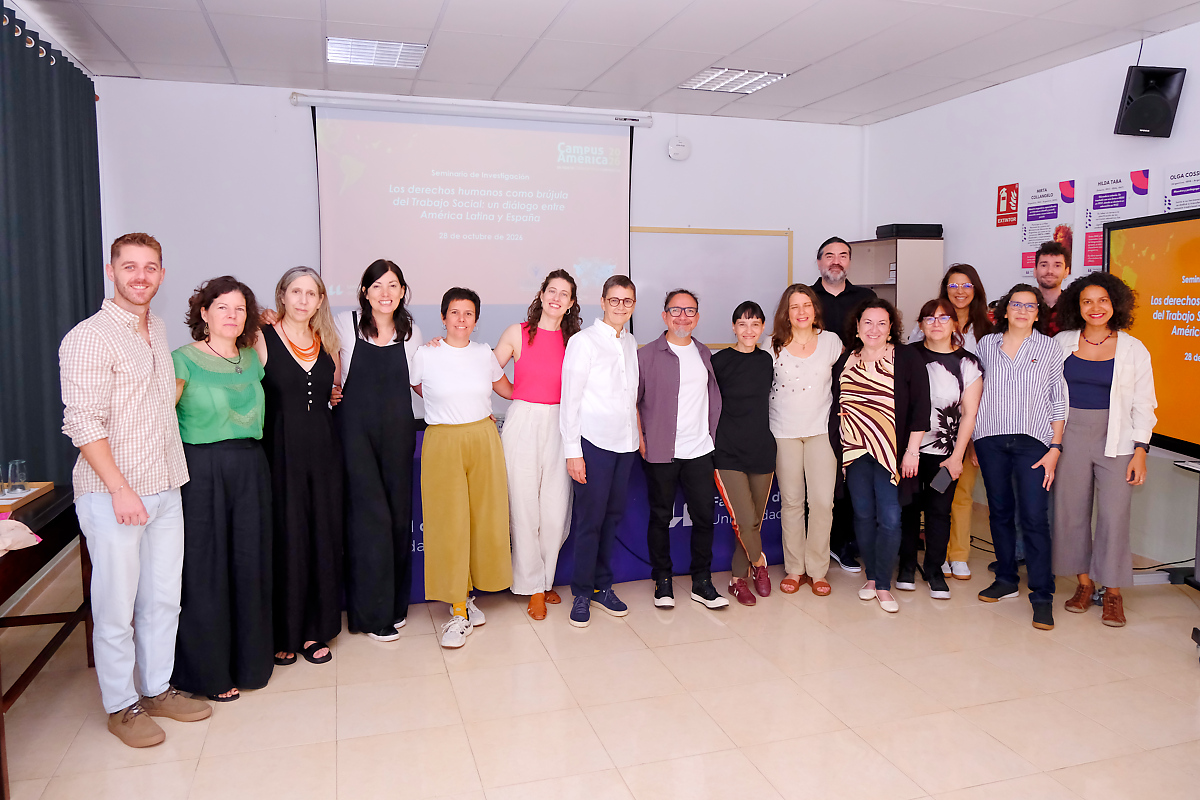
Campus América is in its final stretch with a seminar on the role of human rights in today's society and the potential contributions from the field of social work. It is led by Professor [Name of Professor]. Celsa Cáceres, This proposal brings together expert teachers from Chile, Uruguay, Mexico, Brazil and Colombia at the Faculty of Education.
This group of professors is part of an international network focused on social work training, and they have chosen Campus América to strengthen their lines of action and propose new collaborative projects. Human rights are the guiding principle of this network and, in this case, of the course itself. “They are the main motivation for this international and comparative collaboration. We aspire to have a network that establishes itself over time, and this seminar is part of that journey,” Cáceres stated this morning at the opening.
The course addresses the theoretical and political foundations of human rights, the experiences of various Latin American universities and their institutional challenges, and concludes with teaching practices designed to enhance this training. “It is a network conceived as an open laboratory,” he added.
Marina Servio, a tenured professor at the National University of Rosario (Argentina), specializing in social policies and human rights, spoke first on 'Education and Human Rights: A Contested Field'. According to Servio, the depth and orientation of human rights education are not a technical matter, but rather a field of political debate.
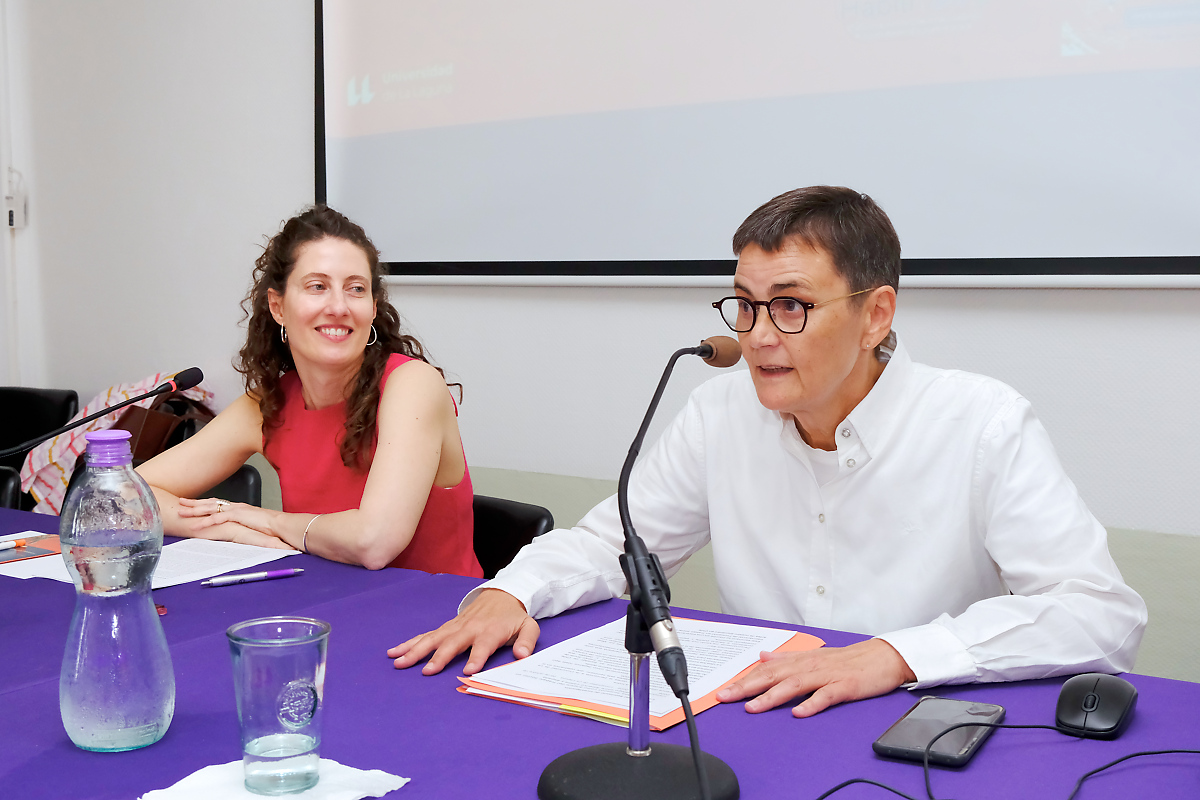
Marina Servio (i) and Celsa Cáceres.
For her, a seemingly insurmountable barrier has been breached: the institutional affection shown to instigators of the coup against democracy, precursors and collaborators of the military coup in her country, who are visited and supported from prison. In this formal context, there is now a significant reduction in the content of social work curricula through a reduced credit system. “For decades, the public university was conceived as a critical and autonomous institution, but now it has shifted to one that measures them by their productivity, hence the proliferation of short degrees and flexible, precarious job opportunities,” the speaker asserted.
The Argentine professor added that the social sciences and social work, from a critical perspective, have been continually questioned because they address issues that are uncomfortable for the hegemonic concept of the State, challenging it. “When the curriculum is cut, the first thing that is cut is its theoretical depth, that is, the substantive framework of these subjects.”.
With a clear trend toward the criminalization of migration and social rights in retreat, defending the breadth of curricula is crucial at a time when public policies are being dismantled, she explained. “Our curricula are not a consolidated achievement, but rather a floor that is being cut according to political whims. The law is not a ceiling: it is a floor,“ the speaker concluded.
In Latin America, according to Celsa Cáceres, human rights education included in school curricula is much more extensive than in Europe, where this subject has been taken for granted. In fact, there is little permeation of the social context into the classroom, because young people today have not yet grasped the importance of human rights for sustaining democracy.
“There is a clear hegemony of the legal field when we think about human rights,” another participant argued, adding that social work has much to contribute. “We must wage the cultural battle in the classroom.”.
The purpose of all this is to work on a comparative research on this subject in different Latin American universities and some Spanish ones (La Laguna, Balearic Islands and Complutense of Madrid), to know the reality of each institution in the approach to human rights through social work, and through a study that is in process and in which researchers from this network participate.

 Spanish
 English
 French