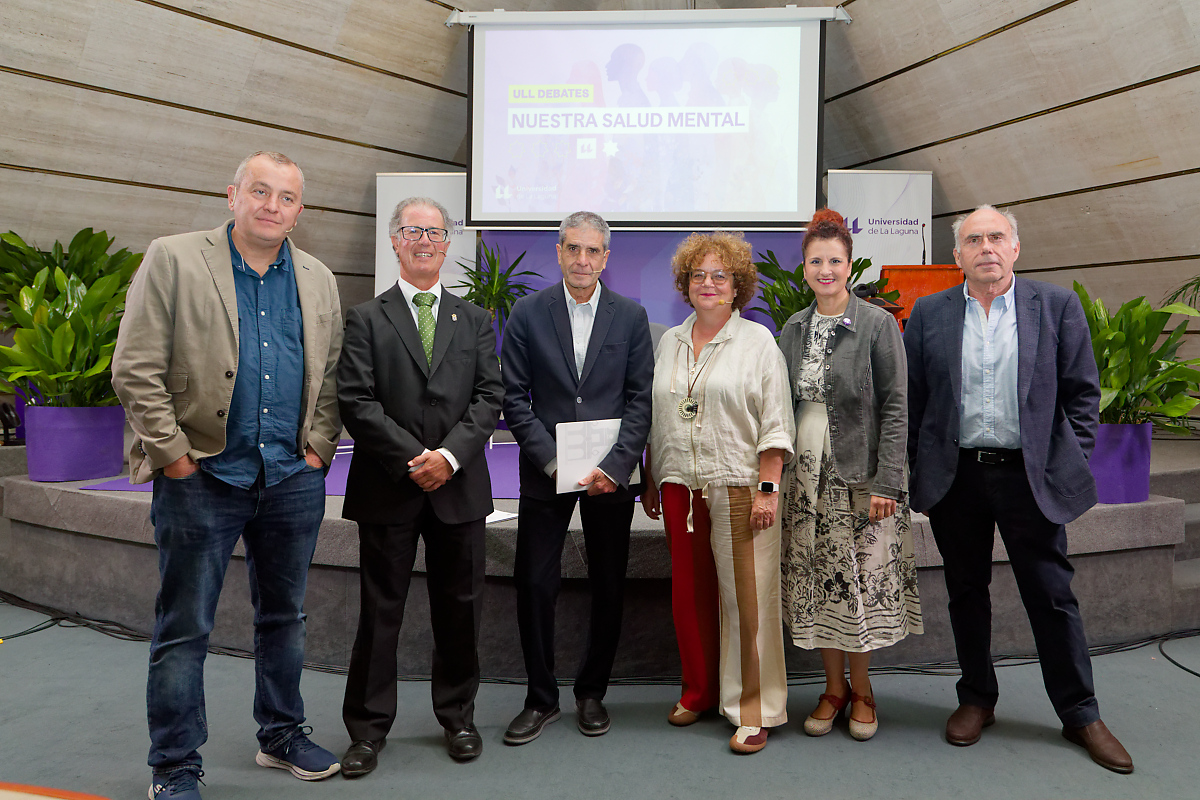
The University of La Laguna held another edition of ULL Debates on Thursday, October 29th, dedicated to analyzing current mental health challenges and the role of institutions, healthcare professionals, and society in addressing them. Entitled “Our Mental Health,” the event brought together specialists in psychiatry, psychology, and healthcare management in the auditorium of the Communication Sciences Building (La Pirámide). They reflected on the need to offer comprehensive care that considers both clinical needs and the personal and social circumstances that influence emotional well-being.
The day began with an artistic performance by Ismael Barredo, a social educator and music therapist, who presented an adaptation of his project "Invisibles." Through a combination of live music and video art, the piece aims to raise awareness of often overlooked illnesses and bring the experiences of those living with them closer to the public.
The Vice-Rector for Culture and University Extension, Isabel León Pérez, opened the meeting with a reflection on how situations such as the loss of a loved one, job insecurity, loneliness or economic difficulties can affect the emotional well-being of any person, without necessarily leading to mental illness.
León explained that the title of the conference, “Our Mental Health,” reflects this collective dimension and the shared responsibility of institutions. In this regard, he defended the commitment of public universities to both the well-being of their community and society at large, through research, education, and knowledge transfer.
Next, the Professor of Psychiatry at the University of La Laguna Carlos de las Cuevas, [Name], who participated in organizing the meeting, opened the debate with a reflection on the complexity of human suffering. Drawing on her nearly four decades of professional experience, she emphasized the importance of distinguishing between the emotional difficulties inherent in everyday life and disorders that require specialized care.
The specialist warned of both the risk of medicalizing common situations and of minimizing the suffering of those with mental illness. He also emphasized that mental health results from the interaction of biological, psychological, and social factors, and therefore its treatment cannot be limited to the healthcare sector. From this perspective, he argued that universities should contribute to creating an environment where asking for help is not a source of shame and where people are valued beyond their academic or professional achievements.
 Prevention, scientific evidence and support
The round table, moderated by Radio Televisión Canaria journalist Marta Rodríguez, included the participation of Fernando Gómez-Pamo Guerra del Río, Director General of Mental Health and Addictions of the Canary Islands Health Service; Wenceslao Peñate Castro, Professor of Psychology at the ULL and director of its Psychological and Speech Therapy Services Unit; María del Rosario Cejas Méndez, psychiatrist, doctor of Medicine and associate professor of Psychiatry at the academic institution; and Fernando Rodríguez Otero, psychiatrist at the University Hospital of Gran Canaria Doctor Negrín and coordinator of the Intensive Outpatient Program for the Treatment of Personality Disorders and the Personality Disorders Area of the Mental Health Plan of the Canary Islands.
During the discussion, Cejas explained that emotions such as sadness, fear, and frustration are part of the human experience and that the need for professional intervention should be assessed based on the intensity of the distress and its impact on daily life. She also emphasized the importance of understanding each patient's personal history and circumstances in order to conduct a proper evaluation.
For her part, Rodríguez Otero focused on the consequences of social isolation, especially among people with severe mental disorders. In this regard, she highlighted the role of personal relationships and support networks in the recovery process.
From a psychological perspective, Peñate defended the importance of using interventions supported by scientific evidence. The professor highlighted the advances in psychological treatments and the availability of therapeutic tools to address different mental health problems.
Gómez-Pamo, for her part, emphasized the need to offer personalized care based on listening, empathy, and support. She acknowledged that healthcare services cannot always resolve the social or personal circumstances that cause distress, but they can contribute to alleviating suffering and providing resources to cope with it.
The meeting also included the participation of the university community, who shared their concerns through pre-recorded video questions. These contributions allowed for discussions on issues such as the influence of social media on psychological well-being, job insecurity and uncertainty, the limitations of healthcare, and the role of the university in creating academic environments that promote mental health.
A look at mental health through painting
The day concluded with the opening of the exhibition “A different look, beyond the diagnosis, to recover, grow and live again”, made up of works created in the Painting Workshop of the Psychosocial Rehabilitation Center, linked to the Canary Islands Health Service and the Nuestra Señora de Candelaria University Hospital.
The exhibition highlights the value of painting as a tool for emotional expression, socialization, and personal healing. Through their creations, the participants find a way to communicate feelings and experiences that are sometimes difficult to express in words.
The exhibition can be visited until November 13th on the ground floor of the Communication Sciences Building (La Pirámide), extending the reflection on mental health through artistic language.

 Spanish
 English
 French