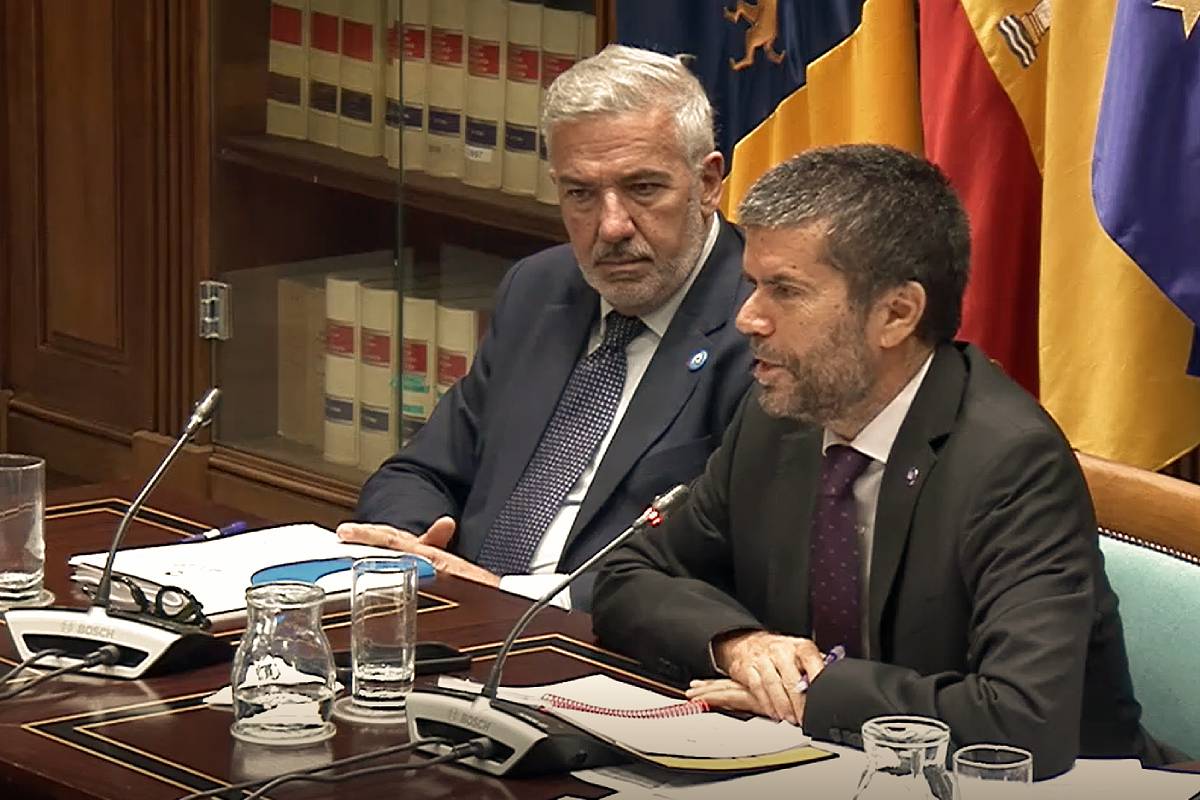
The rectors of the two public universities in the Canary Islands, Francisco García (ULL) and Lluís Serra (ULPGC), addressed the parliamentary committee on Universities, Science, Innovation, and Culture today, October 30, to explain the current situation and future challenges. While they indicated that they are close to reaching an agreement with the regional government on multi-year funding for these public institutions, they stressed that this agreement still needs to be finalized and its implementation ensured.
The rector of the University of Las Palmas de Gran Canaria (ULPGC) spoke first in the parliamentary session, noting that his institution continues to increase its number of new students and boasts significant employability rates. Growth in research is also substantial, with the university securing funding through transfer grants and competitive resources. “We need to reduce bureaucracy, adapt our academic offerings, and strengthen our relationships with businesses and government agencies, and do so with accountability,” Serra asserted, clarifying that his university uses analytical accounting to track how its resources are allocated. “That’s why when we request more funding, it’s not about asking for a blank check, but about having the necessary tools to properly achieve our objectives.”.
The rector argued that the Canary Islands' public universities receive funding that is almost 51% below the Spanish average. "We don't compete with healthcare, equality, or basic education, because we train engineers, economists, teachers, architects... Funding public universities is investing in the future capabilities of the Canary Islands," he pointed out.
Regarding the negotiations, he explained that the structural funding planned for the two universities in 2027 would reach €312 million, while the draft budget submitted to Parliament initially allocates €301 million. The university presidents indicated that the difference would be incorporated through an addendum, and therefore stressed the importance of ensuring that the financial commitments are properly formalized and guaranteed. “The universities are willing to commit to measurable performance targets in all areas, but first, the basic resources must be guaranteed, and these cannot be subject to annual competition,” Serra reiterated to the committee.

Francisco García, rector of the ULL.
Francisco García, for his part, highlighted the contribution of public universities to the economic and social development of the Canary Islands, through the training of highly qualified professionals, the improvement of employability, the generation of economic activity and the social impact of research, innovation and knowledge transfer, fundamental elements to improve productivity and move towards a more diversified, competitive and knowledge-based economic model.
The unemployment rate for the population with higher education in the Canary Islands is 81%, compared to 11.1% for those without university degrees. “We continue to advance in new degree programs with the creation of ten new double degrees and postgraduate programs. We have promoted more than 200 training initiatives for university micro-credentials, with plans to issue more than 2,000 accreditations during 2026, in collaboration with the private sector, to transform the economic sector and make it more innovative and competitive. Three new technology-based companies have been formally established, and a special effort is being made in internationalization, working on relationships with other geographical areas to connect this region with the global stage,” through two European alliances and initiatives such as Campus America, Campus Africa, and Bridge to Africa.
García explained that this year's budget is €181 million for 21,000 students, while the budget for the University of the Balearic Islands exceeds that amount by about €100 million, despite having around 15,000 students. Despite this, he noted, "we are innovating, looking to the future." He emphasized the need to finalize the funding agreement with the Government of the Canary Islands and implement other complementary measures to leverage the potential of the Canary Islands' universities in addressing the challenges facing the islands, which are the same as those faced by public universities.
After the various parliamentary groups had spoken, the university rectors had another opportunity to address the assembly. Serra indicated that a joint accommodation policy, not implemented by individual councils but in an integrated manner, is highly relevant. He also clarified that staff renewal involves not only renewing existing staff but also acquiring new profiles for future projects, and that all of this requires funding. He noted that universities have lost spending capacity during periods of economic prosperity, which seems illogical, and yet they have continued to save money by implementing cross-cutting environmental policies.
“We have been underfunded for many years, and that can’t be fixed overnight, especially after the sustained cuts of 20%,” added the Rector of the University of La Laguna. In response to the members of parliament, Francisco García outlined some of the planned actions to expand the ULL’s presence on the non-capital islands, with year-round activities on La Gomera and La Palma, and the intention to gradually extend these initiatives to other territories. He also mentioned the availability of university accommodation, which currently stands at around 550 units. The university has a similar number of places (similar to the University of Las Palmas de Gran Canaria), but this number hasn't increased for years. It is currently evaluating several public-private partnership proposals which, if sufficient resources become available, could be implemented. In other news, the University of La Laguna has 25 endowed chairs to generate new synergies with strategic sectors of the islands. Finally, in response to a parliamentary question, the rector reaffirmed the role of the University as a space for critical thinking, academic freedom, and pluralistic debate, emphasizing the need to distinguish between legitimate disagreement and hate speech. In his remarks, he referred to the institution's position regarding Israel. "We must know how to distinguish one from the other.".
The hearing highlighted the agreement between both public universities on the need to finalize a sufficient, stable and multi-year funding agreement that guarantees their operation and allows them to expand their contribution to education, research, innovation and the economic and social development of the Canary Islands.

 Spanish
 English
 French