
The University of La Laguna and the Ministry of Agriculture, Livestock, Fisheries and Food Sovereignty of the Government of the Canary Islands continue to advance in their collaboration strategy to promote agritourism and wine tourism as activities linked to the development of the primary sector and the diversification of the archipelago's tourism offer.
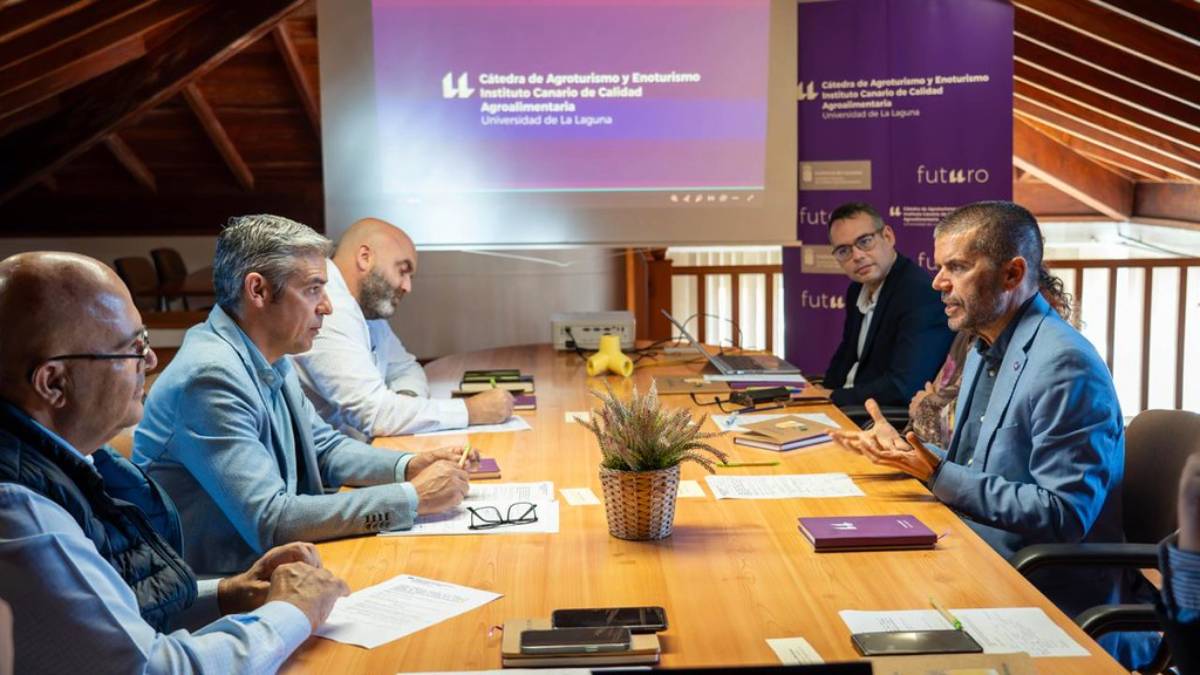
Both institutions held a working meeting yesterday, Tuesday, November 3, at the headquarters of the Chair of Agritourism and Wine Tourism of the Canary Islands, located in the Garoé Building of the Anchieta Campus, to evaluate the actions carried out during the 2025/2026 year and establish the bases of the next collaboration framework.
The meeting was attended by the Rector of the University of La Laguna, Francisco J. García Rodríguez; the Minister of Agriculture, Livestock, Fisheries and Food Sovereignty of the Government of the Canary Islands, Narvay Quintero Castañeda; and the Director of the Chair of Agritourism and Wine Tourism of the Canary Islands, Jesús de las Heras Roger, who was in charge of explaining the different issues addressed during the session, as well as the development, results and future prospects of this joint initiative of the University of La Laguna and the Canary Institute of Agrifood Quality.
Also in attendance on behalf of the Government of the Canary Islands and the Canary Islands Institute of Agri-Food Quality were the director of the ICCA, Luis Arráez Guadalupe; the head of the Technical Area Coordination service, Jaime Núñez Ubach; and the head of the Promotion and Development service, Luis Salvador Hernández Bethencourt.
The University of La Laguna and its General Foundation were represented by the Vice-Rector for Culture and University Extension, Isabel Karely León Pérez, and the Managing Director of the General Foundation, Julio A. Brito Santana. Gabriel Santos García, the Chair's General Coordinator, also participated.
Annual results
The management report and progress report of the work plan for the 2025/2026 financial year certified the consolidation of an activity that connects university knowledge with professionals in the primary and tourism sectors, through research initiatives, specialized training and knowledge transfer, with special attention to sustainable rural development and the enhancement of the Canary Islands' agri-food heritage.
In the area of cooperation, the chair has formalized ten new agreements with universities and sectoral entities, expanding a collaborative network with activity on all the islands and international ties in countries such as Brazil, Croatia, Italy, Latvia, and Portugal. These entities include the University of Strasbourg, organizations linked to the Brazilian wine sector, wine appellations of origin from the Canary Islands, and various organizations focused on rural and agri-food development.
The international dimension has also been reflected in the celebration of the International Agro-Wine Tourism Meeting, which had its latest editions in Lanzarote, in May 2025, and in El Hierro, in April 2026. These last two events brought together more than 180 participants in person and reached more than 1,800 beneficiaries through their online impact, with representation from territories such as the Canary Islands, the Iberian Peninsula, Brazil, Cape Verde, the United States, Italy and Portugal.
Training and awareness-raising are two other key aspects of the activity. During the period analyzed, the 2025/2026 Rural Women's Conference registered 154 participants. The training program included courses, workshops, and university seminars on various islands, addressing topics such as Canary Island avocados, regenerative viticulture, agri-food quality designations, and the historical identity and viticulture of the Atlantic.
In the area of research, the Chair's work has been structured through specialized groups and interdisciplinary teams that address issues such as the development of agritourism, the participation of rural women, the promotion of local products, and sustainable wine tourism. This activity is complemented by scientific publications, presentations at conferences, academic residencies, and collaboration with researchers and universities in various countries.
 New agreement
Another key point of the meeting was the preparation of the new sponsorship agreement for the Chair for the 2027/2028 period. Institutional representatives reviewed the terms of the future agreement and the general strategic guidelines that will direct the work over the next two years.
Among the priorities outlined are institutional strengthening and the expansion of international partnerships, especially with universities and organizations in Latin America, Europe, and Macaronesia. Plans also include boosting applied research and knowledge transfer, maintaining specialized and decentralized training across all the islands, and developing proprietary programs in collaboration with agri-food and tourism companies and organizations.
The new strategic framework also proposes moving towards a more stable and professionalized management model, with the strengthening of the technical and administrative team to address the growth of projects, international agreements, scientific publications and training activities.
In this regard, Francisco García emphasized that the Canary Islands Chair of Agritourism and Wine Tourism exemplifies how the University of La Laguna should engage with society: by listening to its needs, identifying its challenges, and putting knowledge, research, and training at the service of the economic and social development of our region. It serves as a direct link with the business community, the primary sector, and public administrations, enabling the translation of academic knowledge into projects and initiatives with a real impact in the Canary Islands.
At the same time, it constitutes an internationalization platform that contributes to expanding our University's collaborative networks and projecting the knowledge generated in the Canary Islands to other regions. In this regard, we must take advantage of the opportunities offered by international cooperation spaces and programs such as the Tordesillas Group and the European alliance STARS EU, to strengthen academic, scientific, and business exchange, establish new partnerships, and share experiences with universities and regions facing similar challenges.
During the meeting, the role of the Chair as an instrument of cooperation between the university, the public administration and the business sector was also addressed, with the purpose of generating knowledge applicable to the challenges of the territory and promoting new economic opportunities linked to the agri-food and tourism resources of the Canary Islands.
For his part, the Minister of Agriculture, Livestock, Fisheries and Food Sovereignty of the Government of the Canary Islands, Narvay Quintero, highlighted the importance of "continuing to promote agritourism and wine tourism as activities that add value to our local productions, favor the diversification of agricultural activity and generate new business opportunities for wineries and other companies in the primary sector, while contributing to enhancing the value of our agricultural, landscape and gastronomic heritage.".
In this regard, Quintero emphasized that "the collaboration with the University of La Laguna, through the ICCA and this Chair, allows us to advance in three fundamental areas: research, specialized training, and knowledge transfer to professionals in the sector." He also highlighted the importance of "strengthening alliances and the exchange of experiences with other producing regions, both nationally and internationally, to leverage synergies, share success stories, and continue developing the potential of agritourism and wine tourism in the Canary Islands.".
With this meeting, the University of La Laguna and the Ministry of Agriculture are moving forward in consolidating a framework for collaboration that seeks to give continuity to the work developed by the Chair of Agritourism and Wine Tourism of the Canary Islands and reinforce its contribution to research, training and knowledge transfer, promoting the connection between the primary sector and tourism activity and the enhancement of the resources and identity of the archipelago.

 Spanish
 English
 French