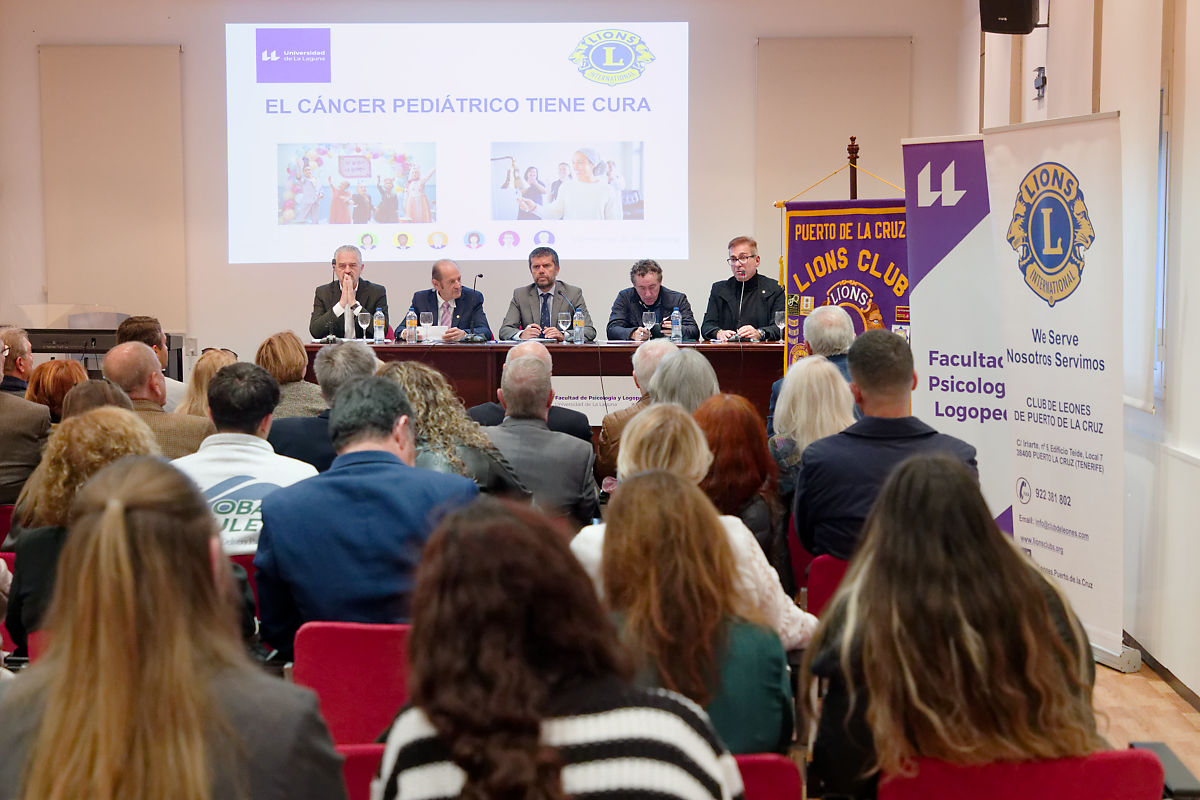
Each year, an average of 60 children are diagnosed with cancer in the Canary Islands. Once they overcome cancer, both the treatment received and the disease itself can produce neurocognitive sequelae such as language problems, memory loss, and other cognitive, behavioral, and emotional disorders. This often leads to poor academic performance, with only 10% of this group reaching university. With appropriate intervention, it is possible to mitigate this situation, and therefore, the Lions Club of Puerto de la Cruz and the University of La Laguna have signed an agreement to promote research that will help improve these treatments.
This agreement was signed last Friday, January 24th, at the Faculty of Psychology and Speech Therapy, by the Rector of the University of La Laguna, Francisco García, and the President of the Lions Club of Puerto de la Cruz, Eric Stienon. Also present at the signing were the lead researcher on the project and a professor from the Department of Clinical Psychology, Psychobiology, and Methodology. Sergio Hernández Expósito; the dean of the host faculty, Juan Manuel Bethencourt; and the director of the Canary Islands Network for Assistance to Children and Adolescents with Cancer, Jorge Gómez.
Although the agreement was initiated by the Puerto de la Cruz Lions Club, other Lions Clubs throughout the Canary Islands and even mainland Spain have joined, including those from San Miguel de La Palma, Santa Lucía Vecindario, Arucas, Los Realejos, and A Coruña Os Pequerrechos, all of which have made financial contributions. This support was made possible after researcher Sergio Hernández presented the project a few months ago at a summit of these organizations, which led to these endorsements. Another island-wide meeting will be held on February 14th in Gran Canaria, where the project coordinator will present the initiative and hopes to garner further support.
The agreement outlines the main objectives of the research to be carried out, which include the neuropsychological evaluation of potential neurocognitive sequelae in children diagnosed with cancer in the Canary Islands who have completed surgery or chemotherapy and radiotherapy, are currently undergoing treatment, or have not yet begun; intervention to address their neurocognitive sequelae and deficits; and a study of the impact of factors such as cancer type, treatment type, disease progression, gender, and age on these sequelae. Biological markers and their relationship to these sequelae will also be investigated, as well as variables that could help maximize the effectiveness of the intervention.
To achieve these objectives, the project includes activities such as the development of a neuropsychological intervention protocol to objectively measure cognitive performance; the acquisition and study of tests that are part of this protocol, as well as materials to implement the different tasks; the collection of data on both neuropsychological and psychosocial interventions carried out on the children; the establishment of collaborations with other relevant entities; and training for families of children with cancer on therapeutic strategies that can be implemented at home.
The agreement has a four-year term, renewable, and the funds raised will be invested in two research fellows with experience in neuropsychological intervention, one for each of the Canary Islands provinces, and in the acquisition of specialized intervention software. As the project manager explains, this is a research initiative, since the actual intervention is the responsibility of practicing professionals. Thus, this project will lead to publications and training activities on the most effective intervention models for addressing the needs of pediatric cancer patients requiring neuropsychological care.
In addition to Sergio Hernández, the project involves two researchers from the Insular University Hospital Complex, Antonio Molinés and Kishore Melwani; one from the University Hospital Complex of the Canary Islands, Macarena González; one from the Nuestra Señora de Candelaria University Hospital Complex, Jorge Gómez; and a representative from the Lions Club of Puerto de la Cruz, José Gregorio Alonso.

 Spanish
 English
 French