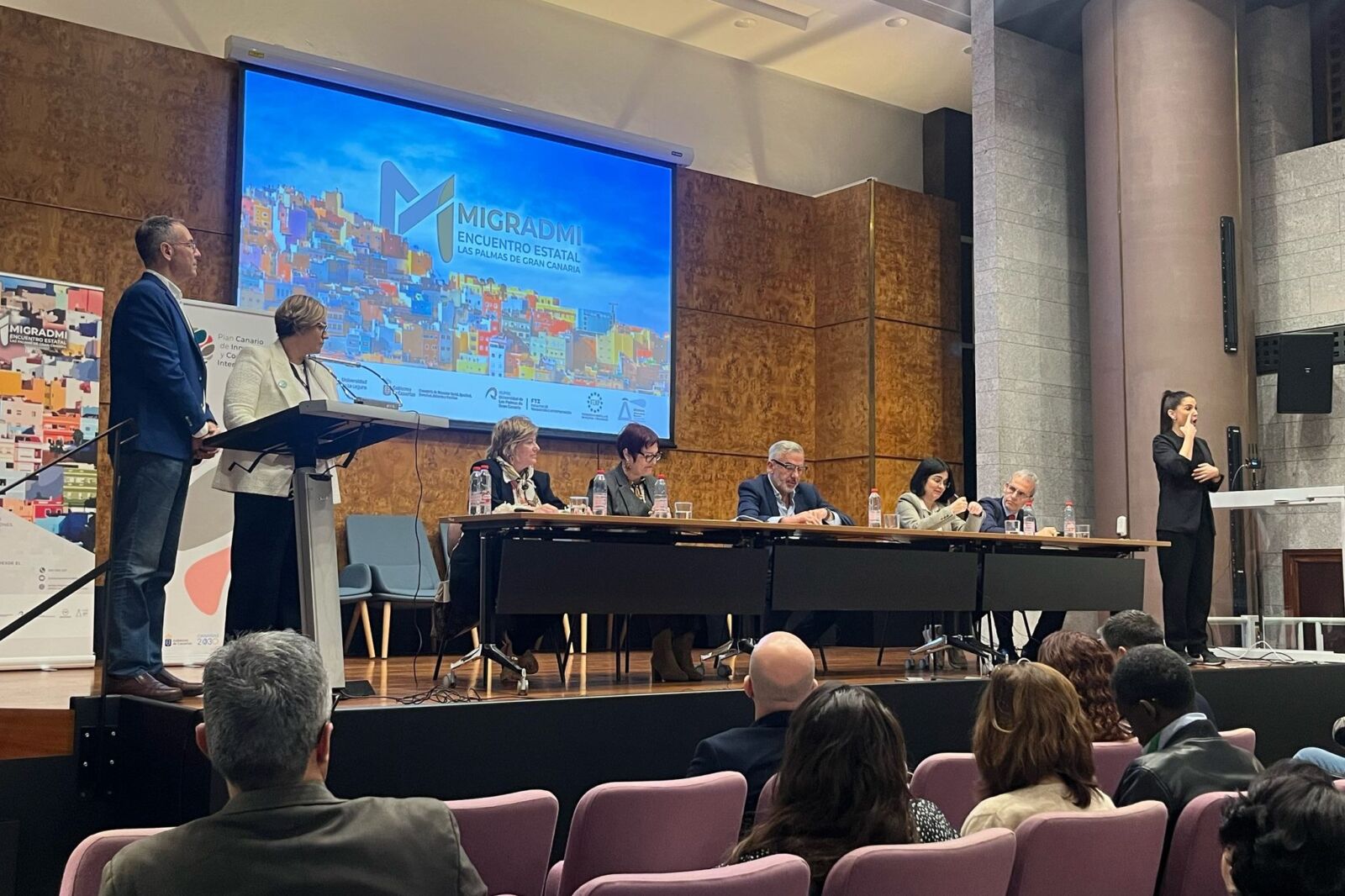
MIGRADMI is the acronym chosen for the "State Meeting on Planning in Migration Management, Cultural Diversity, and Social Coexistence from the Public Administrations," held at the Obelisk Campus of the University of Las Palmas de Gran Canaria on February 13 and 14. It is conceived as a forum for reflection and debate on migration planning among individuals and entities linked to public administrations and third-sector organizations responsible for managing immigration and its effects, cultural diversity, and social coexistence within Spain. Around 350 people from 11 autonomous communities attended the first session, approximately 200 in person and the rest via online broadcast.
Promoted by the Canary Islands Government's Ministry of Social Welfare, Equality, Youth, Children, and Families, within the framework of its Canarias Convive Program managed by the University of La Laguna through its General Foundation, this second edition was organized with the involvement of the University of Las Palmas de Gran Canaria. The event aims to take place on different islands of the archipelago, among other things, to facilitate the recognition and appreciation of local initiatives that can serve as a benchmark for reception, inclusion, and coexistence with an intercultural approach. The event also saw the participation of the Spanish Federation of Municipalities and Provinces (FEMP) and the Ministry of Inclusion, Social Security, and Migration through the Spanish Observatory on Racism and Xenophobia (OBERAXE). Representatives from 34 municipalities, several island councils, and 9 Spanish universities attended.
Among the main conclusions of the first day of work, one can highlight the demand for a greater role for municipalities in designing strategies for managing migration and its effects at the local level, the framework within which the growing mobility of people in our country is expressed. This mobility is viewed positively because it has clear benefits in various aspects of the economic, social, and cultural life of municipalities, benefits that are even greater when there is adequate planning and specific work aimed at the inclusion of newcomers and their integration into the community as a whole.
Based on the premise of upholding the rights of all people and ensuring their equal access to public services, emphasis is placed on the need to promote more structured, long-term working models. These models should enable the development of strategies, the organization of resources, the adaptation of structures, the training of professionals, and other essential elements for providing better responses to increasingly diverse populations. This growing complexity of societies demands improved institutional preparedness, along with a greater willingness to establish more robust spaces for collaboration and cooperation.
There is also a demand for more policy and action from government bodies and less institutional noise, formalizing the aspiration for more inclusive social contexts, best achieved through consensus by defining plans that incorporate a long-term strategic vision, since consistent progress is often synonymous with success compared to disjointed actions. Political leadership and social commitment are essential ingredients for facing these kinds of challenges.
In this sense, it is also crucial to incorporate appropriate approaches that promote the active participation of society in its ongoing reconfiguration, such as interculturalism, which connects with the community-based construction of relationships, essential for moving towards achieving coexistence. And also, to prevent new residents from being offered only "the margins," since it is increasingly evident that newcomers contribute to ensuring the general well-being in many places, particularly in those that create the conditions for this to happen.
In these types of processes, the involvement and contribution of universities is considered relevant, both in terms of their participation in gaining a comprehensive understanding of reality at different scales, and in supporting initiatives by contributing their expertise. The example set by the Canary Islands through its public universities is therefore highly valued, especially because they are strengthening their ties and providing a joint response to many of the demands emanating from the institutional and social spheres of the archipelago.

 Spanish
 English
 French