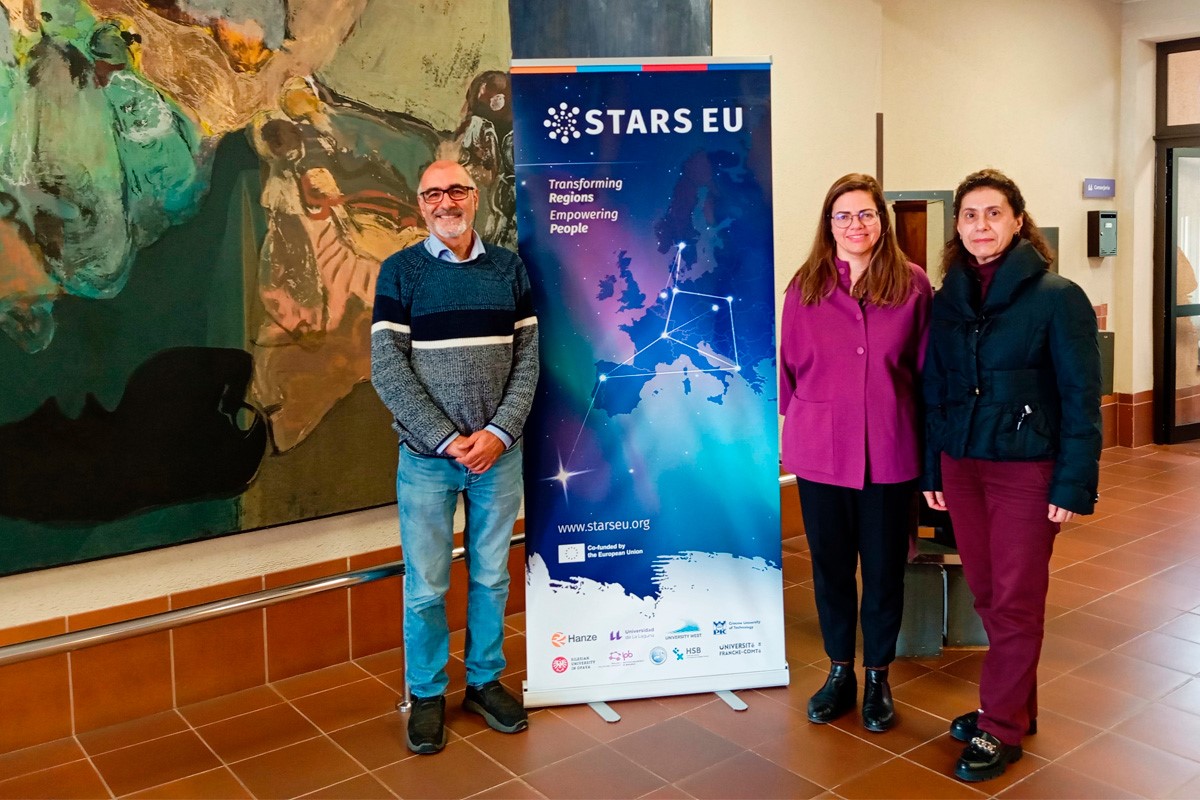
The researcher Zulimar Hernández Hernández, of the Polytechnic University of Braganza (IPB), He recently addressed at the University of La Laguna the advantages of belonging to the European University Alliance. STARS EU, of which the ULL is a part, along with the Portuguese institute and seven other European higher education centers.
The specialist of Mountain Research Center (CIMO), A multidisciplinary research unit focused on Mediterranean mountains and integrated within the IPB, gave a talk to faculty and doctoral students in the Chemistry Department. The meeting served to present the work carried out within the STARS network and to discuss the advantages offered by the mobility program to both faculty and technical management staff within the framework of the alliance.
In his talk, Hernández referred to the more flexible training programs for students, which combine physical mobility with a virtual component, such as Blended Intensive Programs (BIPs), which must be developed by at least three higher education institutions belonging to the STARS EU alliance. “This is a modality that we strongly promote at IPB because it combines great advantages for both students and faculty.”.
In addition to the BIPs, the researcher pointed out the possibilities offered by the Staff Mobility for Teaching (STA) and Staff Mobility for Training (STT) programs, which can be chosen by PDI and PTGAS, as well as the Student Mobility for Study (SMS) and Student Mobility for Traineeship (SMT) programs, intended for students in internships or doctoral students, within the framework of the alliance.
“The Canary Islands can gain a lot from this network because I know how other European alliances with a longer history work and what they represent in terms of opportunities, of course for students, but also for faculty and management staff, allowing them to further open up to internationalization. And to all this we must add the great advantage of having more powerful resources for research, which are combined by the nine centers that make up the network,” Hernández comments.
In this regard, the IPB representative highlighted the possibility of joining the nine Thematic Interest Groups (TIGs) STARS EU, focused on issues as important as energy transition, entrepreneurship and innovation, digital transformation or inclusion and social justice, among others, and the fact of being able to work in a “more supportive” network together with researchers from other partner universities.
Research on agri-food waste
In addition to outlining the advantages of belonging to the STARS EU network, Hernández presented in his talk the conclusions obtained in his research on the valorization of agri-food waste, the result of several international projects in which he has been able to advance in one of his lines of research, focused on increasing the carbonization of soils.
One of the aspects their studies are now focusing on is exploring the possibilities of olive waste, since, despite having no economic value, it contains 5% of lactic acid, which is used to obtain low-quality oil that is not consumed but is refined. “This process has a very high ecological footprint because it produces a lot of CO2, so the approach involves how to reduce that pollution. Furthermore, this waste does not allow for an optimal composting process because it is very moist and phytotoxic.”.
Alongside this line of research, the IPB expert has developed a Class A Organic Compost (the first open European brand) that will bear her name in a few months, allowing farmers to produce her own recipe once they have completed the necessary registration. In addition to her research on composting processes, she is also working on the restoration of soils burned by wildfires—especially in certain areas of Portugal—to enable the reintroduction of species native to these ecosystems.
The recent visit by the IPB researcher, a graduate in Biology from the University of La Laguna and honorary professor at the Autonomous University of Madrid (UAM), took place within the framework of the mobility programs carried out within the STARS EU network, which is financed under the Erasmus+ program.

 Spanish
 English
 French