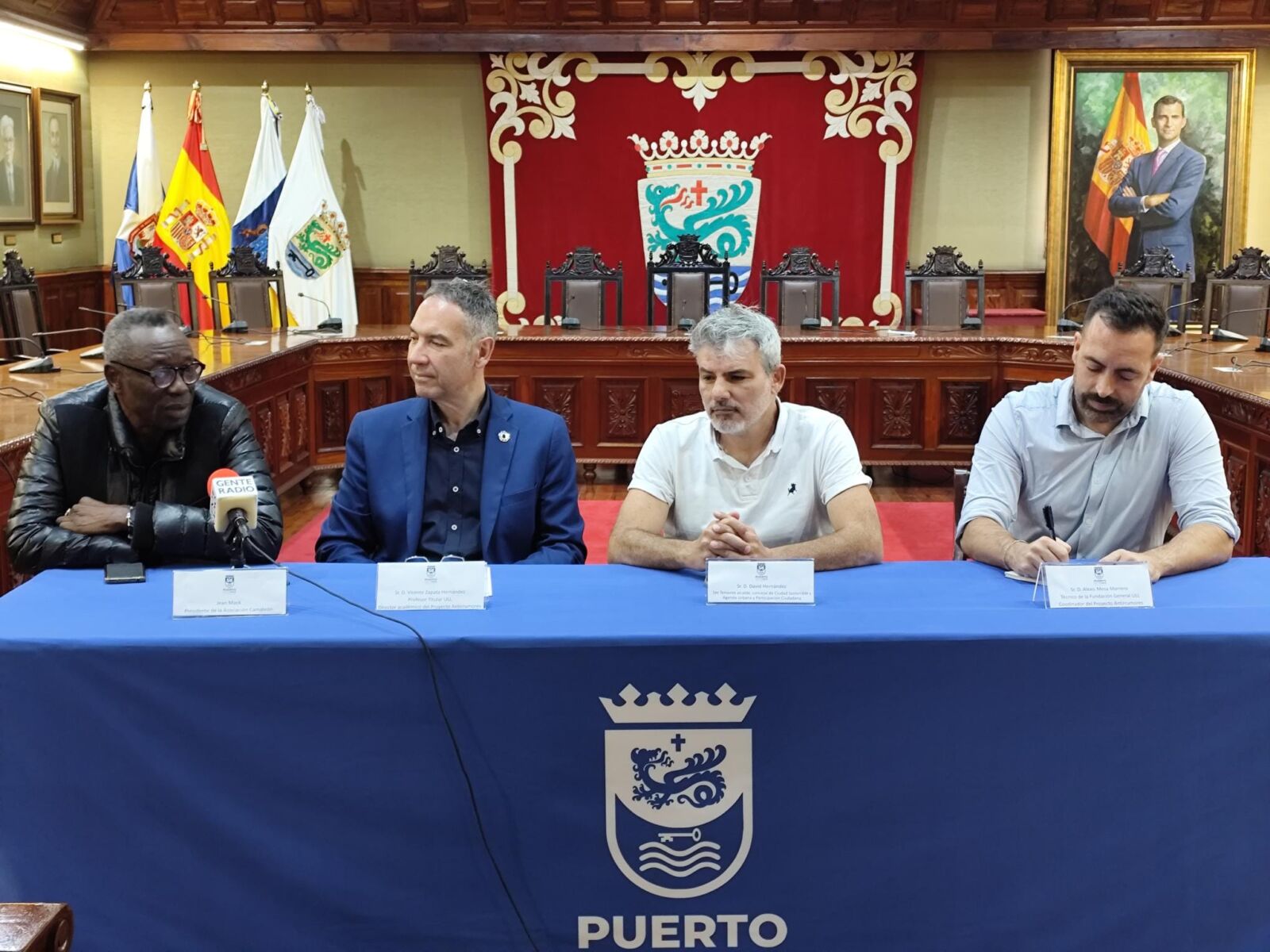
The University of La Laguna, in collaboration with the Department of Equality of the Puerto de la Cruz City Council, has presented the Anti-Rumor strategy in the aforementioned town, which seeks to counteract negative stereotypes, clichés and false rumors about immigration and cultural diversity, thus fighting against racism and xenophobia in society.
The professor at the University of La Laguna and academic director of the Anti-Rumor Project, Vicente Zapata; the councilor for Equality of the Puerto de la Cruz City Council, David Hernández; the technician of the General Foundation and coordinator of the Project, Alexis Mesa and the president of the Camaleón association, Jean Mack, gave the details of a project that wants to highlight the richness of culturally diverse societies through community involvement and participation.
Vicente Zapata pointed out that the University of La Laguna (ULL) is collaborating on a project aimed at strengthening the model of intercultural coexistence. To this end, the University has been working on anti-rumor strategies for some time. «It is crucial to contribute a different kind of narrative that fosters a more inclusive society and builds environments for coexistence. It is a participatory strategy to confront xenophobia and racism and identify false rumors. Puerto de la Cruz is one of the Canary Islands territories where a diverse society has emerged most quickly; we will encourage citizen participation at all levels, embracing the idea that the best framework for this work is the municipality,” he commented.
For his part, David Hernández explained that lies related to immigration prevail in today's society, and that we must counterattack these extremist positions. "We have to combat it with facts and by dismantling the lies with data, because attacking the most disadvantaged is giving votes to the extremists in their strategy of pitting the poor against each other. With this project, we are going to debunk the rumors and lies and, as far as possible, restore balance and a positive perception of both diversity and social cohesion," he emphasized.
Alexis Mesa outlined the phases of the project that will be developed this year by the Social Innovation Area of the General Foundation of the University of La Laguna. He explained that the first phase involves identifying and analyzing prevalent rumors in the municipality related to immigrants and cultural diversity. This will entail studying the most common stereotypes and false rumors circulating in the community, with the aim of understanding their origin, impact, and how they affect the perception of immigrants. Next, objective information will be gathered. Solid and verified data will be collected to debunk existing prejudices, thus providing informative tools to help raise awareness among the population about the importance of a more realistic and inclusive view. This information will be crucial for changing the narrative surrounding immigrants and cultural diversity, offering evidence that supports peaceful and respectful coexistence.
Finally, Jean Mack expressed her gratitude for this initiative and highlighted "the importance of each community countering misinformation and lies, because we quickly forget the reasons why migrants leave their country, which is none other than seeking a better life.".
The project will use methods and techniques from the Social Sciences to organize the activity of the work team and to interact with the population, social organizations, the associative fabric, or the business sector, including its relationship with the educational, health and welfare spheres, citizen security.
Among these activities, depending on their relevance, we can mention fieldwork, in-depth interviews and listening sessions, focus groups, the development of online questionnaires, the organization of community meetings, document review and analysis, and the management of information and statistical data. Furthermore, extensive engagement with the socio-territorial reality of the municipality will be undertaken, facilitating the team's mobility and networking through the use of mobile devices and five laptops. Preliminary work will be carried out using online systems, a resource that will be available to the project throughout its duration.

 Spanish
 English
 French