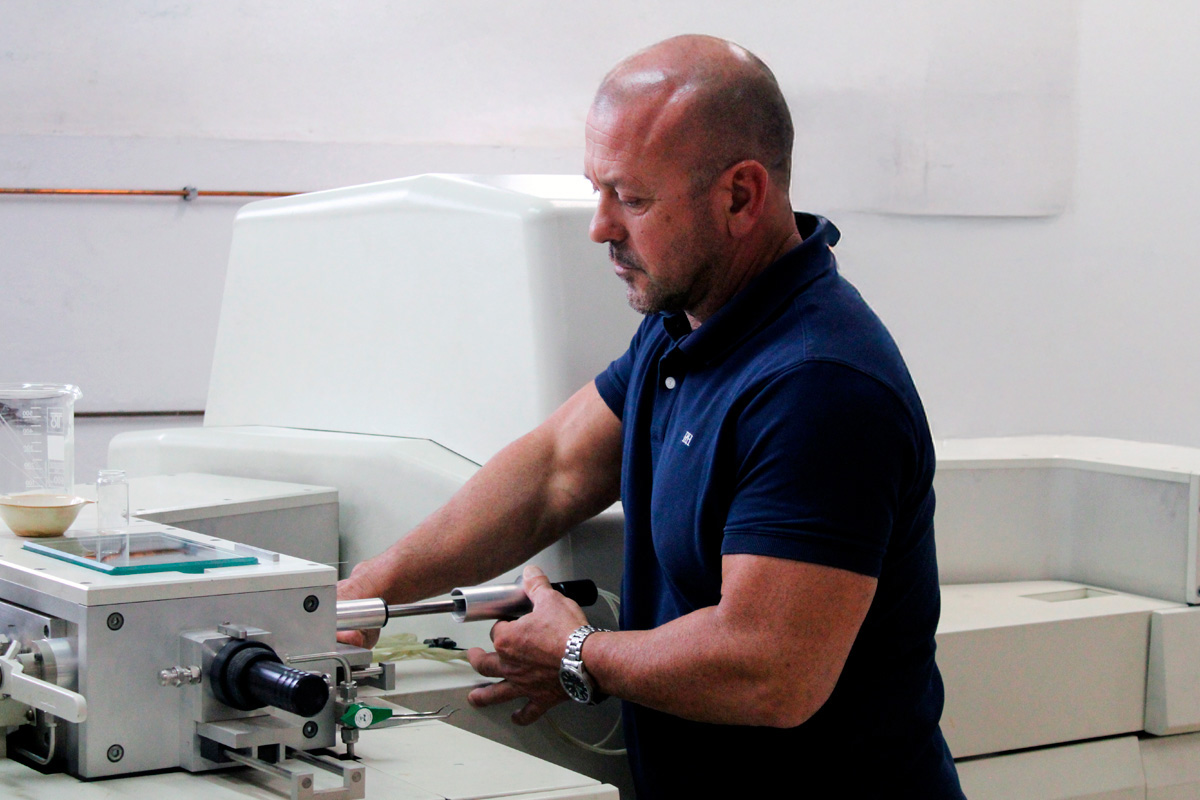
He General Research Support Service (SEGAI) The University of La Laguna provides scientific, instrumental, and technical support to research within the institution itself and in collaboration with external entities. Specifically, the Mass Spectrometry and Elemental Analysis Service, Located at the Antonio González University Institute of Bio-Organic Science, it conducts detailed studies on the composition of chemical substances, thanks to the mass spectrometry of chemical products and elemental analysis.
Although molecules have mass, their size is so small that very specialized equipment is needed to measure it. Mass spectrometry is the technique that allows for the precise determination of the mass of chemical compounds, helping to identify, quantify, and understand their molecular structure.
This technique stands out for its high sensitivity, capable of detecting even minute quantities of substances, and for the speed with which it delivers results. Furthermore, it is very versatile, as it can be applied to a wide variety of chemical compounds thanks to different available methods, which are chosen according to the characteristics of the substances being analyzed.
The process involves measuring mass and analyzing how molecules fragment when subjected to certain conditions, generating a spectrum that provides very detailed information about the composition and structure of substances.
Applications
Its technician, Sergio Suárez, explains that the applications of this service are very varied. Although it is widely used in the field of research, it also plays an important role in sectors such as the chemical, food, and pharmaceutical industries, especially in quality control tasks, drug analysis, and anti-doping tests, as well as in refineries for the analysis of the composition and quality control of petroleum products.
Elemental analysis, another technique offered by this service, is especially useful in sectors such as food and construction, where it allows you to know the composition of materials such as plaster and concrete.
The service boasts highly specialized equipment. For mass spectrometry, it uses the Micromass VG AutoSpec spectrometer, a magnetic trisector with EBE geometry, which allows for techniques such as accelerated electron impact. “This tool is very suitable for substances with low molecular weight,” says Suárez. Furthermore, this equipment is coupled to a gas chromatograph, enabling the analysis of more complex samples. “If we analyze a perfume, we can inject it into the chromatograph and observe the compounds it contains,” he explains.
On the other hand, for elemental analysis, a Thermo FlashEA 1112 Series elemental microanalyzer is used, based on the modified Dumas method. “It is a combustion analyzer: it has a reactor tube where complete combustion of the product takes place, and what we obtain is the mass composition of carbon, hydrogen, nitrogen, and sulfur in solid samples, both organic and inorganic, as well as in liquid samples,” he explains.
These instruments are used primarily by research groups at the University of La Laguna specializing in organic and inorganic chemistry. However, the service also receives samples from the Technological Institute of the Canary Islands, the University of Las Palmas de Gran Canaria, and some local petrochemical companies, such as Ascanio Química.
“This equipment is extraordinarily expensive,” says Suárez. The mass spectrometer, although old, had a high cost. Currently, a new one would cost between 600,000 and 900,000 euros. The elemental analyzer, for its part, costs around 100,000 euros. Added to this is the cost of maintenance: for example, the mass spectrometer requires complementary equipment such as vacuum pumps and water-cooling systems. The elemental analyzer also uses helium as a carrier gas—which increases costs—and pure oxygen for combustion.
This service has a specific budget allocation within the SEGAI general budget. At the state level, calls for infrastructure projects are occasionally published, which the University of La Laguna applies for in order to renew or acquire new equipment.

 Spanish
 English
 French