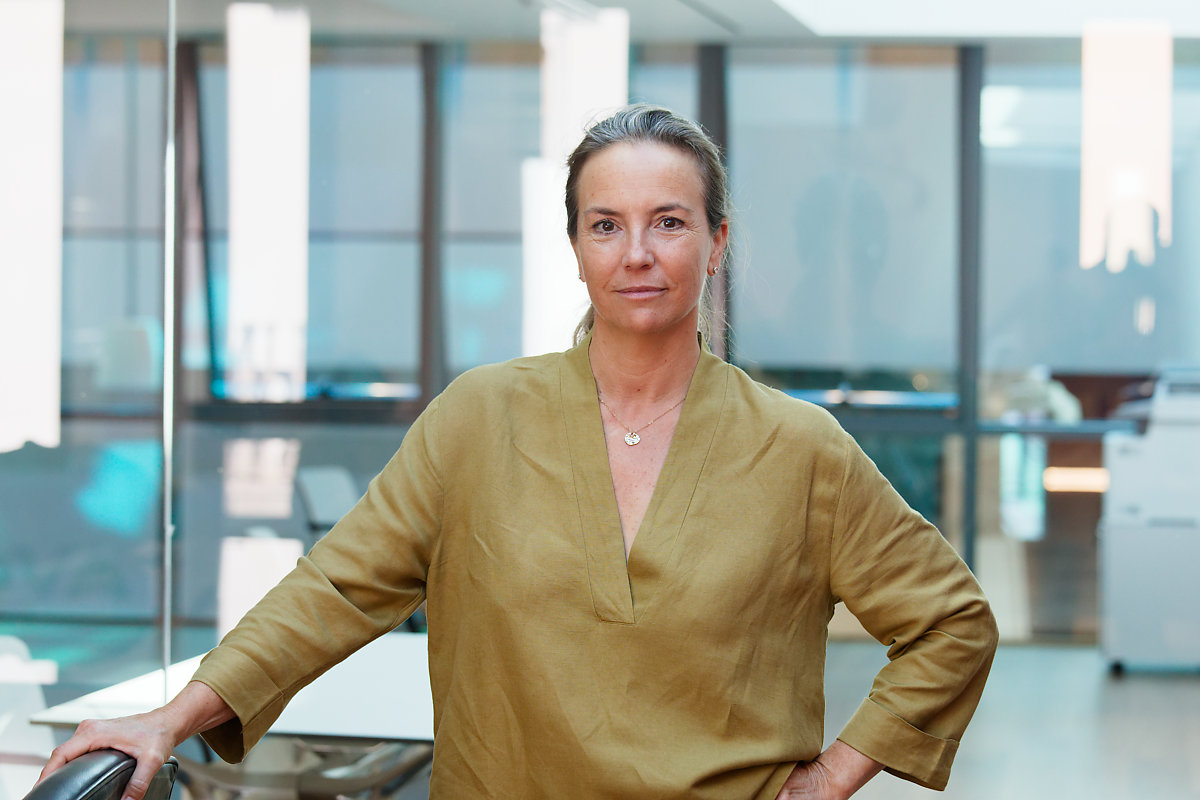
Science communicator and biologist Odile Rodríguez de la Fuente recently participated in the event Diginnova Inspires, A conference dedicated to innovation, sustainability, and digital transformation, organized by the University of La Laguna, featured a presentation titled “Climate of Change.” In it, she addressed the main environmental challenges facing the planet, calling for a redefinition of the relationship between humanity and nature. “We have to realize that we are nature, nothing more and nothing less. Everything we do to nature, we do to ourselves,” she stated, inviting everyone to reconnect with the natural world and place life at the center of our decisions.
With a career focused on environmental education and biodiversity conservation, Rodríguez is the daughter of renowned naturalist Félix Rodríguez de la Fuente and has dedicated much of her life to continuing his legacy, combining outreach, research, and innovative sustainability projects. She has participated in social awareness programs, ecosystem restoration initiatives, and environmental education projects aimed at young people and communities, seeking to unite science, technology, and ecological values.
For Rodríguez de la Fuente, the main environmental challenges facing Spain can be summarized as the climate emergency, the loss of biodiversity, and a lack of ecological awareness. He warns that the Iberian Peninsula is especially vulnerable to prolonged droughts, fires, and extreme weather events, and in this regard, he emphasizes that “it is urgent to raise awareness and educate people about our relationship with the planet because it is the root of everything that is happening to us,” he explained.
Furthermore, he emphasized the need for nature-based adaptation, citing examples such as "sponge cities," which allow for the sustainable storage and management of rainwater. These cities incorporate spaces that allow water to infiltrate the soil, as well as urban wetlands capable of retaining large volumes of water. In this way, not only is adaptation to intense rainfall and flood prevention facilitated, but better water resource management is also ensured during prolonged periods of drought.
Furthermore, he highlighted biomimicry, a discipline that seeks inspiration in natural structures, processes, or systems to solve problems with more efficient and sustainable designs. An example of its application is Velcro, invented by the Swiss engineer George de Mestral, who, during a walk, observed that burdock seeds adhered to his dog's fur and his clothing. Examining them under a microscope, he discovered that they were covered in tiny hooks that caught on textile fibers; from this observation, he devised the well-known hook-and-loop fastening system, now used worldwide.
Rodríguez de la Fuente added other examples: “The bullet train inspired by the kingfisher or buildings that regulate their temperature like African termite mounds show how we can learn from nature to create efficient and sustainable solutions,” he noted.
Education, technology and ecological awareness
Regarding current technologies, he emphasized that they are valuable tools in the fight against the climate emergency, biodiversity loss, and the lack of ecological awareness. blockchain ”For traceability of sustainable products, artificial intelligence to understand the dynamics of the planet, or the internet of things to optimize resources and reduce waste are some examples,” he explained.
Rodríguez de la Fuente argues that changing the current socioeconomic model is complex because it involves questioning deeply ingrained beliefs and confronting the system's inertia. "We must redefine ourselves so that nature and human well-being are at the center, but we are adrift," he stated.
In that regard, he pointed out that “despite the Paris Summit, the Montreal Summit, and all the agreements of the European Green Deal, we continue to increase emissions and lose biodiversity.” He also warned that “the problem is that nature’s timescales are not our timescales, and perhaps we have already passed the point where we can truly intervene in the forces we have unleashed.”.
However, he sees universities, and especially young people, as having a fundamental role: "They have the ability to question the established order, and that fresh perspective should nourish educational institutions," he stated.

 Spanish
 English
 French