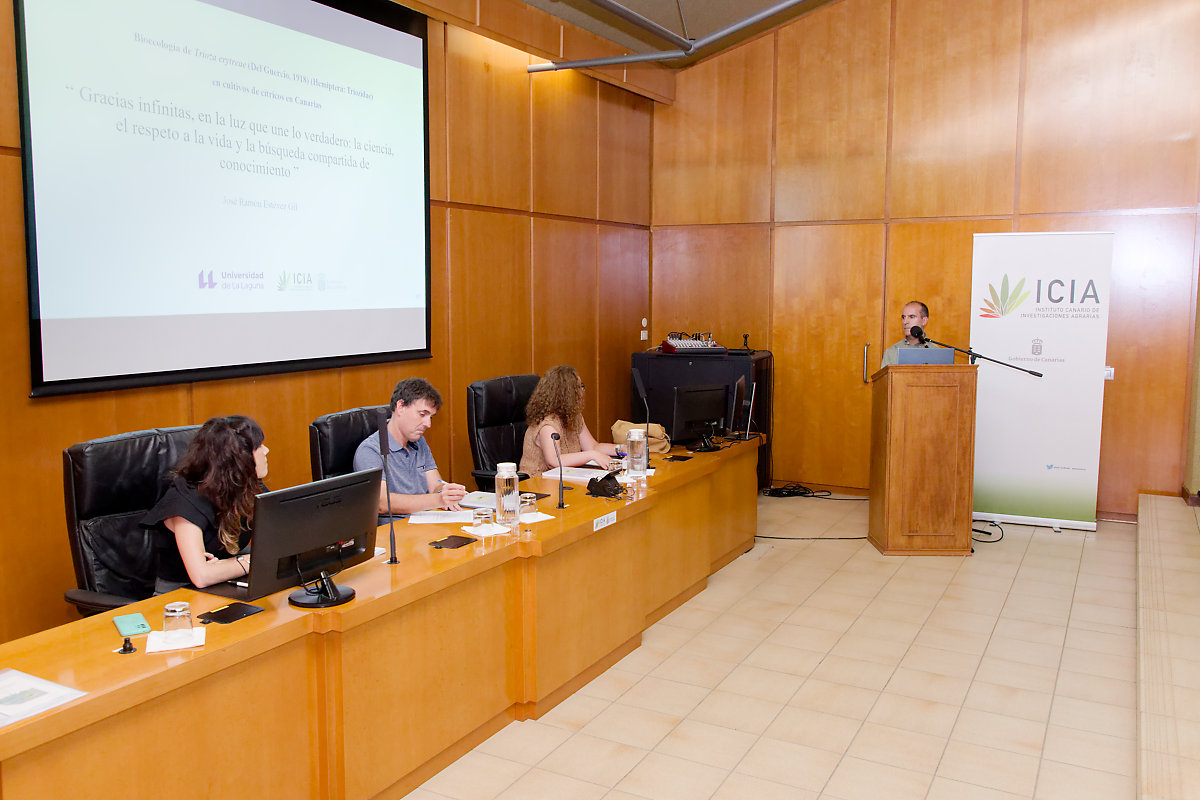
Academic research offers new insights into the control of Trioza erytreae, A small insect known as the African citrus psyllid, which feeds on the tender shoots of citrus trees and can transmit the bacteria that causes Huanglongbing (HLB), a lethal disease for these crops..
The doctoral thesis “Bioecology of Trioza erytreae (Del Guercio, 1918) (Hemiptera: Triozidae) in citrus crops in the Canary Islands”, recently defended by José Ramón Estévez Gil, was directed by Estrella Marina Hernández Suárez, Alejandro Tena Barreda and Juan Antonio Sánchez Sánchez and tutored by Raimundo Cabrera Pérez. The defense took place in the Canary Islands Institute of Agricultural Research (ICIA), in the Biodiversity and Conservation category. The secretary participated on the panel. Cristina Giménez Mariño, Jésica Pérez Rodríguez as member and César Monzón Ferrer as president.
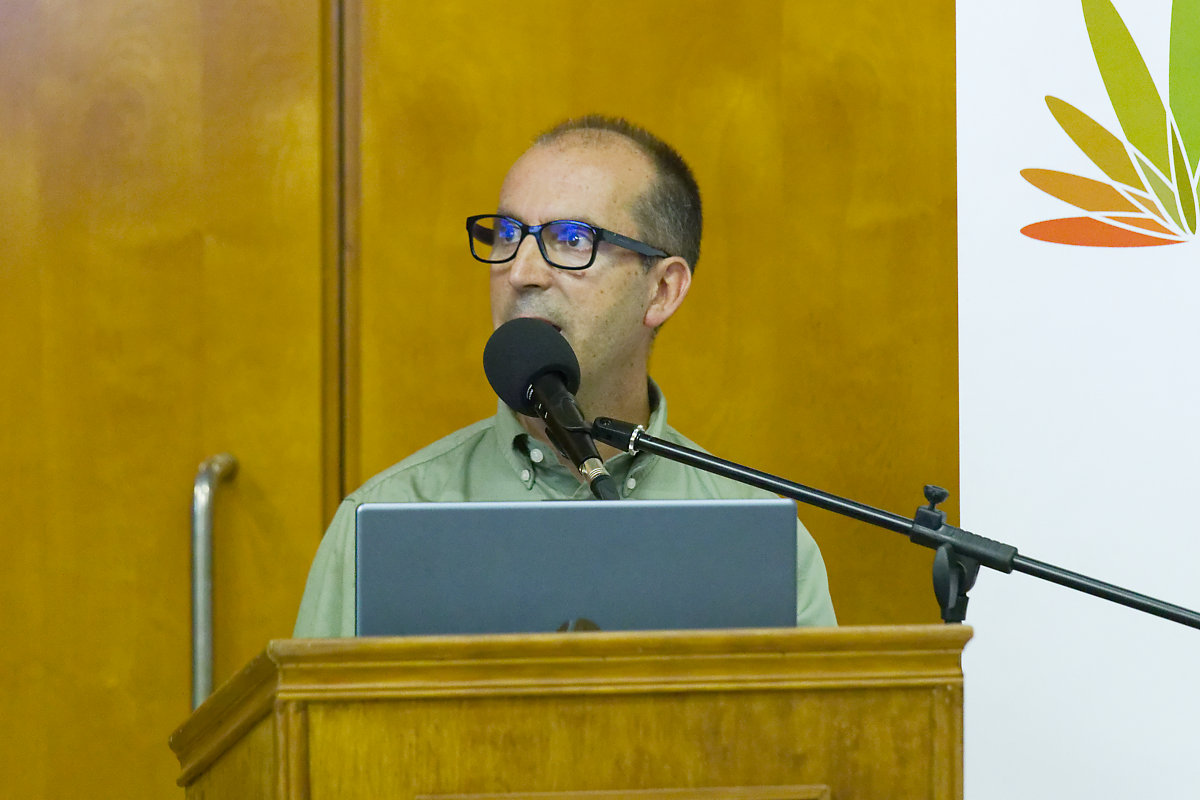
The now Dr. José Ramón Estévez.
This thesis from the University of La Laguna arose from the need to understand the population behavior of the insect in areas where it has been recently introduced, such as the Canary Islands, due to a lack of specific information. This gap motivated the detailed study of the pest's dynamics and its implications for advancing its eradication.
Scientific research has shed light on the sustainable control of Huanglongbing (HLB), one of the most aggressive and incurable diseases in citrus. The study, conducted in the Canary Islands, combined population analysis of the citrus psyllid, identification of its natural enemies, and the impact of climatic factors, with the aim of generating adapted and sustainable management strategies.
Although the incidence of Trioza eryteae In the Canary Islands, it has been considerably reduced and, since 2021, its presence is scarce and localized thanks to the release of Tamarixia dryi, A parasitoid that acts as a natural biological control of the insect continues to pose a high risk because it is the natural transmitter of the bacteria Candidatus Liberibacter africanus, The causative agent of Huanglongbing (HLB). Similarly, HLB has not yet been detected in Europe; however, the introduction of the pathogen would result in irreparable economic losses and permanent ecological damage.
The academic work was carried out through monthly monitoring over two years in eight citrus plots located on the islands of Tenerife and Gran Canaria, selected for their diverse climatic conditions. Sampling methods such as ring sampling, sampling of tender shoots, and the poultice method were used, allowing for the precise quantification of the psyllid population density. The results showed significant variations in the population density of T. erytreae Depending on the season and climate zone, significant peaks were recorded during the warmer months. It is worth noting that the insect's reproductive activity showed a close synchronization with citrus budding, allowing for accurate prediction of its population peaks.
Thanks to the research, 18 species of generalist predators were identified, including new records for the Canary Islands, which will be key to contributing to the natural control of T.erytreae. As José Ramón Estévez explains when comparing integrated pest management with the use of insecticides, “although both strategies show similar effectiveness in the direct control of T. erytreae, The integrated approach is more sustainable in the long term because it preserves biodiversity and maintains stable natural control.”.
Farmers, for their part, can adopt several practical measures to prevent and reduce the spread of the pest. Recommendations include regular monitoring of young shoots, choosing plant protection products compatible with beneficial insects, promoting ecological infrastructure, and limiting the movement of plant material.
Looking ahead, the aim is to further integrate conservation biological control, enhancing the presence of predators and parasitoids such as Tamarixia dryi, along with the development of biopesticides based on entomopathogens, which are microorganisms capable of infecting and eliminating pests without harming the environment or other beneficial insects.
The study also highlights the need to prepare for the effects of climate change by assessing how pests and their natural enemies might behave in new at-risk areas, such as the Mediterranean basin. In this regard, the researcher emphasizes that “in parallel, it is advisable to make progress in combining less susceptible rootstocks and cultivars and in training farmers to implement integrated pest management.”.

 Spanish
 English
 French