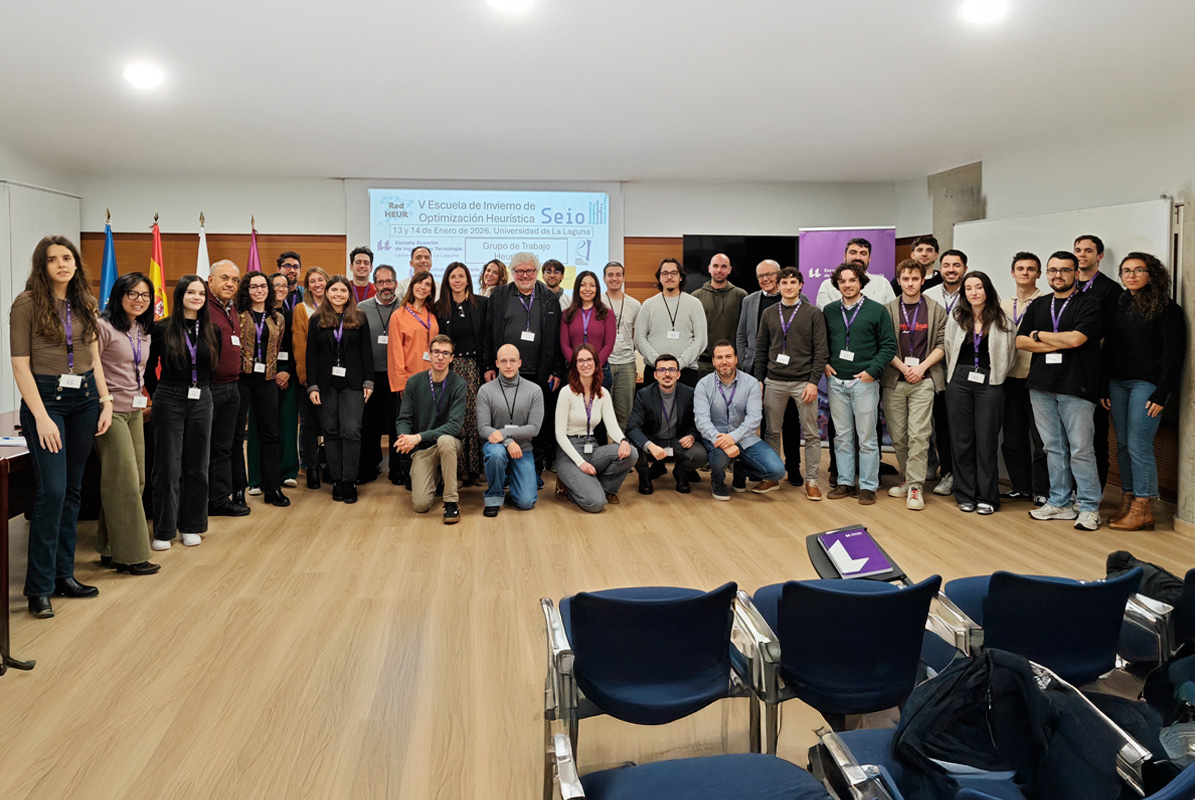
The University of La Laguna became the venue this week for the 5th edition of the Winter School on Heuristic Optimization, an initiative organized by the Heuristics working group within the Society of Statistics and Operations Research (SEIO), in collaboration with the Heuristics Network HEUR, both national in scope. These two institutions have developed the Winter School for doctoral and master's students, as well as young PhDs, with the aim that, in addition to presenting their work and research, they can establish future contacts, collaborations and professional relationships within the field of heuristics.
The opening ceremony featured a speech by the Vice-Rector for Digital Transformation at the University of La Laguna, Vicente Blanco Pérez, who emphasized the importance of this initiative as a space for learning and the collective construction of knowledge. He noted that the School of Heuristic Optimization is not only a training event, but also “a space for community, discussion, and knowledge building,” especially relevant in a context where these disciplines are at the heart of numerous scientific, technological, and social challenges.
The Winter School was founded in 2018 at the University of Valencia by Rafa Martí, with the aim of creating a space for the exchange of ideas and scientific debate. Subsequent editions took place at the Rey Juan Carlos University, the University of Burgos, and the Pablo de Olavide University in Seville. The University of La Laguna took over thanks to the initiative of Marcos Moreno and Belén Melián, to the active collaboration of the University Institute for Regional Development (IUDR) and the Higher School of Engineering and Technology, as well as to the work of the organizers of the Winter School at the national level, Anna Martínez-Guevara and Eduardo García Pardo.
This edition featured approximately 30 students who presented their doctoral theses and were supported by a panel of experts in heuristic optimization. These specialists provided them with expert feedback and guided them throughout the program sessions.
In addition, extensive coverage was provided, combining workshops with presentations of recent national contributions from master's and doctoral students. This year also featured two keynote lectures led by two prominent figures in the field. The first was Professor Mauricio Resende, an internationally renowned researcher who has worked at AT&T and Amazon and is known for developing the GRASP and BRKGA metaheuristics. The second guest speaker was Eva Vallada, Professor of Statistics and Operations Research at the Polytechnic University of Valencia.
According to Eduardo García, The organizer of the conference on behalf of Rey Juan Carlos University and a member of the SEIO Heuristics working group explained that heuristics is a trending artificial intelligence technique. “But AI is a broad concept encompassing many fields, and not all of them involve giant language models like ChatGPT.” Heuristics is one of the techniques that form part of AI, and one that doctoral students use in their dissertations. During these presentations, researchers will share opinions and suggestions with a panel of experts.
García also reminded the students that the main objective of this meeting goes beyond simply presenting work or providing academic feedback. She emphasized the importance of using the School as a space to meet researchers of the same generation, who are developing their doctoral theses at different universities across the country, in order to establish contacts and lasting professional relationships.
“There are no useful models without quality data, no automation without traceability, and no robust decisions without transparency,” emphasized Vicente Blanco, who added that trust in intelligent systems can only be built on responsibility. He also highlighted the fundamental role of heuristic and metaheuristic optimization in decision-making in complex environments, stating that “optimizing is not just about solving problems faster or finding better solutions, but about learning to decide with imperfect information, limited resources, and under uncertainty, and still doing things that make sense.”.

 Spanish
 English
 French