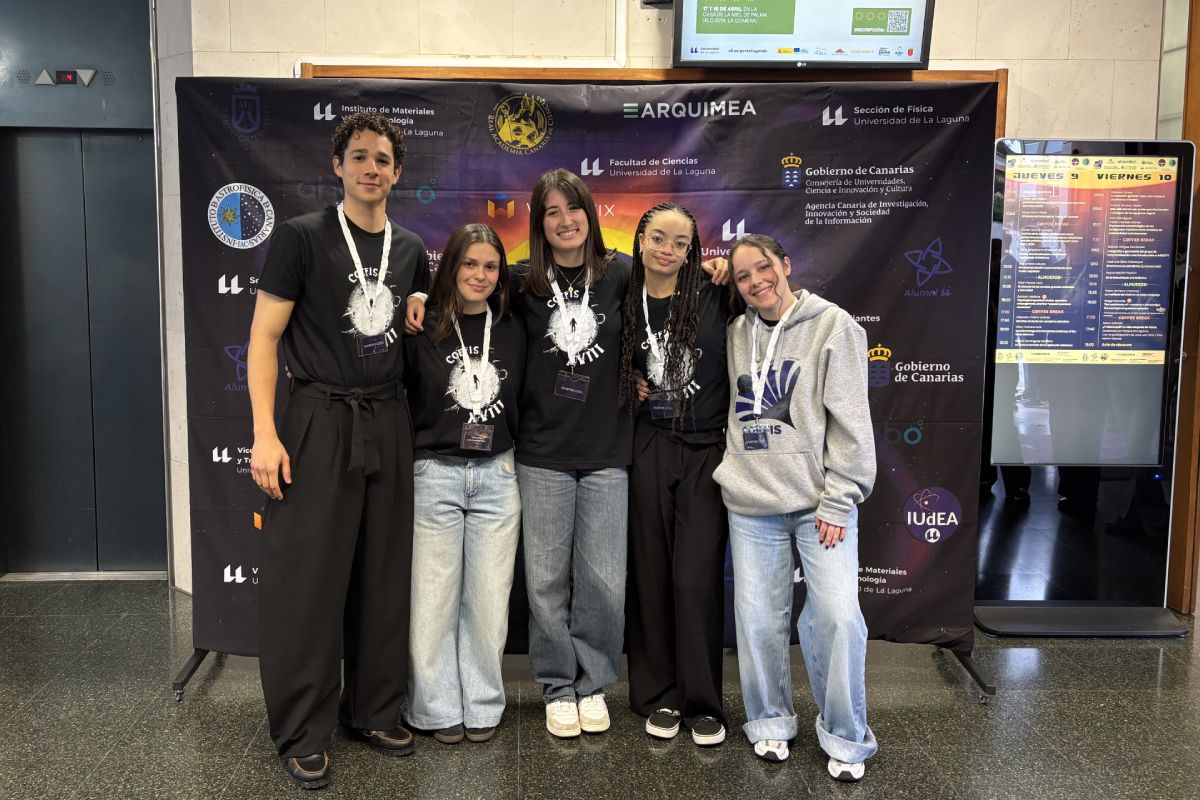
The 18th Physics Students' Congress (COEFIS) The event began today with the first of its two days, designed as a forum for leading national and international researchers to meet with undergraduate, master's, and doctoral students of Physics at the University of La Laguna. The Blas Cabrera Felipe Auditorium in the Faculty of Sciences is hosting this well-established event, which in its 2026 edition brings together more than 250 attendees per day and will feature the participation of two Nobel Laureates in Physics.
The program includes, on Thursday the 9th, a lecture by Duncan M. Haldane, professor at Princeton University and winner of the 2016 Nobel Prize in Physics for his theoretical discoveries on the topological phases of condensed matter. In his presentation, Haldane will address topological quantum states, quantum entanglement, and the horizon toward a second quantum revolution.
On Friday the 10th, Serge Haroche, professor at the Collège de France and the École Normale Supérieure in Paris, and recipient of the 2012 Nobel Prize in Physics for his pioneering experimental methods in the field of quantum optics, will speak. His presentation will focus on the importance of basic research, even in areas seemingly far removed from immediate applications, using quantum physics as an example.
Consolidated appointment
The COEFIS has established itself as the most impactful annual scientific conference among students at the University of La Laguna and as one of the most important student-organized events in Spain. In this context, it is worth noting that various national and international rankings place the university's Physics degree program among the best in the country, particularly highlighting the quality of the research and publications produced within it.
This congress covers a wide range of topics, including astrophysics and quantum physics. It also includes informative talks, such as those by José Luis Oltra, a theoretical physicist known on social media as “Cuarentaydos”; Ana Ulla, an astronomer and astrophysicist, who will speak about astrobiology; and Itahiza Domínguez, a seismologist at the National Geographic Institute, who leads research on volcanic activity at Mount Teide.
“This type of initiative motivates undergraduate physics students, since many students in lower years aren't sure which branch they want to study, and it sparks their interest in the discipline they're passionate about,” says Mónica Marín, a member of the organizing committee. In parallel, this congress includes a “mini-COEFIS” aimed at high school students. More than 100 students will participate by conducting experiments and attending short talks given by specialists in meteorology, volcanology, and medical physics.
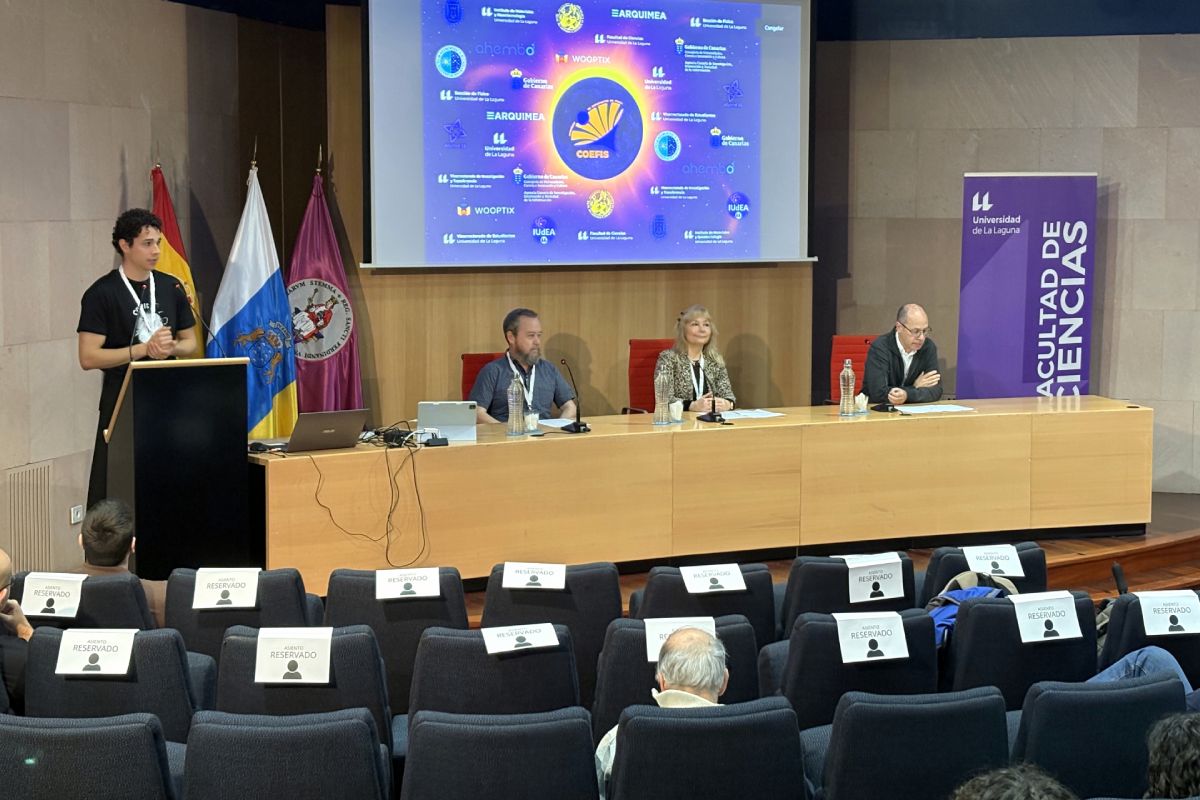
From left to right, Diego Herrera, Pablo Rodríguez, Silvana Radescu and Daniel Alonso.
Opening
During the opening ceremony, the Vice Dean of the Physics Section of the Faculty of Sciences at the ULL, Silvana Radescu Cioranescu, He highlighted the consistently high quality of the presentations and posters, which solidify its position as a key event on the institutional calendar. He also emphasized the value of having top-level invited speakers and the renewed enthusiasm of the student body, reflected in the increase in active participants, high attendance, and, particularly noteworthy in this edition, the excellence of the presentations by national and international scientists.
The coordinator of the organizing committee, Diego Herrera Sánchez, emphasized the importance of this event, held uninterrupted since 2008, as a vital forum for students to share their research and interests. He also highlighted its role in showcasing new talent in various branches of physics, capable of inspiring future researchers, and underscored the importance of such initiatives in strengthening the sense of community among younger researchers.
For his part, Daniel Alonso Ramírez, president of the Royal Canarian Academy of Sciences, emphasized the importance of the congress as a meeting point for the Canarian scientific community. He highlighted, in particular, the opportunity it provides for students and researchers to exchange ideas and debate with renowned specialists, noting that these dialogues are what give a unique value to the experience of the congress participants.
Finally, Pablo Rodríguez Gil, Teaching Coordinator at the Canary Islands Institute of Astrophysics (IAC), reminded attendees that Physics not only allows for a deeper understanding of nature and the universe, but also highlights that understanding reality is a shared endeavor. In this regard, he emphasized the importance of these meetings not only for fostering interest in the field, but also for promoting new conversations and sharing perspectives that contribute to building the science of tomorrow.
The organizing committee points out that one of the main challenges for these types of student-led initiatives is securing funding. In this regard, the 18th Physics Students' Congress has the institutional support of the University of La Laguna, the IAC (Canary Islands Institute of Astrophysics), and the Royal Canarian Academy of Sciences, as well as various companies, such as Wooptix o Archimea, which contribute to the success of the congress.

 Spanish
 English
 French