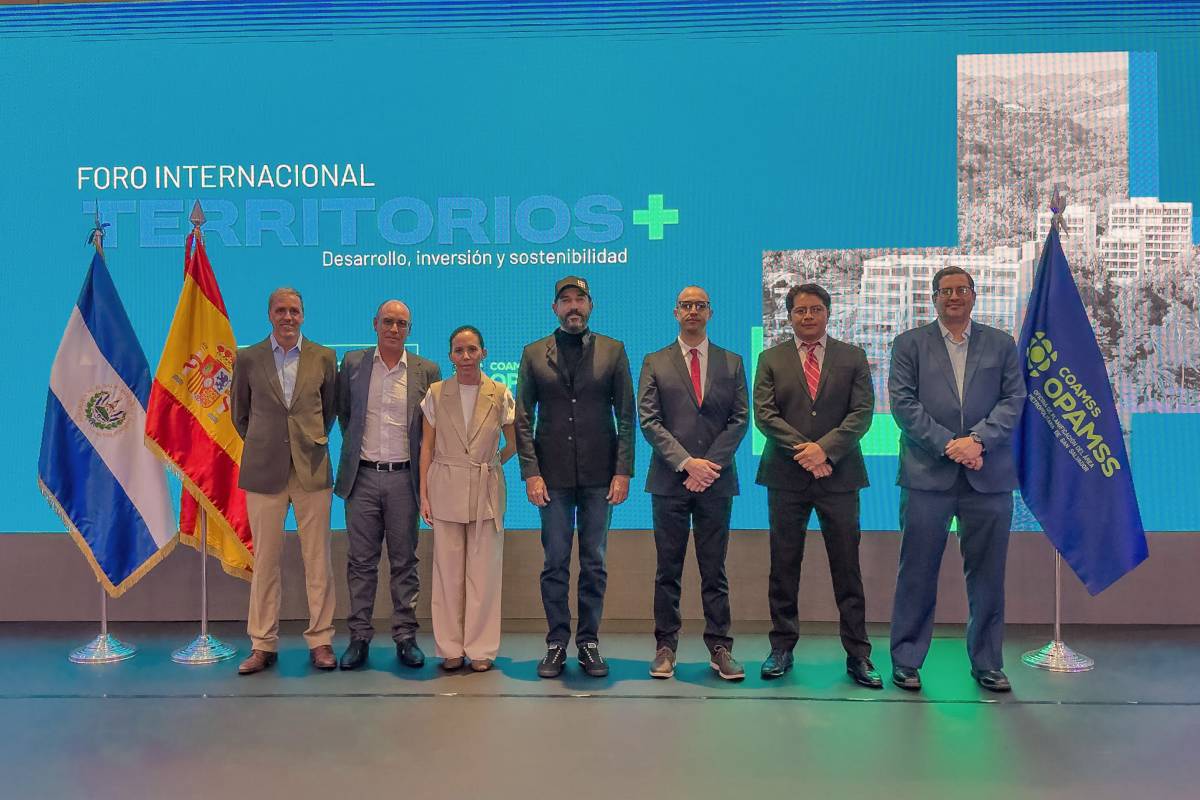
Three professors from the University of La Laguna recently participated in the International Forum Territories+ Development, Investment and Sustainability, Held in the San Salvador Metropolitan Area, the meeting brought together specialists from Spain, Mexico, and El Salvador to exchange knowledge and experiences on territorial planning, coastal development, environmental sustainability, and academic innovation.
The delegation from the University of La Laguna consisted of Angel Lobo Rodrigo, Professor of Administrative Law in the Department of Basic Legal Disciplines; Yurena González González, Professor in the Department of Sociology and Anthropology; and Adrián García Perdigón, professor in the same department.
The opening ceremony was attended by the Spanish Ambassador to El Salvador, Sonia Álvarez, along with representatives from Salvadoran government, academia, and business organizations. The forum was held as part of a project to promote climate change adaptation in the San Salvador Metropolitan Area, funded by the Spanish Agency for International Development Cooperation (AECID) and implemented jointly with the Council of Mayors and the San Salvador Metropolitan Area Planning Office (COAMSS OPAMSS).
The conference addressed the profound economic, social, and environmental changes experienced by El Salvador's coastal territories, particularly following the incorporation of new coastal areas into the San Salvador metropolitan area. The program combined lectures, academic panels, technical meetings, workshops, and field expeditions, with a focus on coastal management, sustainable investment, environmental protection, and cooperation between universities and public administrations.
Ángel Lobo participated in the international panel dedicated to tourism, heritage, and new opportunities for local development. He also delivered a presentation entitled “Territorial and Sectoral Planning of Coastal Tourism,” in which he examined the legal and administrative instruments applicable to coastal tourism development and the need to reconcile investments with territorial planning, environmental protection, and the sustainable management of the public maritime-terrestrial domain.
Yurena González participated in the academic forum and presented the paper “Experiences in socio-community planning with older adults.” She also took part in the panel discussion on integrating care into public management, where the demographic transition, social co-responsibility, and the challenges of incorporating care policies into territorial planning were analyzed.
For his part, Adrián García addressed the possibilities for cooperation between multicultural networks in Africa, Europe, and the Americas. His participation also included a presentation on the socio-ecological management of coastal surf zones, from a social anthropology perspective, and his contribution to the dialogue on care, community networks, and public policy.
The University of La Laguna's presence was further enhanced by the participation of its faculty in technical meetings and field visits to the historic center of San Salvador, the Port of La Libertad, Punta Roca, El Tunco, El Zonte, and various mangrove and coastal wetland areas. These expeditions allowed for on-site analysis of issues related to erosion, wave action, coastal protection works, coastal land use, ecosystem conservation, and investment planning.
The meeting also included specialists from the National Autonomous University of Mexico and representatives from Salvadoran universities, ministries, local governments, business entities, and technical organizations. Topics discussed included coastal engineering, nature-based solutions, marine renewable energy, territorial intelligence, biodiversity, urban resilience, and applied research.
The final day was dedicated to identifying priority areas for academic and technical cooperation between OPAMSS, the University of La Laguna, UNAM, and the Salvadoran universities grouped in AUPRIDES and CIESCE. Participants explored potential joint lines of research, training, technical assistance, publications, academic exchanges, and pilot projects focused on sustainable territorial development.
The participation of the faculty from the University of La Laguna reinforced the international dimension of their research and made it possible to transfer to El Salvador the academic experience of the Canary Islands in areas such as the planning of island and coastal territories, the regulation of tourism, environmental management and the analysis of social processes linked to territorial development.

 Spanish
 English
 French