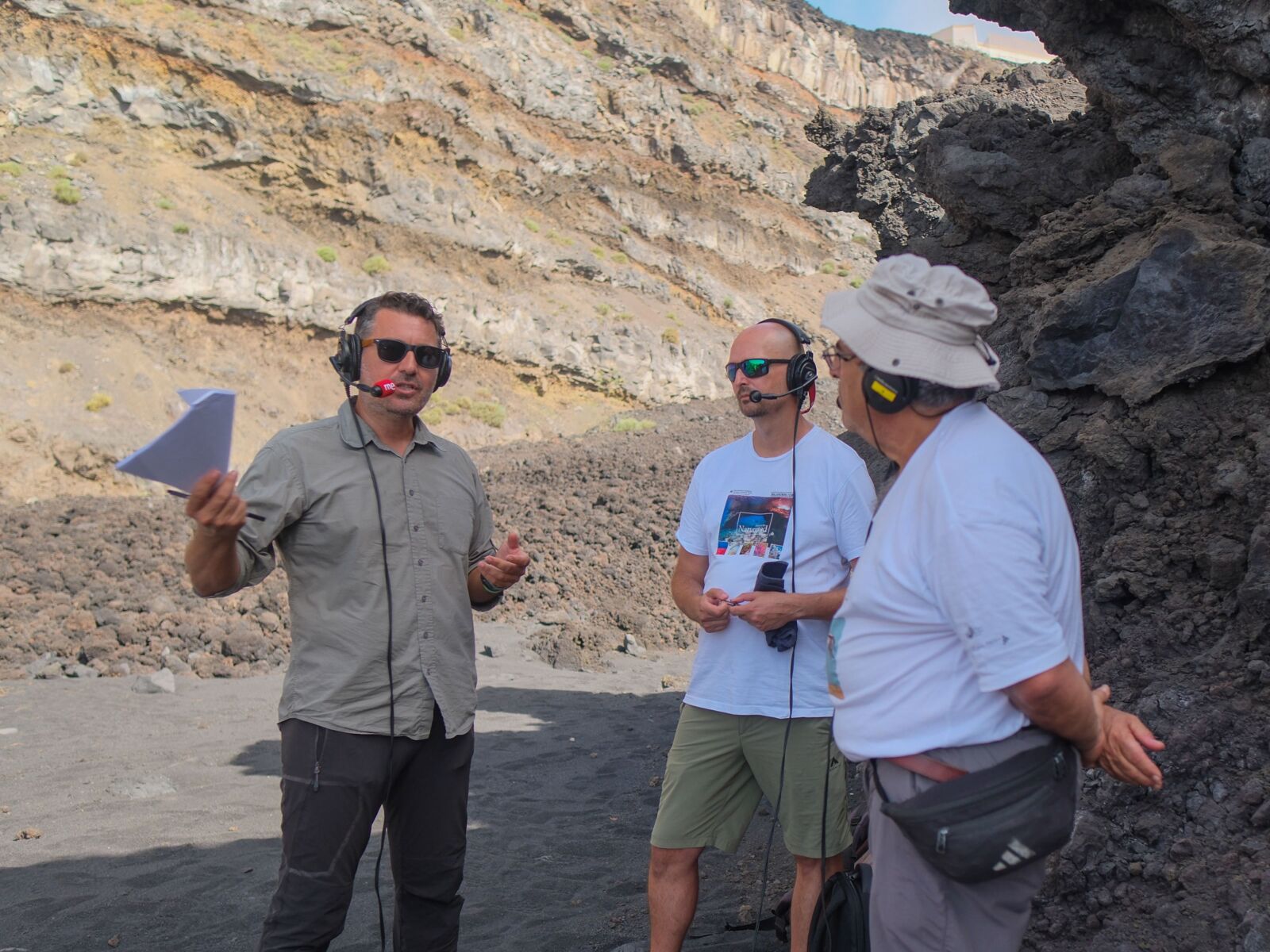
The program "Doble Hélice 3.0," broadcast by Radio Nacional de España in the Canary Islands and produced by the University of La Laguna, aired for the first time a segment filmed on location at the lava delta of La Palma's most recent eruption. La Palma is the youngest island in Europe. This historic production, broadcast last Saturday, commemorated both the fifth anniversary of the volcanic eruption and the 600th episode of the educational program.
The recording was carried out under a strict safety protocol coordinated by a team of firefighters, who ensured the constant maintenance of adequate carbon dioxide levels to guarantee the viability of the program on the ground.
During the special broadcast, the program explored the scientific aspects of the area with experts who shared both their knowledge and personal experiences during the eruption. Ramón Casillas, Professor of Geology at the University of La Laguna, recounted the anticipation and tension with which the scientific community watched the lava flows tumble down the cliff and plunge into the ocean. He analyzed the formation, settling, and complex geological structure of the new, low-lying island on-site. He also explained the dynamic processes currently affecting the land, noting how the force of marine erosion has already pushed back the coastline by more than 100 meters from the original outline left by the lava flow.
On the other hand, Carlos Sangil, a professor in the Botany Department at the University of La Laguna (ULL), recalled the devastating initial scene of the coastline and submerged seabed, characterized by a desolate landscape and a complete absence of life immediately after the volcanic event. From this perspective, the botanist detailed the surprising process of resilience and marine biological colonization that is occurring in the underwater ecosystem, where marine species are beginning to gain ground and regenerate biodiversity on the newly volcanic seabed.
With this radio milestone, Doble Hélice 3.0 celebrates its 600th program after thirteen uninterrupted years on the airwaves of Radio Nacional de España. Under the direction of journalist Juanjo Martín, this science outreach program is the result of a collaboration agreement between the University of La Laguna and RTVE.
Launched in February 2013 with the aim of disseminating the research developed at the academic institution, the program has established itself as a showcase of Canarian science, projecting its work both in the regional society and internationally through its broadcast on Radio Exterior de España.
The program is now available on podcast platforms such as Ivoox, Apple Podcasts, RTVE Audios and Spotify

 Spanish
 English
 French