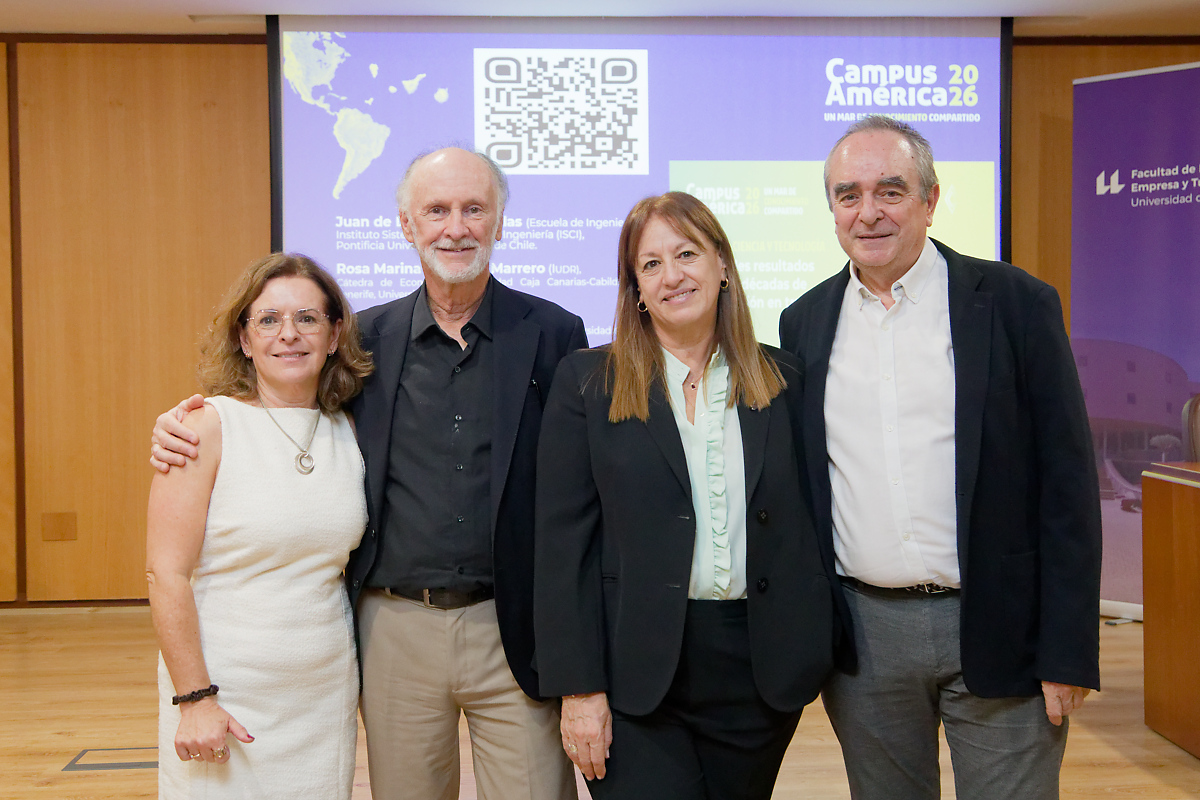
The Professor of Fundamentals of Economic Analysis at the University of La Laguna Rosa Marina González Marrero For three decades, he has focused his research on the economics of transport and the problems arising from mobility. This work has led him to create a collaborative network with researchers from the University of Las Palmas de Gran Canaria and the Pontifical Catholic University of Chile, resulting in several doctoral theses, numerous scientific articles, and various research projects. This trajectory was summarized today, October 27, in one of the Campus América seminars.
In addition to González Marrero herself, those participating in this presentation of results included ULPGC researcher Concepción Román García (accompanied by her colleague from the same center, Juan Carlos Martín Hernández, who did not speak) and, from the Chilean side, Juan de Dios Ortúzar Salas, an engineer who is one of the leading experts in the study of mobility, especially in issues of demand and safety, and author of one of the internationally recognized reference manuals on this subject., Models of Transport. It was also highlighted that he is the key figure in the collaboration between the two public universities in the Canary Islands in this field of study.
González Marrero explained that his interest in mobility research, as well as his relationship with the Chilean university and Professor Ortúzar Sala, began in 1994 with his doctoral thesis, which focused on transportation demand between Tenerife and Gran Canaria. At the time, this included options such as airplanes and the now-defunct jetfoil. Among his conclusions, he determined the existence of a certain elasticity in the relationship between price and time, such that travelers who valued time more preferred modes of transport like airplanes because they were faster, despite their higher cost. The thesis also proposed a theoretical model of inter-island travel demand, which was validated with real mobility data, thus confirming its ability to predict demand.
That doctoral thesis was the starting point for a collaborative work trajectory that González Marrero divided into three main lines of research: student mobility at the University of La Laguna; sustainable tourism mobility in protected areas; and road transport and fuel demand. Due to time constraints, the three participating speakers only presented results from the first two lines.
In the first of these, a pioneering work was the thesis of Professor Francisco Javier Amador, co-directed by Rosa Marina González and Juan de Dios Ortúzar, which already analyzed the mobility patterns of the students and investigated their preferences for choosing means of transport, analyzing whether socioeconomic or other factors participated in their decision to take one or the other.
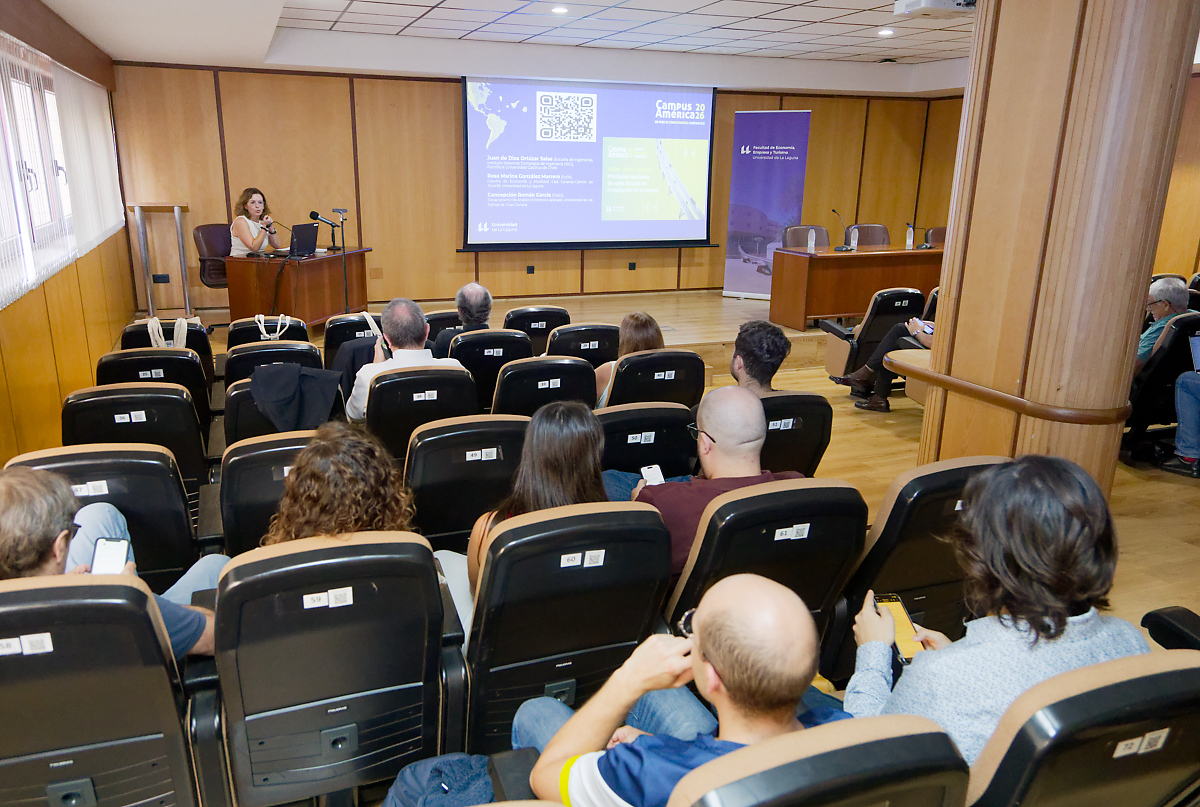 From there came three research contracts with the Tenerife Island Council that allowed for public transport usage surveys to be carried out among students in 2007 (before the tram was put into operation), in 2009 (with the tram already running) and in 2016 (to simulate the acceptance of a hypothetical High Occupancy Vehicle (HOV) lane between Santa Cruz and La Laguna). It was especially relevant to have the data from the first two surveys, since they were carried out at the right times to compare the declared travel preferences (in the first survey) and those revealed (in the second).
During the session, results from several research articles developed by the speaker's collaborators in this field of study were explained. One of these articles, for example, revealed the curious fact that users of public transport such as trams had a mistaken perception of travel time. Specifically, 861% of passengers made errors in estimating the duration of their journey, and 791% overestimated the delay, believing the trip to have been longer. Factors influencing this include having walked to the stop, which introduces a degree of fatigue even before the journey begins. Therefore, the article proposed information campaigns about the actual duration of journeys and an optimization of stop locations.
In the second area of focus, sustainable mobility related to tourism, the seminar director detailed a draft Sustainable Mobility Plan for Teide National Park, a place overwhelmed by its own success, as it is the most visited national park in Spain and among the ten most visited in the world. This plan proposed measures such as regulating access to the park, creating a park-and-ride facility at the entrance, promoting an internal bus system for getting around the park, implementing tiered pricing during peak hours, and establishing specific regulations for tourist buses.
For his part, Juan de Dios Ortúzar discussed a 2010 study that assessed the potential for accident prevention, improving upon the existing system for calculating this variable. It was based on a survey of 523 people, a rather complex survey of both frequent and infrequent drivers, who had to choose between their usual route or an alternative proposed by the survey team. This alternative route was similar but incorporated different travel characteristics that could either improve or worsen the overall route. Analyzing these and other variables, the study calculated the cost in euros of reducing risks: €4.49 million for serious injuries, €26.55 million for fatalities, and €9.35 million for pedestrian victims. Ortúzar noted that these were very high and unexpected values, different from those obtained when conducting the same study in other parts of the world.
Another study presented by Ortúzar focused on assessing travel time savings on the Madrid-Barcelona corridor. This study excluded private vehicles and concentrated specifically on air travel and high-speed rail. In this case, 1,274 people were surveyed, of whom 208 were excluded because they were considered "captive individuals"—that is, without the option of using another mode of transport and, therefore, unable to express preferences. The study yielded travel time values for the main modes of public transport operating on the corridor, considering the various components that make up the total travel time, as well as the willingness to pay for improvements in service frequency.
Finally, Concepción Román García presented a project funded by the CajaCanarias Foundation on sustainable mobility in tourist areas and, more specifically, the preference for using electric vehicles. In this case, she presented the concept of “Mobility as a Service” (Mobility as a ServiceThis concept would integrate various modes of transport into a single, user-friendly digital platform, a kind of fixed-price package that already includes several options and therefore wouldn't require travelers to pay multiple times for each journey or use different technological environments. The study proposed several such offers at varying prices, and the most popular option was the package that provided the greatest unlimited access to regular public transport, over options like shared electric vehicle platforms and personal micromobility vehicles such as electric scooters, e-scooters, and bicycles.

 Spanish
 English
 French