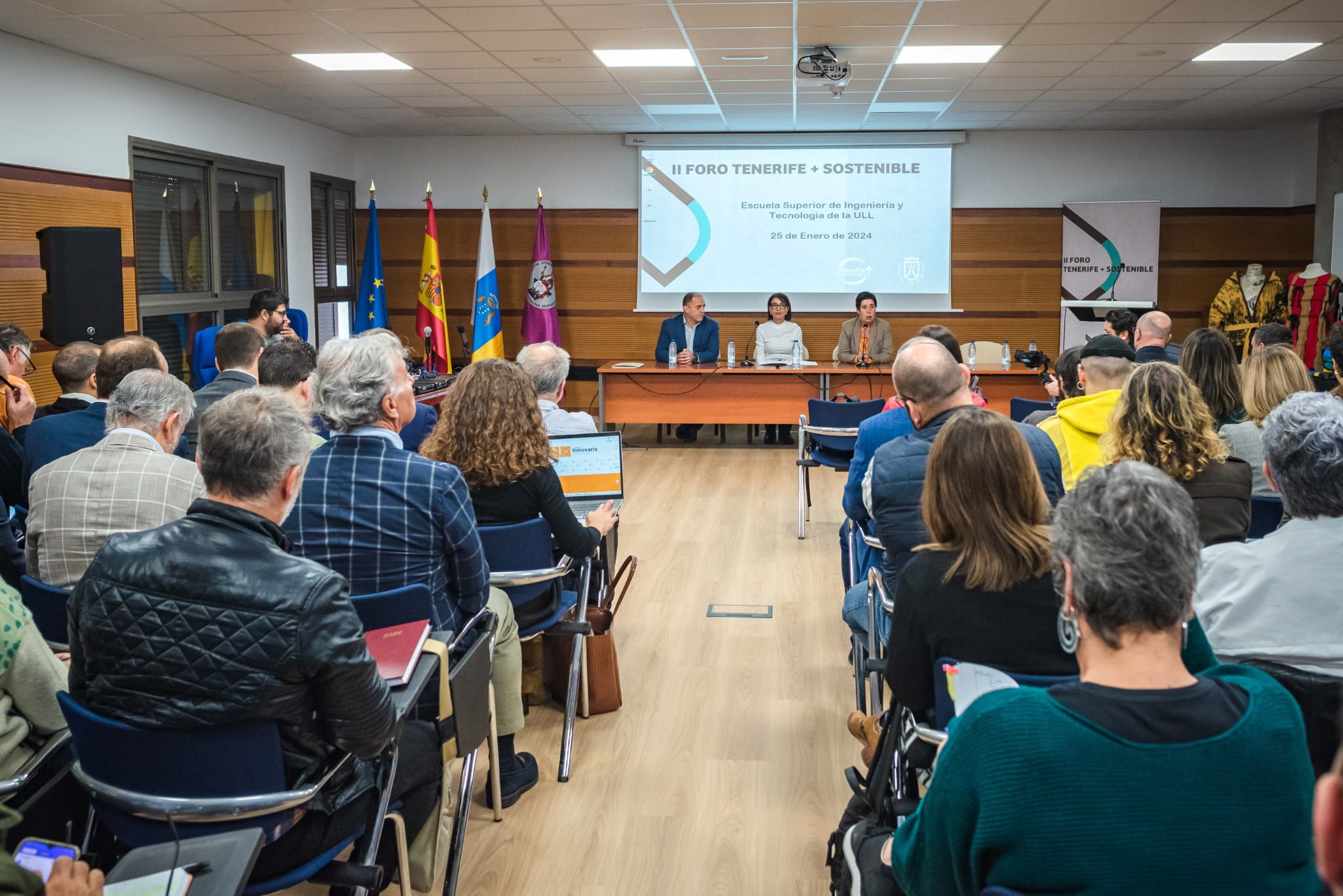
The Tenerife Island Council will allocate €5 million this year—€2.5 million this year plus the €2.5 million from last year that went unused—to research and development in sustainability. This was announced by the Councilor for Natural Environment, Sustainability, and Security and Emergencies, Blanca Pérez, during the 2nd Tenerife+Sustainable Forum, an event held last week at the Higher School of Engineering and Technology of the University of La Laguna. The forum analyzed the current state of waste management and reuse, and the urgent need to implement initiatives to increase source separation and strengthen selective collection of packaging waste on the island, among other topics.
This event was presided over by the Vice-Rector for Sustainability and Infrastructure, Candela Díaz, who praised the commitment of the university community. "It is precisely this commitment that drives us not only to lead initiatives that make a difference, but also to continue with those that have already made a difference. This is the case, for example, of the CAMPUSTAJE project, led by Fine Arts professor Carlos Jiménez and supported from the outset by the Tenerife Island Council." Díaz indicated her commitment to relaunching this project and expanding it "so that the professionals of the future, our graduates, are citizens committed to the environment." The Vice-Rector explained that "the sustainable management of the organic waste generated by the community is a model in which we can distinguish ourselves as a university, as a municipality, and as an island, and can serve as an example for other institutions.".
Therefore, the Vice-Rector's Office is committed to implementing, in the new service contract specifications, the requirement to separate the organic fraction and subsequently compost it, thus closing the life cycle of the materials and minimizing the environmental impact of this waste. "On this path towards sustainability, education and awareness are the most powerful tools available to a modern society; sustainable waste management is not just the responsibility of a Vice-Rector's Office, but a collective commitment that we must all embrace.".
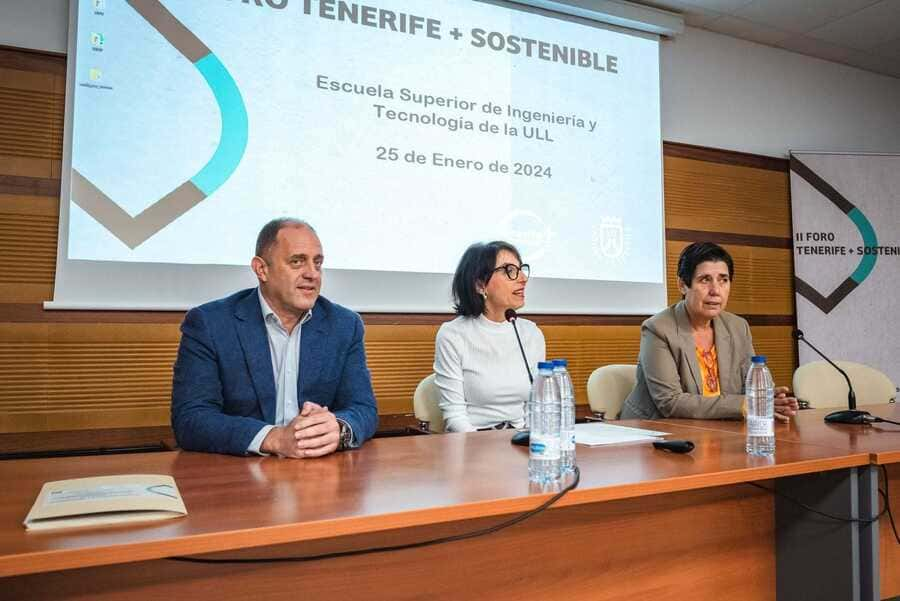 “This Forum arises from the need to discuss, analyze, and debate the issue of waste with all social stakeholders and within the university sphere, focusing on research and development of projects and ideas for the comprehensive management of waste from its origin, through its transformation, and the reuse of materials,” stated Blanca Pérez, who did not hesitate to warn that “the situation on the island is critical, as we have very low recovery rates, and it is necessary to raise public awareness about the importance of separating and recycling.» The data reflects an alarming decrease in waste collection and separation, «and we cannot allow that to continue,” she affirmed.
Blanca Pérez, accompanied by the island's Director of Waste Management, Alejandro Molowny, and the Vice-Rector for Sustainability and Infrastructure at the University of La Laguna, Candela Díaz, concluded her address by calling for "the commitment of all those involved." She added, "We will support the generation of ideas within the university to strengthen research and development policies that can be implemented to benefit us all. Working hand in hand with the University of La Laguna will be crucial in the coming years.".
For his part, Alejandro Molowny was clear in stating that the best waste is the waste that isn't produced, highlighting the telling statistic that in Tenerife, in 2023, 550,000 tons of waste entered the Tenerife Environmental Complex (CAT), and yet, "we don't have the critical mass to create an industry that can work with it." The island's Director of Sustainability detailed the overall situation of waste management, providing data on its evolution over the last few years and outlining a short-term work plan that includes other administrations, "because we must act decisively" for the control, management, transformation, and reuse of materials, among other issues. At this point, he gave another important statistic to understand the need to act "as soon as possible": between 100 and 110 waste collection trucks work on the island every day to transport the waste to the CAT.

 Spanish
 English
 French