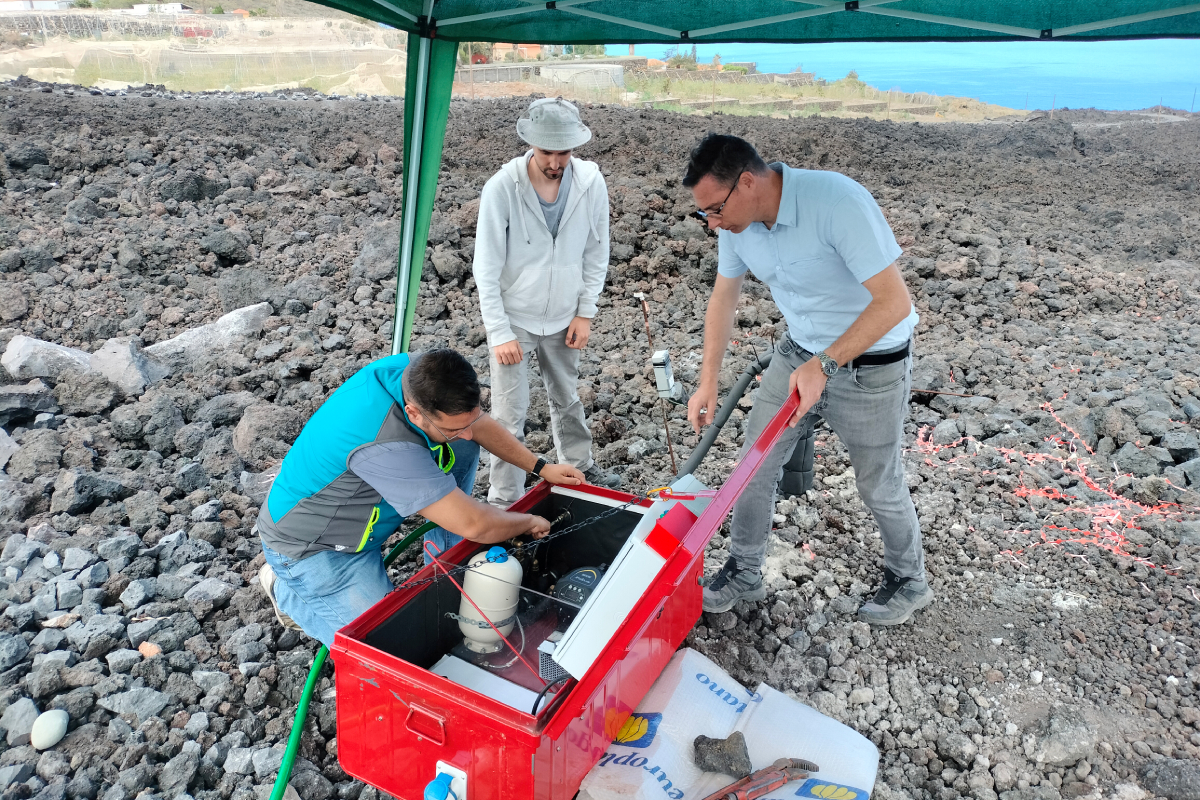
The Shallow Geothermal Energy for the Canary Islands (SAGE4CAN) research project aims to demonstrate the significant potential of shallow geothermal energy for decarbonizing the heating and cooling sector, especially in urban-volcanic environments like the Canary Islands. Its principal investigator is Alejandro García Gil, a senior scientist at the Geological and Mining Institute of Spain (IGME) of the Spanish National Research Council (CSIC), and the University of La Laguna is a partner institution. Today, Wednesday, May 22, a thermal response test (TRT) was successfully completed on one of the lava flows of the Tajogaite volcano on La Palma.
Shallow geothermal energy is a technology that harnesses the heat stored in the first few meters of the subsoil, typically up to about 100 meters deep, to heat and cool buildings and generate hot water. Unlike deep geothermal energy, shallow geothermal energy utilizes the relatively constant temperature of the ground near the surface.
Thermal resistance tests (TRTs) are used in shallow geothermal systems to assess the soil's capacity to transfer heat. This test is crucial for the proper design of the geothermal heating and cooling system, ensuring its optimal efficiency and performance.
The completion of these TRTs marks a significant milestone for the Canary Islands, as it is the first time this type of testing has been carried out in the archipelago. Conducted in the unique volcanic environment of the Tajogaite volcano, these tests will provide valuable information on the behavior of geothermal energy under extreme conditions, as explained by Juan Carlos Santamarta, a researcher at the University of La Laguna and member of the project. Furthermore, it represents a major step forward for the project after several years of development and studies on various islands, such as El Hierro and Lanzarote.
The project also aims to integrate the hydrogeological regime into the calculation of the theoretical and technical potential of shallow geothermal energy in the Canary Islands. It is an innovative project in its approach to the problem, as it considers, for the first time, the renewability of the resource and, therefore, its sustainability, explains García-Gil.
As an additional objective, the project seeks to promote the use of this form of urban climate control, which is quite uncommon in the archipelago, in line with the energy efficiency and renewable energy goals of Spain and the European Union. SAGE4CAN aligns with Spain's research and development priorities in low-carbon technologies and sustainable resource innovation.
Furthermore, it not only focuses on technical research but also addresses key aspects such as resource assessment, sustainable and efficient management of shallow geothermal energy, and the identification of potential conflicts and environmental risks associated with its use. Therefore, the project represents a novel exploration of renewable energy alternatives in an archipelago highly dependent on fossil fuel imports. In addition to its impact on reducing greenhouse gas emissions and improving energy security, SAGE4CAN also seeks to foster the technological and economic development of the region.
With the successful completion of these thermal response tests in La Palma, the project is moving forward with determination towards its goal of demonstrating the potential of shallow geothermal energy as a vital tool in the fight against climate change and the transition to a more sustainable energy future.

 Spanish
 English
 French