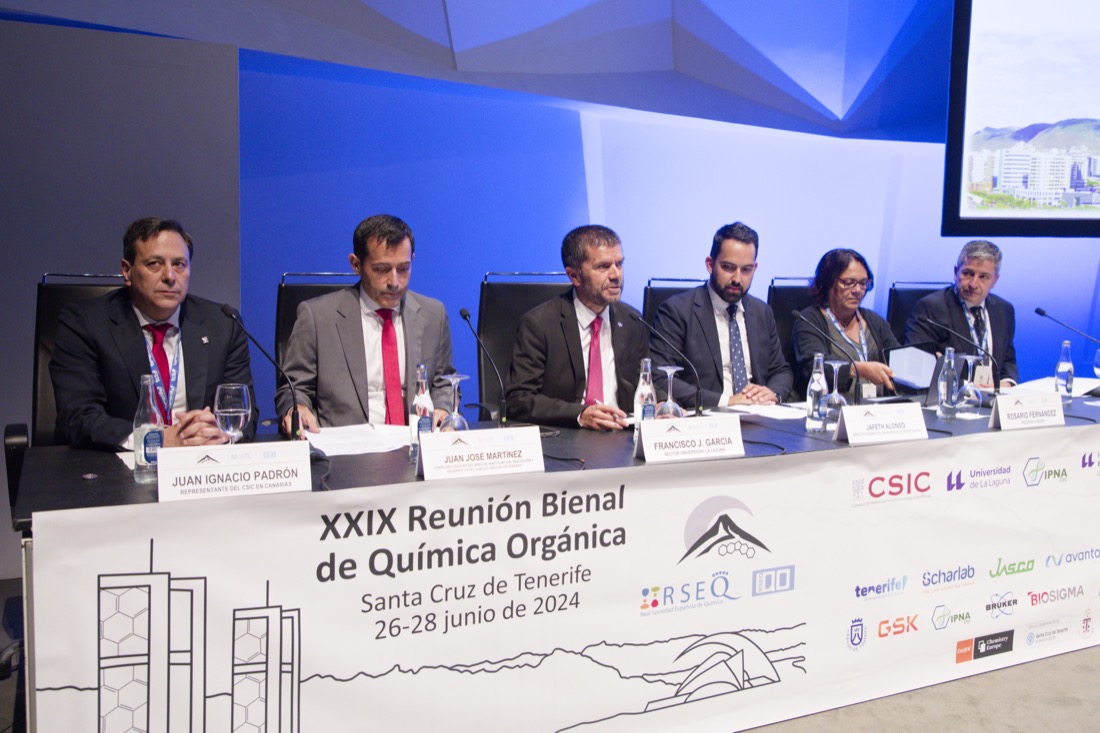
The Auditorio de Tenerife Adán Martín has been hosting since yesterday, June 26th, the Biennial Meeting of the Specialized Group on Organic Chemistry, A scientific event that will run until Friday the 28th, featuring the participation of leading experts in the field. This event, originally planned just as the pandemic hit, has now taken place with the same program and virtually the same scientific committee, and is sponsored by the Antonio González Institute of Bio-Organic Chemistry at the University of La Laguna, the Institute of Natural Products of the Spanish National Research Council (CSIC), and the Royal Spanish Society of Chemistry.
The collaboration between the first two institutions is by no means recent, as there are many projects and scientific personnel linked to both. Furthermore, the University Institute of La Laguna recently celebrated its sixtieth anniversary, a fact highlighted by the rector, Francisco García, at the opening ceremony of the biennial. He noted that it is a highly competitive center that began with the aim of exploiting the natural resources of the surrounding area and has now moved into conducting cutting-edge science with significant international impact.
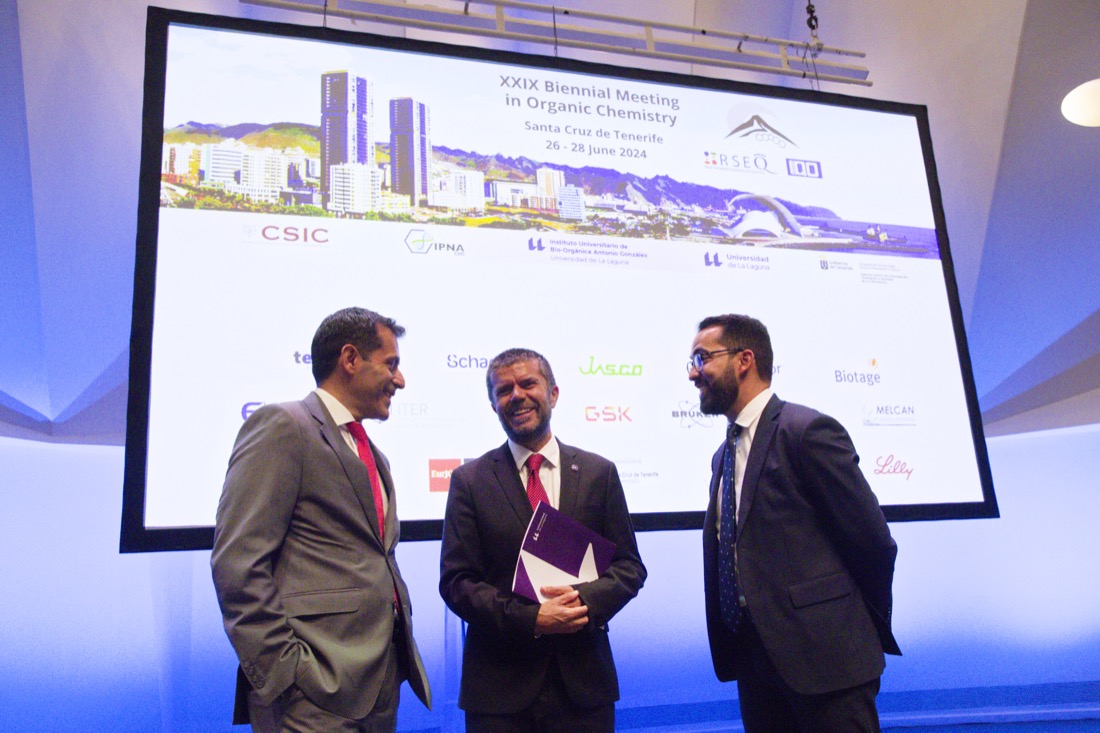
The rector speaks with the island councilor for Innovation (i) and with the general director of Universities (d).
Francisco García added that holding these scientific events is very common and that in just one week the University of La Laguna has hosted the world tourism congress, a national conference on university employment and others related to health economics, which demonstrates the strength of this academic center, which generates resources and transfers to society a good part of the knowledge it creates; not surprisingly, it occupies the top positions in the ranking that measures the contribution of higher education centers to regional development.
For her part, the president of the Specialized Group of Organic Chemistry of the Royal Spanish Society of Chemistry, Rosario Fernández, pointed out that this is the largest group, with more than a thousand specialists, many of whom are also members of other divisions, which in her opinion demonstrates the trend towards the transversality of science.
This event brings together around 300 researchers who participate in a program structured around five plenary lectures by world-renowned scientists, twelve invited lectures by recognized Spanish scientists, 42 oral presentations, 62 flash presentations, and 139 poster presentations. This biennial addresses the main challenges in organic chemistry today, such as
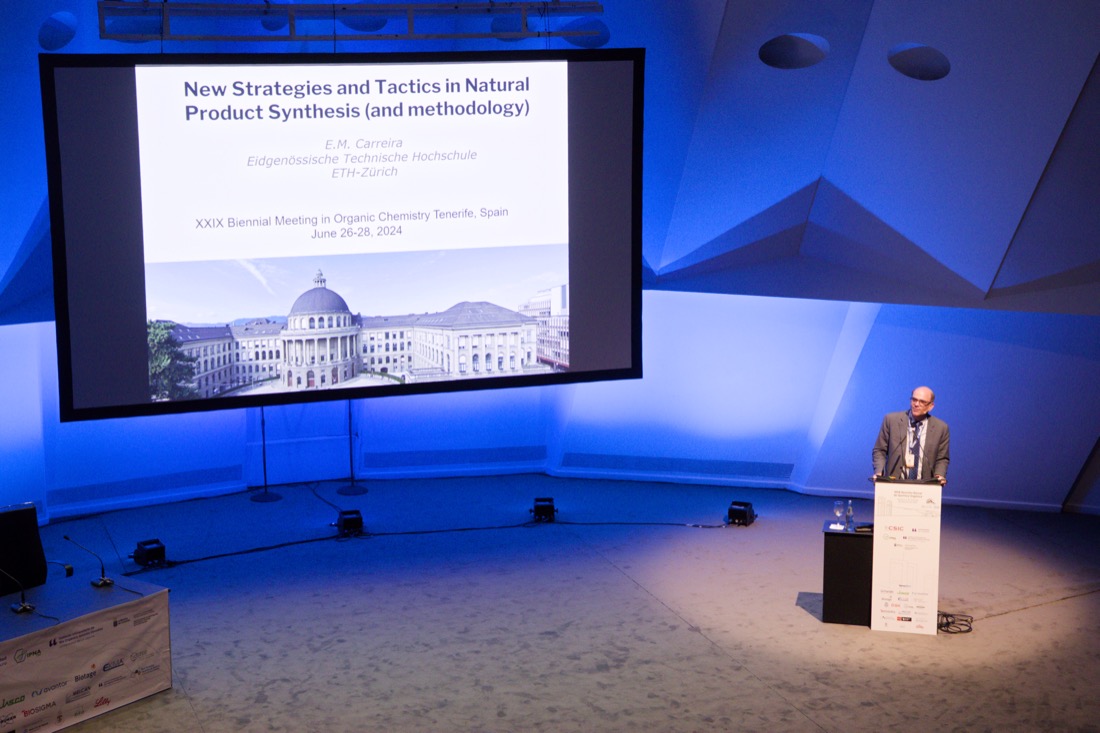
Image of the first plenary conference given by Carreira.
These include biocatalysis, supramolecular chemistry, organometallic chemistry, photocatalysis, and the chemistry of natural products.
The opening ceremony also included the participation of the Island Councillor for Innovation, Juan José Martínez, and the Director General of Universities, Jafeth Alonso, who expressed their strong support for events like these that connect scientific development with the capacity for knowledge transfer to the productive sector. Also present were Tomás Martín, from the organizing committee, and Juan Ignacio Padrón, representing the Spanish National Research Council (CSIC). Yesterday's session opened with the first plenary lecture, given by EM Carreira of TTH-Zurich.

 Spanish
 English
 French