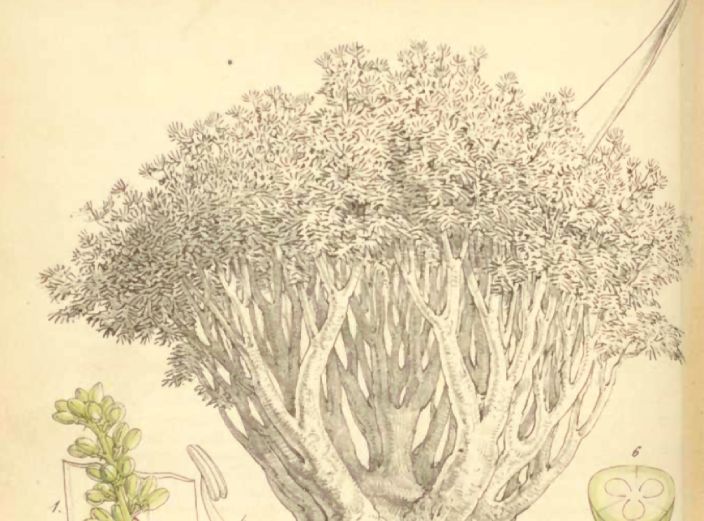
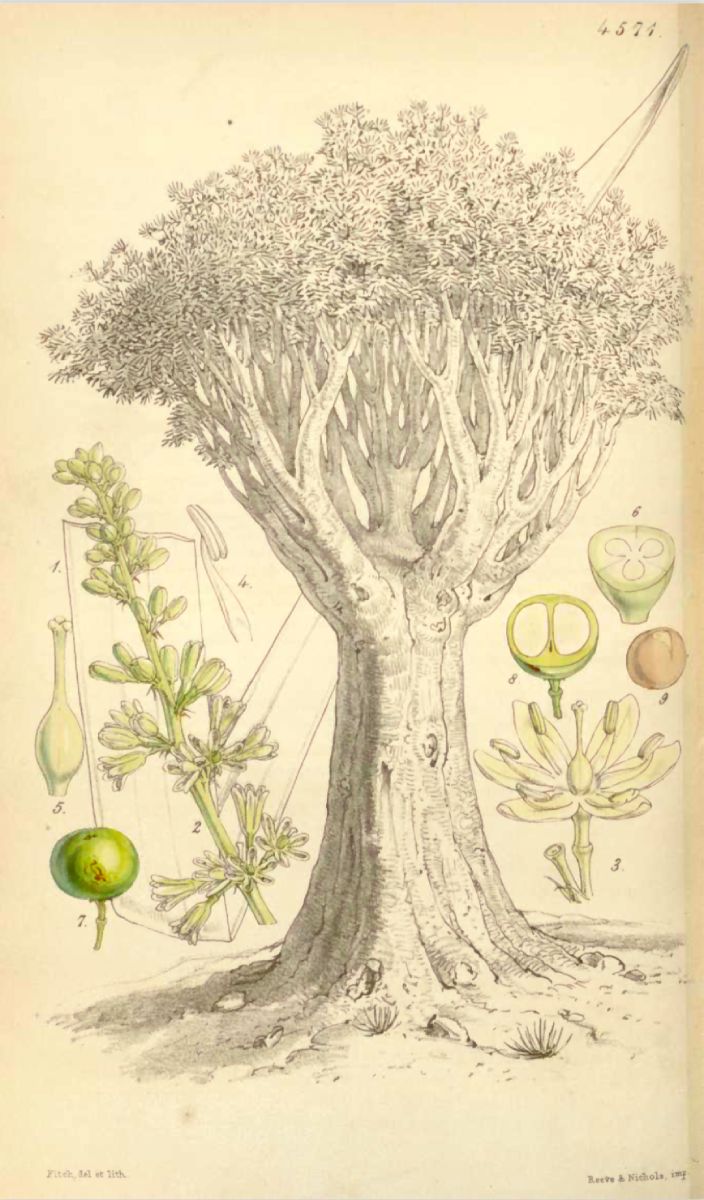
Illustration of a Dracaena Draco specimen.
The Azores, Madeira, the Savage Islands, the Canary Islands, and Cape Verde share a number of floristic elements that warrant recognizing Macaronesia as a biogeographical region independent of the Mediterranean, given its sufficient internal cohesion. This is the argument put forward. a scientific article recently published in the prestigious journal Biological Reviews, whose main author is the Professor of Ecology at the University of La Laguna José María Fernández-Palacios.
In the work, entitled “In defense of entity of Macaronesia as a biogeogaphical region”The project involves some twenty botanists and plant ecologists researching the flora of Macaronesia, from the universities of La Laguna, Las Palmas de Gran Canaria, Madeira, Azores, Lisbon, Granada, Marseille, Hawaii, and Oxford, as well as scientific institutions such as the CSIC (Spanish National Research Council), the Jardín Canario (Canary Garden), and the Museum of Natural Sciences of Tenerife. Among them are also professors Lea de Nascimento and Rüdiger Otto from the University of La Laguna, members of the research group in Island Ecology and Biogeography, led by the first author.
The work consists of a detailed introduction to the historical origin of the term Macronesia, as well as its use in Biogeography since it was first coined around 1850 by the British botanist and geologist Philip Barker Webb to designate the volcanic archipelagos of the northeastern Atlantic Ocean.
Contrary to some works that question the validity of Macaronesia as a biogeographical region, the authors defend the uniqueness of the Macaronesian biogeographical region within the Holarctic Kingdom, as proposed at that time by Webb and, more recently, by many authors, the Armenian biogeographer Armen Takhtajan in his work “Floristics Regions of the World” (1986).
Among these unique floristic elements, the Macaronesian laurel forest stands out, an impoverished relic of the Paleotropical Geoflora that existed on the edges of the Tethys Sea during the Paleogene and Neogene periods and disappeared from the continent after the onset of the Pleistocene glaciations. This element is shared by the three northern archipelagos.
Secondly, the African Rand Flora, an element currently restricted to the coasts of the Red Sea, Namibia or Maghreb and shared by Madeira, the Canary Islands and Cape Verde where it integrates the depleted thermophilic forests.
Finally, perhaps the most striking element is that of the Macaronesian neo-endemics of Mediterranean origin, present in all the archipelagos, for which the Macaronesian vascular flora is known worldwide, having about fifty genera and a thousand endemic species.

 Spanish
 English
 French