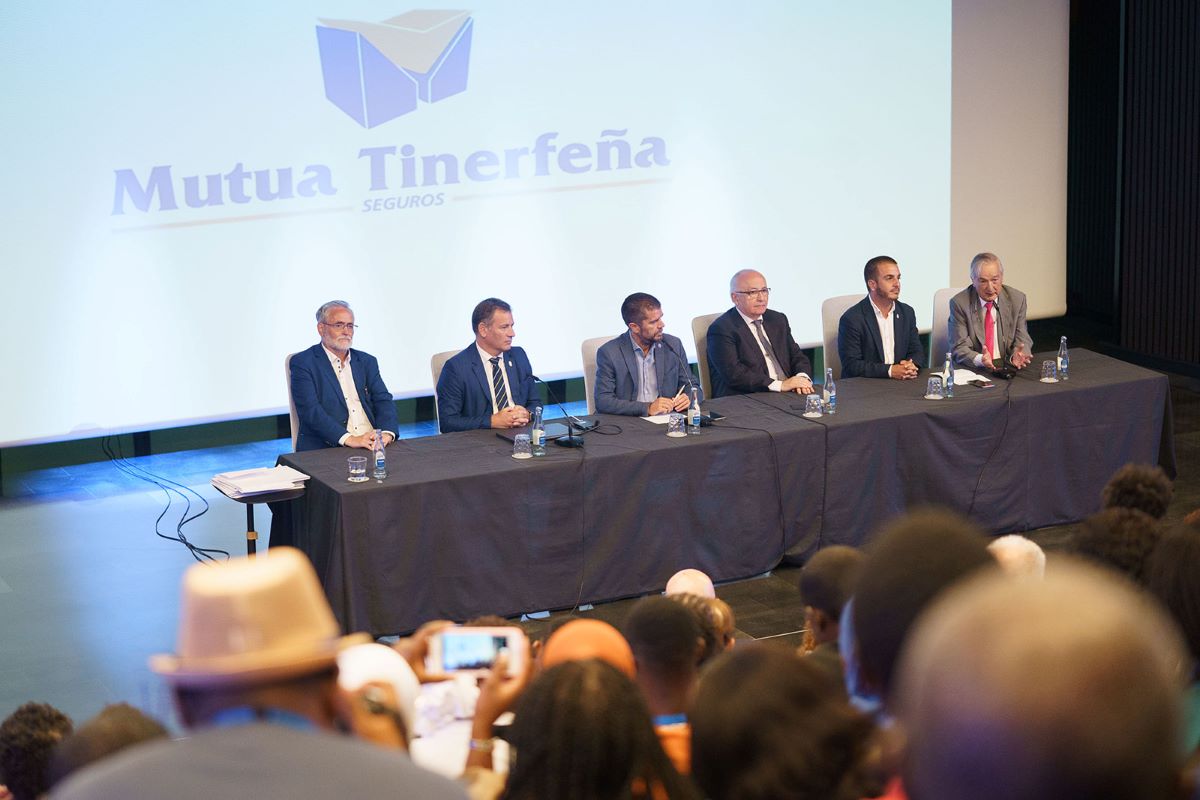
Campus Africa concluded its sixth edition after two weeks of intensive work focused on the environmental, cultural, and global health challenges facing the island territories of the African Atlantic. Based on the empowering power of science, this successful international university cooperation program hosted more than 100 African scholarship recipients this year from countries such as Gabon, Cameroon, Guinea-Conakry, Senegal, Cape Verde, and Morocco.
The closing session last Friday, July 26, was attended by the rector of the University of La Laguna, Francisco Javier García; the councilor for Education and Youth of the La Laguna City Council, Sergio Eiroa; the general director of Foreign Action of the Cabildo, Pedro González; the president of Mutua Tinerfeña, Juan Antonio López de Vergara; and the co-directors of Campus África, José Gómez Soliño and Basilio Valladares.
The Rector of the University of La Laguna, Francisco Javier García, closed the final session with a message of gratitude and hope, concepts he linked to the essence of Campus Africa. “We hope that this small contribution will serve as inspiration and motivation to generate change,” he concluded.
Earlier, Valladares used the closing ceremony to deliver a final message to the scholarship recipients before they departed for their home countries. He emphasized the “important inter-institutional and private collaboration” that had made this training program possible. “You have an obligation to contribute to the development of your countries. Seize the future, don't let it pass you by; we are part of a society we must serve,” he concluded. Gómez Soliño echoed this sentiment, adding, “May Campus Africa be an inspiring event that motivates you to consider how you can improve your communities.”.
For his part, the Councilor for Education and Youth of the San Cristóbal de La Laguna City Council thanked the organization for its “great effort and commitment” in carrying out this training project. “I hope they take away fond memories of this municipality and that they return soon to share experiences and knowledge with us,” he stated.
The Director General of Foreign Affairs for the Island Council, Pedro González, thanked the students for their participation in this program, which promotes education and knowledge as tools for development. “You chose to be here; you could have chosen any other path, but you are here because you want to improve yourselves, you want to learn so you can contribute to your countries. That is why I believe we must thank you for prioritizing learning,” he stated.
The president of Mutua Tinerfeña, Juan Antonio López de Vergara, expressed his gratitude that the closing ceremony was held at the headquarters, located in La Laguna, and reiterated the institution's commitment to training initiatives "with great social impact," such as Campus África.
During the ceremony, diplomas were awarded to the students who participated in the Campus program. The students thanked the organizers for the educational experience they had during the two weeks. "These days have provided us with memorable experiences and we have gained invaluable knowledge," said the student spokesperson.
The event served as the setting for the final lecture by Óscar Octavio Noya González, entitled 'Tropical Medicine in the Context of Global Health.' His presentation began with a reference to one of the most recent and serious cases of zoonotic disease: COVID-19. ‘This disease taught us that the contribution of science was fundamental with the development of vaccines in record time. Furthermore, it helped us realize that these types of diseases, originating in animals, will become increasingly common,’ he pointed out.
Along these lines, the expert pointed to malaria as one of the diseases “we fear most” given its contagiousness. “Malaria is a disease we will not be able to eradicate, even if we have a vaccine,” he noted. Noya González emphasized that climate change is one of the main factors influencing the spread of this disease and cited the case of the United States, where up to eight serious outbreaks have been detected recently.
Climate change, which in the case of Spain, is evident in the recent outbreaks of West Nile virus, a disease caused by the bite of the mosquito. culex pipens which acts as a vector. “This mosquito is native to tropical areas, but as temperatures rise, it begins to appear outside its endemic zone,” he explained.
Coinfection is one of the most common scenarios in tropical areas due to the high biodiversity, which leads to the presence of countless pathogens. This is compounded by the multitude of ethnic groups in these regions, necessitating a multidisciplinary approach to working with these communities on prevention. “It’s a type of medicine that goes beyond simply treating patients; we have to be a bit like entomologists, for example, because we have to directly search for the reservoirs or vectors,” the expert concluded.
Sponsorships and collaborations
Campus Africa is sponsored by the Government of the Canary Islands, the Tenerife Island Council, the San Cristóbal de La Laguna City Council, and a number of other collaborating entities that guarantee the success of the initiative.
In addition to the organizational capacity of FUNCCET (Canary Islands Foundation for the Control of Tropical Diseases), Campus Africa also collaborates with the University Institute of Tropical Diseases and Public Health of the Canary Islands; CIBER Infec; the Royal Economic Society of Friends of the Country of Tenerife; the Parliament of the Canary Islands; Casa África; and the Canary Islands Association for the Progress of Macaronesia. Support is also provided by the CajaCanarias Foundation; Cinfa; the "la Caixa" Foundation; the Loro Parque Foundation; Binter; Loro Parque; Cofarte; Melcan; the Official College of Pharmacists; Urbasser; Nivaria; FCC Medioambiente; and adDiagNost.

 Spanish
 English
 French