
He Social Council The University of La Laguna held a plenary session today, September 30th, to address the current status of negotiations between public higher education institutions and the regional government for a multi-year funding mechanism. The government submitted an initial working document during the summer, which was reviewed by the university rectors in August. While they acknowledged the proposal, they disagreed with its content due to insufficient funding to guarantee basic financing.
The social councils have contributed to this process of reaching an agreement, rather than establishing a third perspective, stated councilor Víctor Díaz. Following the latest meeting, held yesterday, progress was made, and in his opinion, the feeling that an agreement is imminent is plausible.
The document, as explained previously, defines a base funding structure, with a central portion dedicated to personnel and operating expenses, and another portion based on objectives. While there is agreement on this, there is disagreement regarding the quantification of the first portion, the councilor indicated. It is requested that aspects arising from external contingencies, such as salary increases for civil servants, be automatically transferred to the universities. The Government appears to be accepting these issues, Díaz stated, thus resolving this matter.
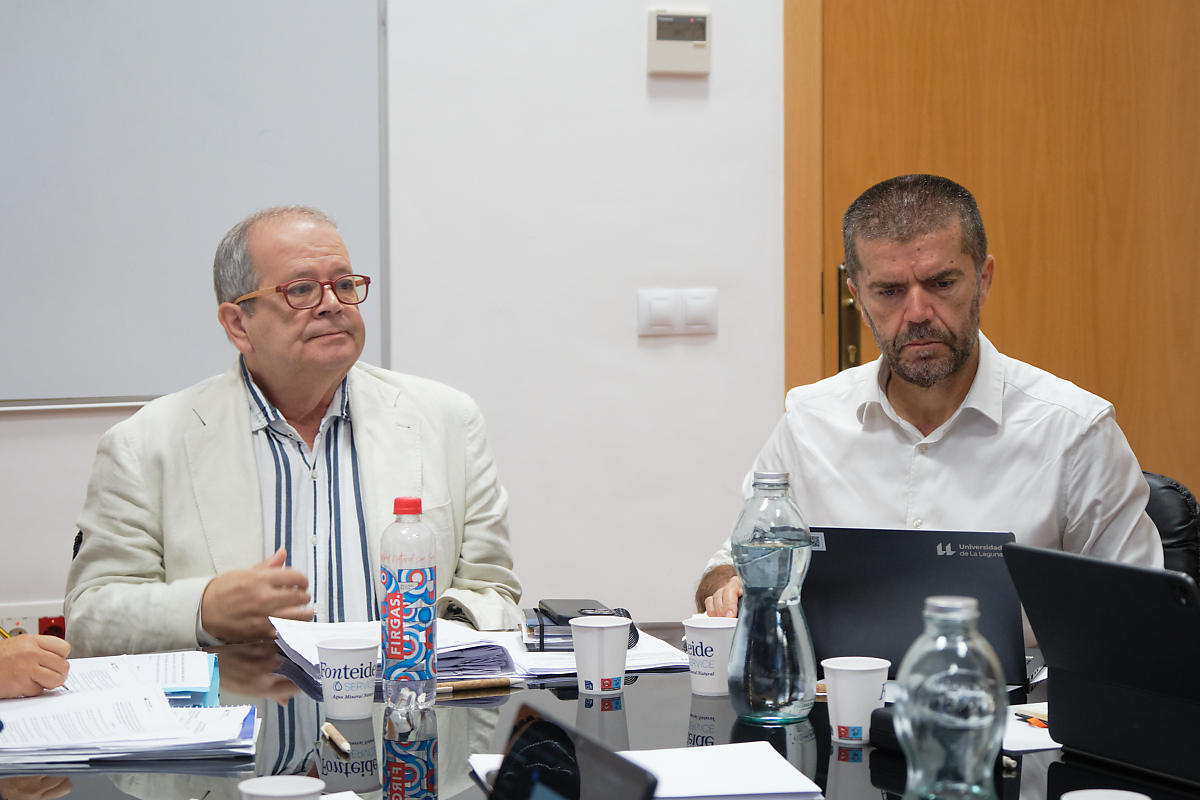
The president of the Social Council, Francisco Almeida, and the rector of the ULL, Francisco García, during a moment of the meeting.
A leveling fund has been added to the discussion document to address the financial shortfall of recent years, which has diminished universities' management capacity. This establishes a mechanism to gradually address this issue, and a larger contribution is expected next year compared to subsequent years, the councilor explained.
However, a disagreement remains regarding funding, although there is potential for convergence, he noted, and a reasonable prospect of reaching a consensus. Differences still need to be resolved concerning unique and technological infrastructure, for example. The government, in turn, is proposing performance indicators for universities. In Víctor Díaz's opinion, shared responsibility is appropriate, but these criteria, which must be finalized before October 15th, need further definition.
For his part, the rector of the University of La Laguna, Francisco García, added that basic funding should evolve according to the obligations that arise, which seems reasonable, and the key is to agree on the initial amounts.
Regarding the equalization fund, he expressed understanding that it would not be implemented solely in the coming year, but rather gradually over subsequent years. “We continue working on this and we thank the Social Council for its efforts in this matter,” the rector added. In fact, he recalled the Prime Minister's explicit commitment to the two universities to reach a final and appropriate text in the near future.
For her part, the institution's manager, Lidia Pereira, added that a technical meeting will be held soon to establish the basic structural funding, as well as the calculations for the equalization fund. Finally, the president of the Civil Service Staff Committee, Inmaculada Rey, added that the document falls short of the target set in the LOSU (Organic Law on University Services) of 11% of GDP by 2030, something which, she reiterated, will mean that in the coming years the staff's spending capacity will be further reduced.
2027 Budgeting Criteria
Lidia Pereira presented the basic budgeting criteria for 2027 to the Social Council, the foundational document upon which next year's budget will be based. As the new financing instrument is still under discussion, the current legal framework remains in place, with external uncertainties given that the central government has not yet approved the budget stability or public debt targets.
In the event that multi-year funding is formalized during the year, the necessary adjustments will be incorporated, the manager noted, who presented the planned schedule, which will include the proposals from the centers before October 23, the date from which the preliminary budget will be prepared and sent to the Faculty Council for their information and to the Social Council for their approval.
Progress in updating undergraduate and master's degree programs, continued rollout of micro-credentials, revision of student assessment regulations, and improvements to student support services and the financial aid system are also among the goals highlighted by the manager for 2027. Regarding research, the plan includes further strengthening of pre-doctoral and post-doctoral programs, while also improving R&D&I planning and execution. The implementation of a horizontal career path for technical and management staff, along with the corresponding funding, is also among the objectives for the year, among other matters.
The agenda also included other matters, such as the authorizations for the installation of mobile cafeterias at several faculties, as a temporary measure until the completion of the corresponding university dining halls. The manager also reported on the processing of several tenders related to various maintenance and support systems for university services, as well as salary supplements for teaching and research staff.
New university degrees
The Vice-Rector for Teaching, José Manuel García Fraga, announced the launch of the Microdegree in Contemporary Sculpture, a 36-credit program designed to deepen students' knowledge of this art form. The program is open to both university students and external professionals, the latter requiring proof of extensive specific training, although priority will be given to students with Fine Arts degrees.
She also announced a specialized degree program for students with high intellectual abilities, a collaborative effort between several universities. This program was offered in previous years, but its curriculum has been reorganized.

 Spanish
 English
 French