Index
Introduction
Currently, identification systems are centralized, operating through a common source of trust. This common source of trust serves as the root of trust, providing the means to identify a user. The major problem is that these roots of trust are managed by private entities, who also manage the data. Users have no control over the data managed by these entities, often remaining unaware of its use. In recent years, alternatives to these centralized authentication systems have been explored, with the most promising being Self-Sovereign Identity (SSI).
Context
This final degree project (TFG) presents the research and concepts necessary to understand one of the new solutions that have emerged in the field of Secure Information Systems (SIS). This solution, known as KERI, was developed by Samuel M. Smith and is a recently developed technology that aims to become the leading solution in the world of SIS. In addition to introducing this technology, this work delves into concepts essential for understanding SSI, such as Decentralized Identifiers (DIDs). Furthermore, it is necessary to have knowledge of the most widely used alternative in SSI today: Blockchain.
To carry out this project, it is necessary to understand a series of recently coined terms. The title “A First Approach to the DID Method for KERI” contains two of these terms, which are essential for understanding the development of this project.
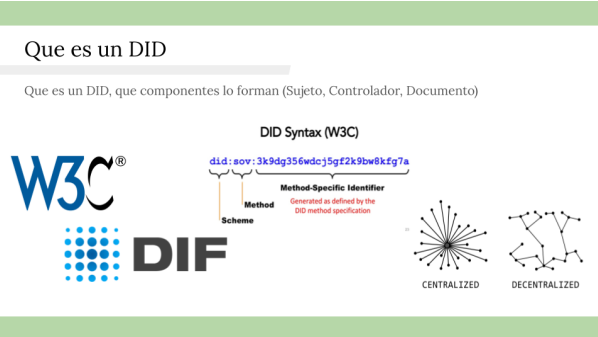
Decentralized Identifiers (DIDs) are the foundation of SSIs. They are identifiers that are... conceived and designed to work in decentralized systems. These systems do not share a single root of trust and can have multiple roots of trust.
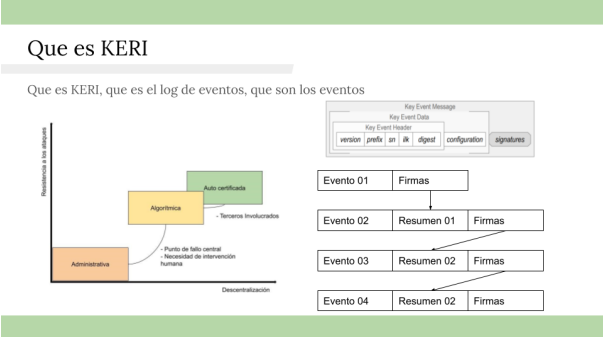
KERI is an infrastructure for managing public keys. It defines a series of mechanisms and protocols to enable the identification and validation of entities using decentralized technologies. Furthermore, KERI provides security and trust-building systems to facilitate these relationships without relying on a common source of trust, often known as Blockchain.
Project summary
This project was developed under the supervision and support of Antonio Estévez, R&D Director at Open Canarias, a company focused on the digital modernization of IT systems and ICT communications. It also received support from José Luis Roda García, Professor and Director of the BOB Chair at the University of La Laguna.
The development of this project can be divided into three phases:
- A research phase that focuses on the different concepts necessary to understand the field in which we are working. Without a doubt, this is the most important part of the project, since ultimately the project is an introduction to these technologies.
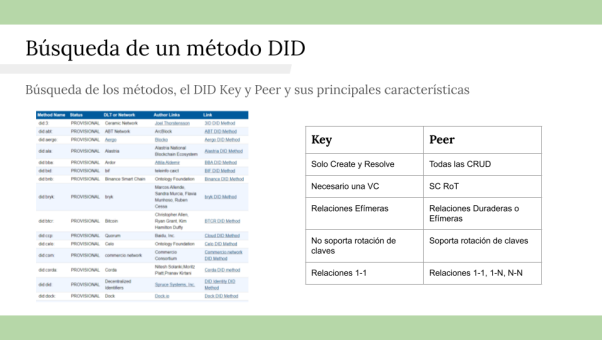
- After studying the solutions, and having a clear understanding of the different elements and how KERI and DIDs work, the next step was to find the closest match to an existing solution. This solution had to be based on DIDs and support the features that KERI needs to function.
- Once the different concepts within the world of SSI are understood, a possible solution is proposed. In this case, the solution is to implement DID Peer. As will be seen, this solution is not definitive, since the area of study on which this project is based is constantly changing and evolving.
The next steps in this project would be to carry out the implementation outlined here. Many mechanisms and decisions still need to be made before this implementation can take place. This project aims to be a first step in this area, facilitating its future development.
More information
The report on the work is publicly available at the Institutional Repository of the University of La Laguna.
- Author: Pablo Molina Martínez
- Tutor: José Luis Roda García
- Co-tutor: Antonio Estévez
- Partner company: Open Canarias

