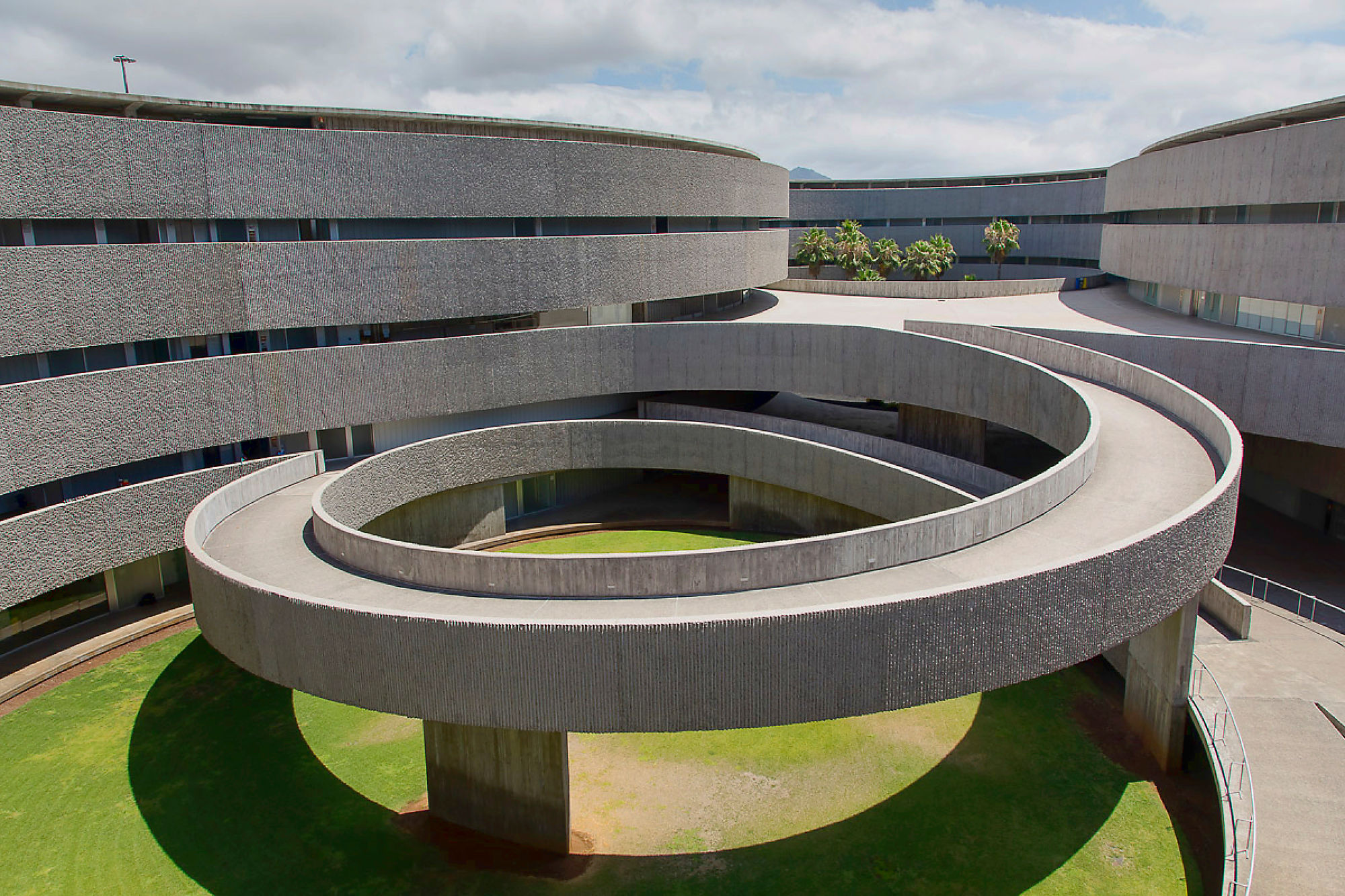
Faculty of Fine Arts
Guajara Campus
Quality Assurance System
Faculty of Fine Arts
The Faculty of Fine Arts has committed to implementing the AUDIT program (Program for the Recognition of Internal Quality Assurance Systems for University Education) through its Internal Quality Assurance System (SGIC), the design of which was approved in March 2010 by the National Agency for Quality Assessment and Accreditation (ANECA). The scope of the Faculty of Fine Arts' SGIC includes all degree programs currently offered and those under their responsibility, as well as those to be implemented in the future.
The design of the SGIC of the Faculty of Fine Arts consists of twenty procedures that consider the following criteria, aimed at continuous improvement:
The SGIC documentation consists of a Quality Manual, which defines the system's general characteristics, and a Procedures Manual, comprised of a series of procedures that are in accordance with the "Criteria and Guidelines for Quality Assurance in the European Higher Education Area," developed by the European Agency for Quality Assurance in Higher Education (ENQA) and adapted by ANECA. The documentation is supplemented by a series of annexes, including the Center's Quality Policy and Objectives and the Process Map.
Evaluation report on the design of the Internal Quality Assurance System. ANECA_March_2010
The Center's Management Team, and in particular its Dean, assumes responsibility for establishing the Center's quality policy and objectives, will appoint a Quality Officer to represent it in all matters relating to the monitoring of the Quality Management System, and will propose to the Faculty Board a review of the composition and functions of the Center Quality Committee (CCC).
To advise and assist the Dean in the tasks related to the design, implementation, maintenance and improvement of the SGIC, the figure of the Coordinator of Quality and Teaching Innovation has been created.
Regardless of the responsibilities indicated in the corresponding appointment or subsequently assigned, the Coordinator of Quality and Teaching Innovation has sufficient responsibility and authority to:
The Center's Quality Commission is an advisory body to the Center's Management Team, which participates in planning and monitoring tasks of the SGIC, and acts as one of the vehicles for internal communication of the policy, objectives, plans, programs, responsibilities and achievements of the same.
There may be different committees related to the review and improvement of other bodies and/or organizational units, services, etc.
Quality Policy and Objectives of the Faculty of Fine Arts
(Approved by the Faculty Board on October 7, 2010. Reviewed and approved by the Faculty Board on July 25, 2012)
Introduction
The Faculty of Fine Arts at the University of La Laguna has been a leading institution in the training of artists and professionals in various visual disciplines for over thirty years, making a significant contribution to the cultural and social development of our community. During this time, we have built a team of highly qualified and specialized faculty and researchers in the main artistic disciplines and professions related to visual creation and production, thereby fostering the continuous improvement and diversification of our academic offerings.
In accordance with this trajectory, the Faculty of Fine Arts is committed to continuing to improve the quality of its university training offer in all its undergraduate and postgraduate degrees.
Similarly, it aims to continue contributing to the promotion of culture, art, the conservation and restoration of cultural heritage, design, and other visual disciplines through its university outreach activities, while also promoting innovation and research. This entails establishing quality commitments and objectives, which we outline below.
Principles and commitments
The Faculty of Fine Arts views its mission as a public service rooted in society and committed to its development. Therefore, our commitment is to promote the quality policies of the University of La Laguna and facilitate their implementation in the areas of teaching, research, management, and services, encouraging the adoption of a culture of quality among all members of the Faculty.
The aim is to maintain and intensify the commitment and responsibility for a continuous improvement of the quality of the institution and the degrees.
We also intend to address current and future needs in the implementation of the degrees taught at the Faculty of Fine Arts, focusing our activities on continuous improvement.
Ultimately, it proposes a commitment to a culture of quality and excellence in service to and development of society.
To achieve these aspirations, we propose to implement and maintain the Center's Internal Quality Assurance System, and to promote the participation and commitment of all parties involved in the development of degrees and the operation of the Center, teaching and research staff, administrative and service staff, and students.
Specific objectives
We also wish to establish a series of specific objectives that respond to concrete needs and strategic approaches of the Faculty of Fine Arts. In this regard, we commit to:
The Faculty of Fine Arts at the University of La Laguna has a formally established and publicly available Internal Quality Assurance System (SGIC), developed according to the guidelines proposed by the National Agency for Quality Assessment and Accreditation (ANECA) through the AUDIT Program. The SGIC consists of several documents, including the SGIC Manual, which outlines the foundations and scope of the system. This manual addresses the main elements affecting university education: quality policy and objectives, quality assurance of training programs, student guidance and teaching development, academic and teaching support staff, material resources and services, training outcomes, and public information on the training programs offered. The SGIC documentation also includes the Procedures Manual (PM). The PM comprises a series of procedures that are in accordance with the "Criteria and Guidelines for Quality Assurance in the European Higher Education Area," developed by the European Higher Education Quality Assurance Agency (ENQA) and adapted by ANECA. Each of the documents that elaborate on the different procedures comprising the SGIC is added to the SGIC documentation.
Evaluation report of the design of the Internal Quality Assurance System.
ANECA_March_2010.
Results of the teacher evaluation. DOCENTIA Program:
Academic Year 2015-2016.Evaluation of teaching activity of the teaching staff. 2015 Call for Proposals. Link
Academic Year 2014-2015.Evaluation of teaching activity of the teaching staff. 2014 Call. Link
Academic Year 2013-2014.Evaluation of teaching activity of the teaching staff. 2013 Call. Link
Academic Year 2012-2013.Evaluation of teaching activity of the teaching staff. 2012 Call for Proposals. Link
Academic Year 2011-2012. Evaluation of teaching activity of the teaching staff. 2011 Call. Link
Academic Year 2010-2011.Evaluation of the teaching activity of the teaching staff. 2010 Call for Proposals. Link
Report of results of the satisfaction questionnaires for newly admitted and continuing students
The New Student Satisfaction Questionnaire has been designed to gather the opinions of students beginning their studies at the center on various aspects: the recruitment process, degree program selection and enrollment, and their experience in university settings. The Current Student Satisfaction Questionnaire has been developed to collect the satisfaction of current students on issues related to: the curriculum, support and guidance services, infrastructure, equipment and service hours, the communication channels used to disseminate information about the center, degree programs and services, and the results obtained in the previous academic year.
Academic Year 2009-2010. Report on the results of satisfaction of newly admitted and continuing students of Bachelor of Fine Arts degrees. Link
Academic Year 2010-2011. Report on the results of satisfaction surveys for newly admitted and continuing students. (New students enrolling in the Bachelor of Fine Arts degree and continuing students enrolled in the different courses of the Bachelor of Fine Arts degree and the Bachelor of Fine Arts degree). Link
Academic Year 2011-2012. Report on the results of satisfaction surveys of newly admitted and continuing students. (New students enrolling in the Bachelor of Fine Arts degree and continuing students enrolled in the different courses of the Bachelor of Fine Arts degree and the phased-out Bachelor of Fine Arts degree). Link
Academic Year 2012-2013. Report on the results of satisfaction of newly admitted and continuing students of the Bachelor's Degree in Fine Arts, Bachelor's Degree in Conservation and Restoration of Cultural Heritage, and Bachelor's Degree in Design. Link
Report on the results of student satisfaction questionnaires on the development of teaching
Academic Year 2009-2010.Report on the results of the student satisfaction questionnaire on the development of teaching: Bachelor of Fine Arts. Link
Academic Year 2010-2011. Report on student satisfaction with teaching activities and the teaching process: Planning, development and results. Bachelor of Fine Arts. Link
Results on student academic performance indicators
Academic Years 2008/09, 2009/10 and 2010/11.Results on student academic performance indicators by subject in the Bachelor of Fine Arts (1st, 2nd, 3rd, 4th, 5th year). Link
Academic Years 2008/09, 2009/10 and 2010/11.Results on student academic performance indicators by subject in the Bachelor of Fine Arts (1st, 2nd, 3rd, 4th, 5th year. Data by calls and type of admission). Link
Academic years 2009/10 and 2010/11. Results on student academic performance indicators by subject (1st and 2nd year) of the Bachelor's Degree in Fine Arts. Link
Academic years 2009/10 and 2010/11. Results on student academic performance indicators by subject (1st and 2nd year) of the Bachelor's Degree in Fine Arts (Data by calls and type of admission to the courses. Link
Academic performance indicators for the degree (enrollment rate, average access grade, performance rate, dropout rate, graduation rate, success rate, efficiency rate of graduates, number of graduates, etc.)
Bachelor of Fine Arts. 2009-2010 / 2010-2011 / 2011-2012 / 2012-2013. Link
Bachelor's Degree in Design.2012-2013. Link
Degree in Conservation and Restoration of Cultural Heritage. 2012-2013. Link
Results report on indicators (performance, dropout rate, graduation rate, efficiency, success) by branches of knowledge and qualifications.
Comparison of results: Qualifications to be phased out vs. Degrees. 2005-2006 to 2011-2012. Link
Report on the Guidance and Tutoring Action Plan
Academic Year 2012-2013. Self-report. Guidance and Tutorial Action Plan: assessment of its implementation in the Faculty of Fine Arts. Link
Job placement
Quantitative analysis of the labor market insertion of graduates from the University of La Laguna from 2006 to 2009 with special emphasis on the cohort of 2008 (includes data related to the Bachelor of Fine Arts). Link
Qualitative analysis of the employment situation of university students at the University of La Laguna (ULL), as well as the various aspects of the job placement process (includes data related to the Bachelor of Fine Arts degree). Link
| RATE EVOLUTION [%] | |||||
|---|---|---|---|---|---|
| Verification Memory Data | Course 12-13 | Academic Year 13-14 | Academic Year 2014-15 | Academic Year 15-16 | |
| Graduation rate | 70 | – | – | – | – |
| Dropout rate | 15 | 10,4 | 13 | 22,4 | – |
| Efficiency rate | 85 | – | – | 100 | 94,6 |
| Rate of return | – | 77,2 | 81,7 | 80,2 | 81,6 |
| Title success rate | – | 89,7 | 91,2 | 91,2 | 93,3 |
| STAKEHOLDER SATISFACTION LEVEL [Likert Scale 1 to 5] | ||||
|---|---|---|---|---|
| Bachelor's Degree in Design | ||||
| Bachelor's Degree in Design | Course 12-13 | Academic Year 13-14 | Academic Year 2014-15 | Academic Year 15-16 |
| Overall student satisfaction with the degree | 3,18 | 2,93 | 2,73 | 2,98 |
| Level of student satisfaction with the teaching staff | 3 | 2,85 | 2,87 | 2,79 |
| Level of student satisfaction with the resources | 2,43 | 2,92 | 2,83 | 2,91 |
| Level of teacher satisfaction with the degree | – | 3,14 | 3,4 | 3,2 |
| Graduate satisfaction level with the degree | – | – | 3 | – |
| Employer satisfaction level with the degree | – | 3,14 | 3,4 | 3,2 |
| EVOLUTION OF INDICATORS i | ||||
|---|---|---|---|---|
| Bachelor's Degree in Design | ||||
| Course 12-13 | Academic Year 13-14 | Academic Year 2014-15 | Academic Year 15-16 | |
| New students | 48 | 54 | 49 | 52 |
| Average entry grade | 7,444 | 7,476 | 8,311 | 7,858 |
| Total number of students enrolled | 112 | 154 | 179 | 190 |
| Number of graduating students | – | 11 | 22 | 24 |
| Number of graduating students (excluding adapted students) | – | – | 2 | 20 |
| Average duration of studies | – | – | 2 | 20 |
| Average duration of studies | – | – | 3 | 3,8 |
| RATE EVOLUTION [%] | |||||
|---|---|---|---|---|---|
| Degree in Conservation and Restoration of Cultural Heritage | |||||
| Verification Memory Data | Course 12-13 | Academic Year 13-14 | Academic Year 2014-15 | Academic Year 15-16 | |
| Graduation rate | 70 | – | – | – | – |
| Dropout rate | 15 | 34,4 | 28,9 | 44,7 | |
| Efficiency rate | 85 | – | – | 100 | 96,8 |
| Rate of return | – | 72,5 | 80,2 | 69,6 | 73,9 |
| Title success rate | – | 96 | 92,2 | 86,9 | 87,3 |
| STAKEHOLDER SATISFACTION LEVEL [Likert Scale 1 to 5] | |||||
|---|---|---|---|---|---|
| Degree in Conservation and Restoration of Cultural Heritage | Course 12-13 | Academic Year 13-14 | Academic Year 2014-15 | Academic Year 15-16 | |
| Overall student satisfaction with the degree | 3,1 | 3,05 | 3,11 | 2,97 | |
| Level of student satisfaction with the teaching staff | 3,13 | 3,14 | 3,3 | 3,03 | |
| Efficiency rate | 2,57 | 2,98 | 2,84 | 2,97 | |
| Rate of return | – | 4 | 4,33 | 4 | |
| Graduate satisfaction level with the degree | – | – | 3 | – | |
| Employer satisfaction level with the degree | – | – | – | – | |
| EVOLUTION OF INDICATORS | |||||
|---|---|---|---|---|---|
| Degree in Conservation and Restoration of Cultural Heritage | Course 12-13 | Academic Year 13-14 | Academic Year 2014-15 | Academic Year 15-16 | |
| New students | 32 | 38 | 47 | 48 | |
| Average entry grade | 6,883 | 6,642 | 6,722 | 6,286 | |
| Total number of students enrolled | 41 | 67 | 103 | 113 | |
| Number of graduating students | – | – | 6 | 9 | |
| Number of graduating students (excluding adapted students) | – | – | 1 | 7 | |
| Average duration of studies | – | – | 3 | 3,714 | |