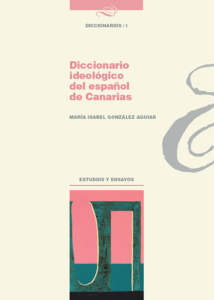
Ideological dictionary of Spanish in the Canary Islands
The author, a lecturer in the Department of Spanish Philology at the academic institution, compiled this lexicographical work as part of her doctoral thesis (a work that was later expanded), supervised by the author of the prologue, Gonzalo Ortega, Professor of Spanish Language. In Ortega's opinion, it is a groundbreaking work, firstly because it is a pioneering contribution to Hispanic regional lexicography, and secondly because it includes definitions alongside words grouped by their conceptual similarities. Furthermore, the volume covers Canarian phraseology and encompasses the full regional lexical competence of the island's speakers.
The criterion applied in the selection of material is differential, according to the author, meaning that only those units of insular Spanish not inventoried for standard Spanish have been included. It is also a comprehensive dictionary, encompassing the lexicon of the entire archipelago and presenting Canarian vocabulary organized by ideas, using as a model the Ideological dictionary of the Spanish language by Julio Casares, with a total of 827 headers in which the more than 7,000 registered units are organized.
The author of the work, who notes in the introduction that the vocabulary in the dictionary is not new, although the organization of the entries according to conceptual criteria is, has divided the dictionary into three parts: the synoptic section, the analogical section, and the alphabetical index of the conceptual groups. The first consists of 37 tables under which the distinctive Canarian lexicon, both simple and complex, is cataloged, while the second corresponds to the central part of the dictionary, defined by the total number of entries and expressions contained in each conceptual group.
Collection:
Series: