Index
Introduction
The insurance sector is a perfect candidate for the application of blockchain technology to improve and automate its services. This is particularly true for parametric insurance policies, whose compensation conditions are objectively measurable and established when the policy is taken out. This type of insurance allows the entire process to be automated, improving conditions for customers and making the insurer's job easier., while intermediaries are replaced by Smart Contracts.
This final degree project focuses on the development of a parametric insurance policy that hotels take out and that compensates them in case any of their guests become infected with Covid-19. Three main players stand out: the insurance company, the hotels, and the laboratories. Due to the technologies used, the insurance users themselves (in this case, the hotels) purchase the policies without the insurer's direct involvement in the transaction. To do this, the insurer must first register each hotel on the blockchain and provide it with the necessary keys to interact with it.
Context
A development team was formed for the project, consisting of Benito José Cuesta Viera (Project Manager and Co-supervisor of the Final Degree Project), Carlos Domínguez García (Developer and member of the BOB Chair), and Eduardo Suárez Ojeda (Developer and author of the Final Degree Project), led by Julio Antonio Brito Santana (Supervisor of the Final Degree Project) and Jose Luis Roda García (Director of the Cajasiete BOB Chair). Mutua Tinerfeña also collaborated to establish a realistic scenario.
The main motivation for the project is the current pandemic situation and its effects on tourism in the islands. The insurance covers extra accommodation expenses incurred if tourists have to quarantine after testing positive for Covid-19.. On the other hand, it's worth highlighting the challenge of applying Blockchain technology to this sector. Its use allows for a more reliable, secure, automated, and convenient service for the end user.
All of this is inherent to Blockchain technology itself, where reliability and security are provided by its immutable ledger and user interaction through asymmetric cryptography with public/private key pairs. The key to eliminating intermediaries lies in Smart Contracts. These are programs associated with the Blockchain that are executed through user transactions. The insurance policy itself is encoded within them, and they are updated with collected data throughout the policy's lifecycle. Based on this data, the Smart Contracts are responsible for issuing alerts in the event of a claim.
Project summary
The project is divided into four components. At its core is the Blockchain. The Hyperledger Besu Ethereum client was used to create the private Blockchain. This acts as a software connector and decentralized ledger. Next, there's the API, which serves as the interface between users and the Blockchain through its predefined functions. There's also an event handler that constantly listens to the Blockchain and performs various actions based on the information it receives. Finally, there's a user interface that provides easy access to the API's functions for users.
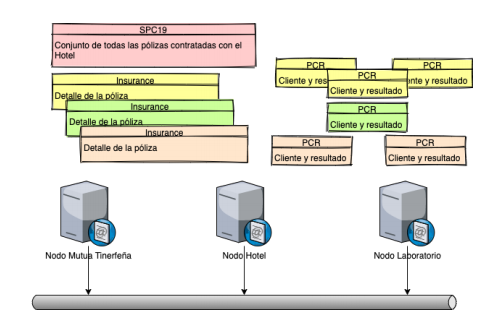
Insurance is implicitly defined in the Blockchain Smart Contracts. There are three types: SPC-19 (general contract), Policy, and PCR. The latter two represent the different policies contracted over time and the PCR tests performed on the members of those policies. The SPC-19 contract acts as a general index, allowing the storage and retrieval of data from the other contracts. As it is a private blockchain, the information is divided so that each participant can access only what is necessary to perform their function. The Policy and SPC-19 contracts are visible to the hotels and the insurance company, while the PCR contracts are visible to the hotels and the laboratories responsible for conducting the tests. To comply with the General Data Protection Regulation (GDPR), no personal data of the tourists themselves is added to the blockchain.
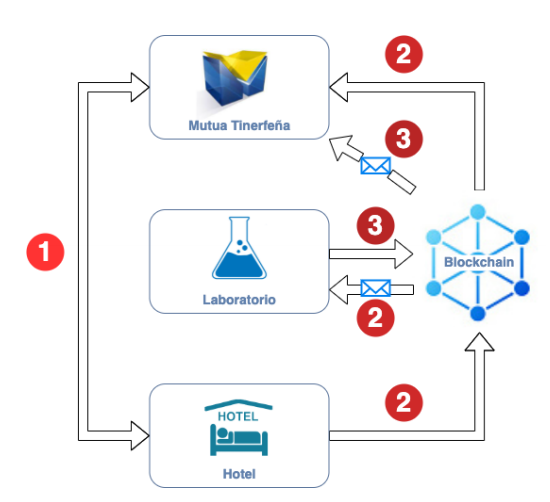
The life cycle of a policy follows these steps:
- The insurer first registers the hotel to allow access to the purchase of policies.
- When a new group of tourists arrives, the hotel takes out the insurance policy and generates the Smart Contract that represents it on the Blockchain, which the insurer can access to track its progress. The laboratory is also notified of the need to perform a PCR test on each tourist at the end of their stay to verify that the compensation conditions are met.
- Once these tests are carried out (it may be the routine one at the end of the stay or additional tests if any of the tourists have any symptoms) the laboratory sends the results to the Blockchain updating the Smart Contracts and in case there has been a case of accident the insurance company is notified with the necessary data so that it provides the compensation to the hotel.
More information
The report on the work is publicly available at the Institutional Repository of the University of La Laguna.
- Author: Eduardo Suárez Ojeda
- Tutor: Julio Antonio Brito Santana
- Partner company: Mutua Tinerfeña

