Higher School of
Engineering and Technology
Anchieta Campus
Infrastructure and services
Classrooms for theoretical teaching
The four degree programs at the Higher School of Engineering and Technology (ESIT) are taught in classrooms located in four buildings on the Campus of Experimental Sciences and Technical Studies, all within an 800-meter radius in the Anchieta area. These buildings, which we will name A through D, have the following classrooms available to ESIT:
-
Building “A” (Physics and Mathematics building): Built in 1995, it has 6 floors (one for laboratories, one for classrooms with a large lecture hall, one for a library and study room, and 3 for offices). It contains:
- 2 classrooms with 164 places each.
- 3 classrooms with 125 places each.
- 2 classrooms with 88 seats each.
- Building “B” (ESIT building): three floors and two phases.
-
Building “C”: the oldest building. It contains:
- 3 classrooms with 46 places each.
- 3 classrooms with 77 places each.
- Building “D” (Chemistry building): The teaching of the Degree in Industrial Chemical Engineering is taught in the Chemistry Section building of the campus, in conjunction with the rest of the facilities available to ESIT.
In all four buildings, every classroom has a fixed projection system. In addition, ESIT has four portable projectors for teaching use.
In all cases, the ULL wireless network provides students and teachers with direct access to the Internet from any of the classrooms.
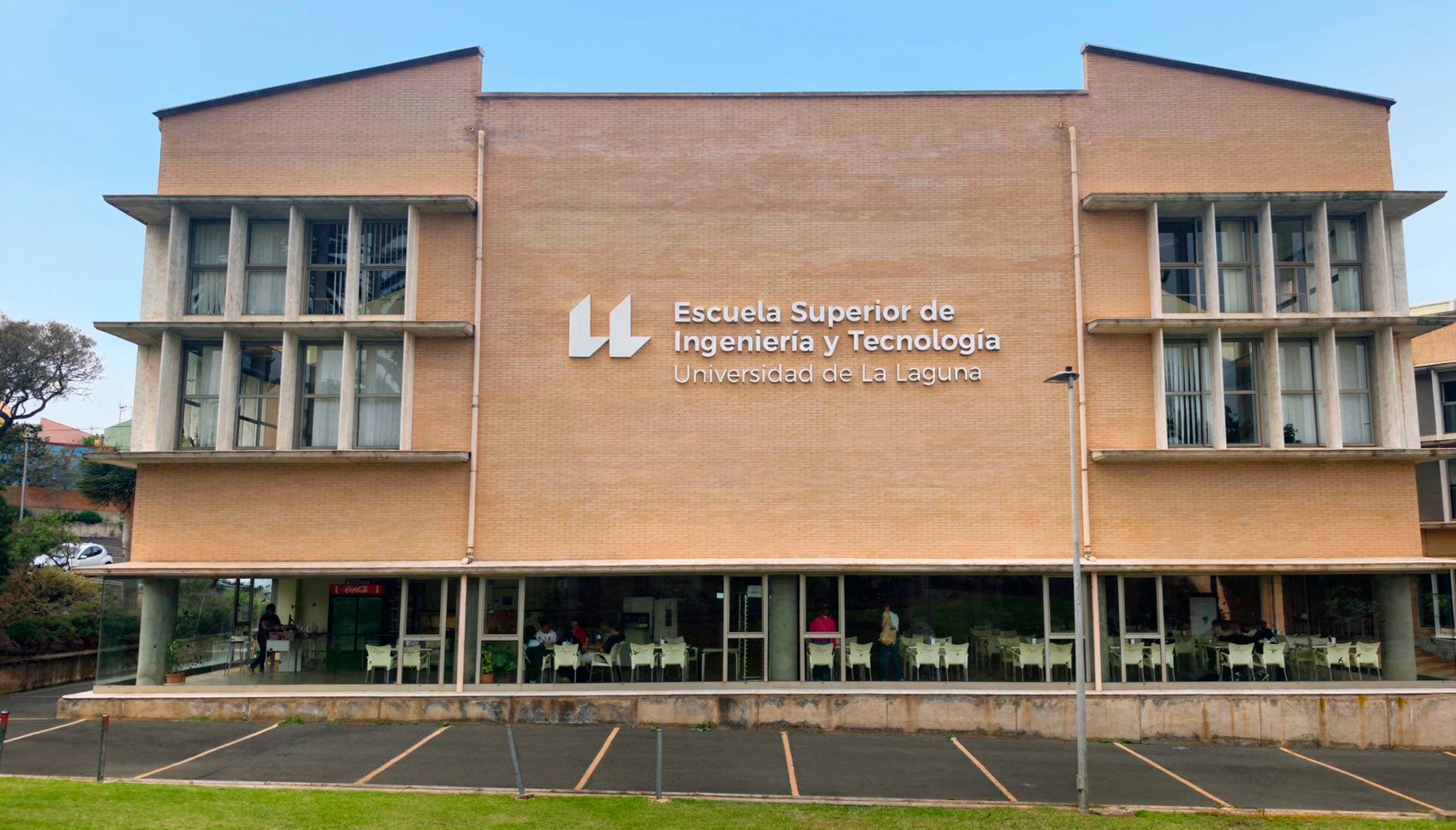
Building “B”, or the ESIT building, opened in 2004 and is fully accessible to people with disabilities, featuring elevators and ramps that facilitate movement both inside and at the exterior entrances. It has a constructed area of 9,244 m², on a total site of 11,883 m², with a landscaped area of 4,117 m². The building houses the following facilities: offices, a secretariat, a reception area, administrative and management offices, classrooms, laboratories, a computer lab, a cultural center, a student union office, a library, and a cafeteria.
The following table shows the layout of classrooms in the ESIT building, indicating for each one the maximum student capacity, the availability of fixed projection systems (computer + projector), the arrangement of the desks (anchored in an amphitheater position or mobile tables) and the availability of access points to the university network.
| Classroom | Area (m²) | Ability | Projection system | Provision | Network connection |
|---|---|---|---|---|---|
| 1.1 | 148 | 110 | Yeah | Mobile | Yeah |
| 1.2 | 154 | 110 | Yeah | Mobile | Yeah |
| 1.3 | 157 | 115 | Yeah | Mobile | Yeah |
| 1.4 | 154 | 115 | Yeah | Mobile | Yeah |
| 1.5 | 193 | 158 | Yeah | Mobile | Yeah |
| 1.6 | 30 | Yeah | Mobile | Yeah | |
| 1.7 | 70 | Yeah | Mobile | Yeah | |
| 1.8 | – | Yeah | Mobile | Yeah | |
| 1.9 | – | Yeah | Mobile | Yeah | |
| 1.10 | – | Yeah | Mobile | Yeah | |
| 1.11 | – | Yeah | Mobile | Yeah | |
| 1.12 | – | Yeah | Mobile | Yeah | |
| 1.13 | 70 | Yeah | Mobile | Yeah | |
| 1.14 | 30 | Yeah | Mobile | Yeah | |
| 2.1 | 65 | 40 | Yeah | Mobile | Yeah |
| 2.2 | 75 | 48 | Yeah | Mobile | Yeah |
| 2.3 | 75 | 48 | Yeah | Mobile | Yeah |
| 2.4 | 48 | Yeah | Mobile | Yeah | |
| 2.5 | 32 | Yeah | Mobile | Yeah | |
| 2.6 | 75 | 60 | Yeah | Mobile | Yeah |
| 2.7 | – | Yeah | Mobile | Yeah | |
| 2.8 | – | Yeah | Mobile | Yeah | |
| 2.9 | 193 | 175 | Yeah | Mobile | Yeah |
| 2.10 | 39 | Yeah | Mobile | Yeah | |
| 2.11 | 60 | Yeah | Mobile | Yeah | |
| 2.12 | 93 | Yeah | Mobile | Yeah | |
| 2.13 | 112 | 93 | Yeah | Mobile | Yeah |
| 2.14 | 40 | Yeah | Mobile | Yeah | |
| 2.15 | 40 | Yeah | Mobile | Yeah | |
| 3.1 | – | Yeah | Mobile | Yeah | |
| 3.2 | – | Yeah | Mobile | Yeah | |
| 3.3 | 48 | Yeah | Mobile | Yeah | |
| 3.4 | 48 | Yeah | Mobile | Yeah | |
| 3.5 | – | Yeah | Mobile | Yeah | |
| 3.6 | 48 | Yeah | Mobile | Yeah | |
| 3.7 | 48 | Yeah | Mobile | Yeah | |
| 3.8 | – | Yeah | Mobile | Yeah | |
| 3.9 | – | Yeah | Mobile | Yeah | |
| 3.10 | 169 | Yeah | Mobile | Yeah |
Resources for practical teaching
Below we describe the laboratories available for practical teaching. Due to the strong practical component of ESIT's degree programs, it is essential to have adequate scientific and technical resources for student training.
Computing Center
The ESIT computer labs are used both for practical teaching of subjects and for free use by students. There are 16 labs in total, with 256 computers, used by students of the Bachelor's Degree in Computer Engineering. The capacity of the labs varies between 18 and 32 workstations, and a few are smaller, with fewer than 10 workstations each, as shown in the following table:
| Classroom name | Ability | Preferential use | Accessibility |
|---|---|---|---|
| PB. 111 | 24(*) | Teaching | √ |
| PB. 112 | 24(*) | Teaching | √ |
| PB. 113 | 18(*) | Teaching | √ |
| PB. 114 | 24(*) | Teaching | √ |
| PB. 115 | 24(*) | Teaching | √ |
| P1. 121 | 32(*) | Teaching | √ |
| P1. 122 | 24(*) | Teaching | √ |
| P1. 123 | 32(*) | Teaching | √ |
| P1. 124 | 24(*) | Teaching | √ |
| 2.5 | 10(*) | Teaching | √ |
| 2.5 external (Tenerife Island Council) | 32(*) | √ | |
| 2.6 | 6 | Autonomous | √ |
| 2.8 – FAP (Framework for Public Administration) | √ | ||
| Project Room 1 | 3 | Autonomous | √ |
| Carrels(3) | 1 | Autonomous | √ |
| TOTAL: 16 Classrooms | TOTAL: 256 Computers> | ||
As indicated in the first column, some of these classrooms have been provided by companies/organizations external to the University through collaboration agreements.
In addition, there are several carrels (offices for students to work in groups) equipped with computers and communication infrastructure. Currently, there are three carrels with one computer each and Project Room 1 with three Macs. It is also worth noting that all computers have broadband internet access, thanks to a state-of-the-art communications infrastructure that provides network speeds of 1 Gbps.
Ships
These are two warehouses for the exclusive use of ESIT, located in the parking lot between buildings “A” and “B”, measuring 200 m²2 in plan, and a total of 500 m2 useful. In addition, students of the Degree in Industrial Chemical Engineering have access to a four-story industrial building (three floors for student internships), each of which is equipped with modular practical facilities and with the capacity to install new equipment.
| Description | Floor area (m2) | Usable area (m2) | Areas that use it |
|---|---|---|---|
| Ship 1 | 200 | 300 | Electrical Engineering |
| Ship 2 | 200 | 200 | Mechanical Engineering: Machines and Heat Engines Manufacturing Process Engineer |
| Ship 3 | 750 | 750 | Industrial Chemical Engineering |
Computer labs
There are two computer labs for mixed use (student and teaching) with a total of 41 workstations, located in building “B”, as well as one computer lab in building “A”, with 21 workstations, and two more in building “C”, with 25 workstations each, all for teaching purposes. In addition, the departments have access to the departmental computer labs indicated in the following table for teaching use.
| Number of classrooms | Description | Area |
|---|---|---|
| 2 | Computer labs in Building B for mixed use (free students and teaching) with a total of 41 workstations | All areas |
| 1 | Computer labs Building A with 21 workstations | All areas |
| 2 | Computer labs in Building C with 25 workstations each | All areas |
| 1 | Departmental computer lab: Mobile whiteboard + eBeam Whiteboard digital whiteboard, digital projector, overhead projector and plotter. 50 computers with various CAD software (AutoCAD, Inventor, etc.), modular in two classrooms of 25 computers each. | Graphic Expression in Engineering |
| 1 | Departmental computer lab: computers with specialized software (3 workstations) | Chemical Engineering |
| 1 | Departmental computer lab: 30 computer workstations with various software | Statistics and Operations Research |
| 3 | Departmental computer labs: 18+15+12 computer workstations with various software | Computer Languages and Systems Computer Science and Artificial Intelligence |
| 1 | Computer Lab: 25 computer workstations with various software | Mathematical Analysis Applied Mathematics |
Laboratories
The departments that teach at the center have the following laboratories
| No. | Description | Area |
|---|---|---|
| 1 | Materials Laboratory (2×25 stations) with Universal Mechanical Testing Machine, Metallographic Microscopes (5), Polishers (3), Durometers (3), Treatment Furnace, Thickness Gauges, Defect Gauges and Coating Gauges | Materials Science and Mathematical Engineering. |
| 1 | Electronics Laboratory (20 workstations) with signal generators, spectrum analyzers, logic analyzers, oscilloscopes, etc. | Electronics Technician Signal Theory |
| 1 | Electronic Design Laboratory (15 workstations) with software such as PSPice, Orcad, etc. Materials necessary for the design and construction of printed circuit boards | Electronic Technology Electronics |
| 1 | Thermodynamics Laboratory (10 stations) equipped for practical work in this subject | Applied physics |
| 1 | Networks and Vision Laboratory (17 positions) with 12 for Computer Networks and 5 for Computer Vision | Electronic Technology |
| 1 | Communications and Instrumentation Laboratory (16 stations) with analog and digital communications trainers | Electronic Technology Signal Theory and Communications |
| 1 | Signal Theory Laboratory (8 stations) with modules for the study of microwaves, transients, transmission lines, antennas, etc. | Signal Theory and Communications |
| 3 | Physics Laboratory (7+7+8 practice stations for 21+21+24 students, respectively) for different practices of electromagnetism, mechanics, thermodynamics, etc. | Applied physics |
| 1 | Classroom-Workshop for Manufacturing Process Technology | Tech. of the Manufacturing Processes. |
| 1 | Robotics and Projects Laboratory (14 stations) 2 SCORBOT ER-Vplus robot arms, 3 Scorbot-er IX, Power supplies, Logic analyzers, Pulse generators, Oscilloscopes, etc. | Systems and Automation Engineering Computer Architecture and Technology |
| 1 | Control Laboratory (28 stations) 1 Digital Feedback pendulum 33200, 2 SAD 100 servo systems, 2 analog calculators, 1 CPI-100 process control plant, 1 Feedback Process Control 38200, 2 PLC controllers for DC and Stepper motors, 1 Feedback temperature process trainer plant, 1 Feedback double rotor plant, Power supplies, logic analyzers, pulse generators, oscilloscopes, etc. | Systems and Automation Engineering Computer Architecture and Technology |
| 1 | Laboratory – Beckhoff Classroom – (26 places) DC motor test bench, Siemens home automation panel, 12 Beckhoff devices (industrial PLCs) with DC motors. | Systems and Automation Engineering Computer Architecture and Technology |
| 1 | Laboratory – Lorenzo Moreno (left) – (18 stations) 17 Siemens S7-200 PLCs, 4 Siemens S7-300 PLCs, FESTO pneumatic industrial plant, Power supplies, pulse generators, signal generators, oscilloscopes, etc. | Systems and Automation Engineering Computer Architecture and Technology |
| 1 | Laboratory – Lorenzo Moreno (right) – (26 stations). Power supplies, signal and pulse generators, oscilloscopes, etc. | Systems and Automation Engineering Computer Architecture and Technology |
| 1 | Chemistry and Chemical Engineering Laboratory (groups of 25 students), equipped with a wide variety of experimental practices, some of which are carried out in the department's four-story industrial building, with an area of approximately 250 m2 each. | Chemical Engineering Organic Chemistry Analytical Chemistry |
| 3 | Chemical Engineering and Pharmaceutical Technology Laboratories: These laboratories feature high and low tables with gratings for assembling equipment, equipped with compressed air, water, and vacuum systems, fume hoods, cabinets and display cases for storing materials and reagents, safety measures such as eyewash stations and showers, and emergency exits. All of these laboratories are equipped for a wide variety of experimental practices. Students conduct these practices in groups, depending on the laboratory capacity. Some practical exercises utilize specific scientific equipment acquired through research projects. | Chemical Engineering |
| 1 | DSIC1 laboratory (18 stations) with computer equipment. | Computer Languages and Systems Computer Science and AI |
| 1 | DSIC2 laboratory (35 stations) with computer equipment. | Computer Languages and Systems Computer Science and AI |
Data Processing Center
To support all the equipment and services offered at ESIT, there is a Data Processing Center (DPC), approximately 70m², which consists of the following resources:
| Equipment | Description |
|---|---|
| Intelligent fire detection and extinguishing system | Fire protection system |
| Environmental monitoring system | Temperature and humidity control |
| Air conditioning system | Room thermal control |
| Emergency power supply via motor | High availability of services |
| Uninterruptible power supply system | |
| Ten state-of-the-art servers | They provide services to ESIT users |
| Storage system | Manages the integrity of user information |
Library
The ESIT library facilities are located on the first and second floors of the north wing of the School building, where they occupy a total area of 1,465 m²² (771 m² on the first floor and 694 m² in the second), and a usable area of 1,268 m². Both floors have their own access doors, and are connected internally by stairs, and externally by elevators, stairs and ramps.
There is a significant number of network sockets (each accompanied by electrical sockets) available to users.
The book and magazine storage area is located in a central cylinder with four levels, connected by stairs and a freight elevator. It contains 645 meters of shelving for the collection, all of which is freely accessible.
The reading and study rooms have 406 places, of which 261 are located on the first floor (233 study places and 28 computer places) and 145 on the second floor.
The library has eight offices for group work: four with four people and four with six. Users reserve the spaces through an application on the library's website.
Currently, there are approximately eight thousand printed monographs organized by subject according to the Dewey Decimal Classification (DDC). These monographs are acquired by consulting the bibliographies in the course guides for each subject.
Regarding electronic monographs, users have access to the Springer, Safari e-Books and ScienceDirect e-Book platforms, through which they can access titles of specialized works in the field of computer science, mathematics, physics, electronics, etc.
The periodicals collection is electronic, with access to 1,341 journal titles. It can be accessed through the library's website, Punto Q, e-revistas, Tecnología de la Información, and specialized databases.
The services offered by the university library are:
- Online catalog of paper and electronic funds
- Home, interlibrary and intercampus loans
- Laptop loan: PROA
- Shipping service for items: SEA
- CLABE Service: Lightweight Clients for Access to the Electronic Library
- Institutional repository
- User training: CI2 Classroom: skills training digital
- Advice for teaching and research staff
- Recommended bibliography
- Library outreach
The Library of the University of La Laguna has the EFQM Europe400+ Seal of Excellence.
Other teaching facilities
ESIT also has other spaces that are used for the development of various activities:
| Denomination | Area (m²) | Ability | Description |
|---|---|---|---|
| Graduation Hall | 110 | 124 | Hall reserved for conferences and official academic events |
| Laptop Classroom | 75 | 60 | Classroom for students to work independently using their laptops |
| Culture Classroom | 110 | 50 | Student cultural activities |
| Student Delegation | 75 | 40 | Workplace for student representation activities at the University |
| Concierge | 47 | Information Point | |
| Secretariat | 176 | Administrative management and custody of documents | |
| Management Area | 216 | Organizational management and work meeting space | |
| Reprographics | 45 | Photocopying and binding service | |
| Professors' Offices | 507 | 22 | |
| Café | 576 | 150 |
Library / BiblioLab
Of the total number of libraries at the University of La Laguna (ULL), two are located within the buildings where the Higher School of Engineering and Technology holds its classes, and they house the vast majority of the bibliographic resources available to the School's students. In total, they contain 29,000 volumes and 400 periodicals in the fields of Engineering, Physics, and Mathematics.
The first one has 1380 m2 of usable space and consists of a reading room with 127 seats; a study room with capacity for 216 students and a hall with 10 computer terminals with Internet access that allow consultation of the electronic catalog, as well as a media library with 16 seats and 3 work offices.
The second library covers 1268 m2 and includes a study hall with 502 reading spaces spread over two floors. It also has six offices for group work and 14 computers for internet access. The BiblioLab is located in this library.
BiblioLab is a space where students can create, collaborate, share, develop ideas, and innovate. In a single environment, students can work in groups and operate electronic components and equipment (3D printers, oscilloscopes, signal generators, development boards, etc.) while also having easy access to resources. This fosters interdisciplinary communication and collaboration, facilitating interaction among students, professors, and researchers, as this space is open to the entire university community during the same opening hours as the ESIT Library.
All information regarding your computer equipment, 3D printing devices, virtual reality, electronic equipment, etc. can be found in the following link.
Graduation Hall
Hall located on the second floor of the building, for holding events such as center meetings, exhibitions of coursework or doctoral theses, technical conferences, company presentations, etc., with a capacity for 124 attendees.
Meeting Room
This room, located on the second floor of the building, is primarily for business meetings. It has two separate areas, one with meeting tables and audiovisual equipment.
Student Delegation
All the information is in the following link.
Information Technology Support Service for Research (SAII)
He SAII It does not depend on the school, but the school provides it with support by offering a space located on the ground floor of the center.
Secretariat
The administrative services are located in the registrar's office. It handles all administrative activities such as registration, maintaining academic records, issuing certificates, and all other procedures necessary for the smooth operation of the Center.
If you wish to carry out any procedure, you can request Appointment required.
Goal
Responsible for opening and closing the center and classrooms, sending and receiving correspondence, controlling access to the photocopiers, guiding users, supervising repairs, etc.
Café
The center has a spacious and bright cafeteria that also provides dining services at affordable prices.