
Days and times (Beginner level)
Mondays and Wednesdays from 11:45 to 12:45
Location
Multipurpose room 2
Description
The word “Core” comes from the English word “nucleus.” As its name suggests, the core is the group of muscles in the central part of the body, responsible for supporting our body, along with the spine.
The core provides stability to the body when performing various tasks in our daily lives, whether in everyday activities or during athletic movements. This stability protects us from many injuries, especially those affecting the spine. The musculotendinous structures that make up the core are fundamental for efficiently transmitting force from the lower to the upper limbs, acting as connectors that allow the kinetic chain to reach its full potential.
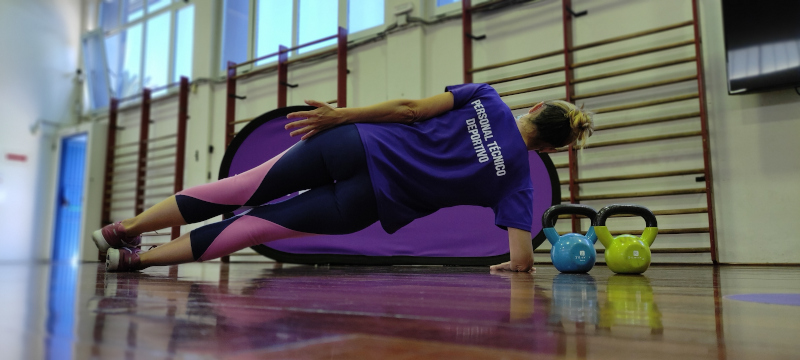
Furthermore, once an anomaly is detected, strengthening the core will lead to a more upright posture, improving our postural hygiene. This, in turn, reduces or prevents pain caused by the diagnosed condition. Ultimately, core work should be performed with exercises that stabilize the spine through instability created by an external load. Therefore, functional training and planks are essential. These functional exercises aim to activate and contract the core muscles through instabilities generated by loads, using planks and functional equipment such as exercise balls, resistance bands, and Bosu balls.
Goals
- Developing balance and stability: Strong core muscles provide the extra support and stability you need to move nimbly during a run. And more importantly, without getting injured.
- Improving economy and efficiency: A person who is an athlete with good running economy is one who saves energy; that is, who is able to run using only the muscles necessary for running and who requires a lesser amount of oxygen when running at a certain pace.
- Reducing fatigue and improving breathing: Using only your core muscle groups and avoiding unnecessary muscle engagement will contribute to lower energy expenditure. This will also improve your breathing.
- Reduce the likelihood of injury and discomfort: Strengthening the core muscles of our body will give our back the firmness and support needed to prevent our lower back from suffering.
- Improve performance: A strong core means a solid and stable spine. The more stability and firmness we give our back, the more effective our movements will be.


