Sustainable Development Goals

The Sustainable Development Goals (SDGs) constitute a universal call to action to end poverty, protect the planet and improve the lives and prospects of people everywhere.
In 2015, all member states of the United Nations approved 17 goals as part of the 2030 Agenda for Sustainable Development, which establishes a plan to achieve the Goals in 15 years, i.e., by 2030. These goals incorporate global challenges that we face every day in different areas, such as poverty, inequality, climate, environmental degradation, etc.
While the SDGs are universal, each country is responsible for implementing national strategies to achieve them. In Spain, the Council of Ministers approved the Action Plan for the Implementation of the 2030 Agenda in June 2018, with the participation of representatives from all levels of government, as well as universities and other social and economic sectors of the country.
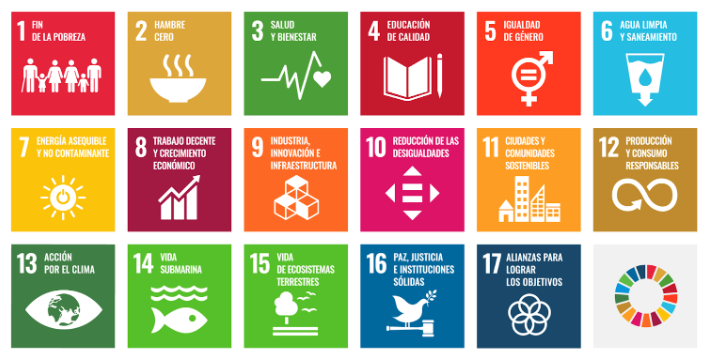
The SDGs consist of 17 goals and their 169 targets.
More information
Transforming our world: the 2030 Agenda for Sustainable Development
17 goals to transform our world
Action plan for the implementation of the 2030 Agenda: towards a Spanish strategy for sustainable development
Canary Islands Agenda for Sustainable Development 2030
The Sustainable Development Goals – what they are and how to achieve them (video)
Following the lines set by Rebiun and by SDSN Australia/Pacific, The ULL Library supports the SDGs by aligning our actions with the following areas:
a. Education:
b. Research
c. Management
d. Social projection
e. More information
How to get started with the SDGs in universities: A guide for universities, higher education institutions and the academic sector
ULL: Agenda 2030 and SDGs
Social Responsibility Diagnosis of the University of La Laguna
Universities and the 2030 Agenda: Contributions from the ULL
The involvement of Spanish libraries in the 2030 Agenda
Good practices in SDGs of REBIUN libraries
Action guide for university and scientific libraries for the SDGs
Information prepared by Professor Cintia Hernández Sánchez
Health is linked to four major determinants: human biology, including a person's constitution; the surrounding environment; lifestyle; and the healthcare system itself. Lifestyle not only shapes health but also our overall well-being. Personal choices such as sedentary behavior, diet, and stress directly impact our lifestyle (Piédrola Gil, 2016).
It is within our power to make responsible choices when it comes to food. Unhealthy options for our bodies are also unhealthy for the planet, and we must promote less harmful environments. The sustainability of food products is crucial for improving our health and the health of those around us (Strategic Plan for Health and Environment 2022-2026).
Consuming local foods, avoiding single-use products that generate unnecessary waste, giving preference to products that respect the earth… allows for a sustainable food system that produces a healthy population (Food, Planet, Health, 2019).
Without a doubt, the best part is that the choice is entirely up to you. Shall we begin?
References:
FERNÁNDEZ-CREHUET NAVAJAS, Joaquín [et al.]. Piédrola Gil. Preventive medicine and public health. 12th ed. Barcelona: Elsevier, 2016. Available at:
http://absysnetweb.bbtk.ull.es/cgi-bin/abnetopac?TITN=596574
Strategic Plan for Health and Environment 2022-2026. Madrid: Ministry of Health, 2021. Available at: https://www.sanidad.gob.es/ciudadanos/pesma/docs/241121_PESMA.pdf
Food, Planet, Health. Oslo: EAT, 2019. Available at: https://eatforum.org/content/uploads/2019/01/Report_Summary_Spanish-1.pdf
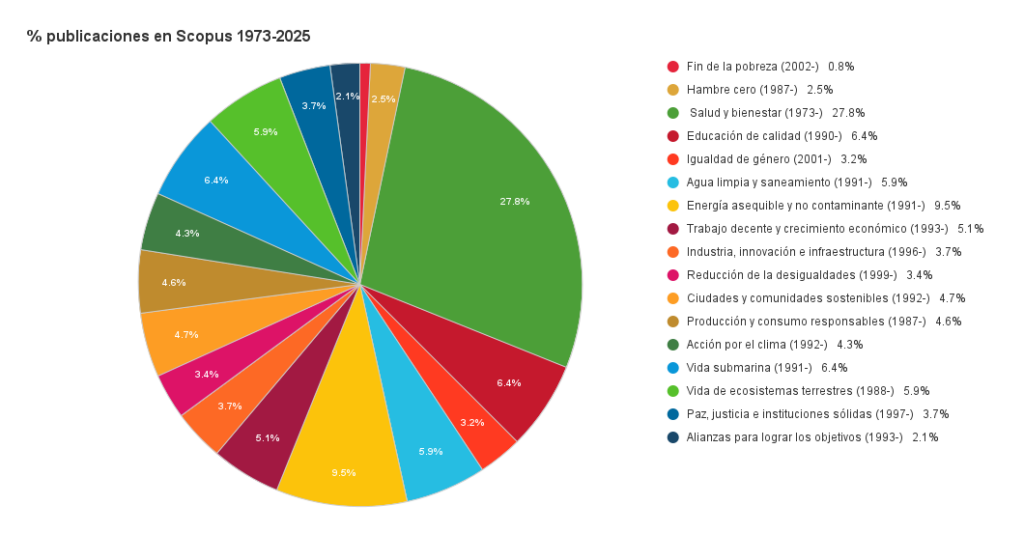
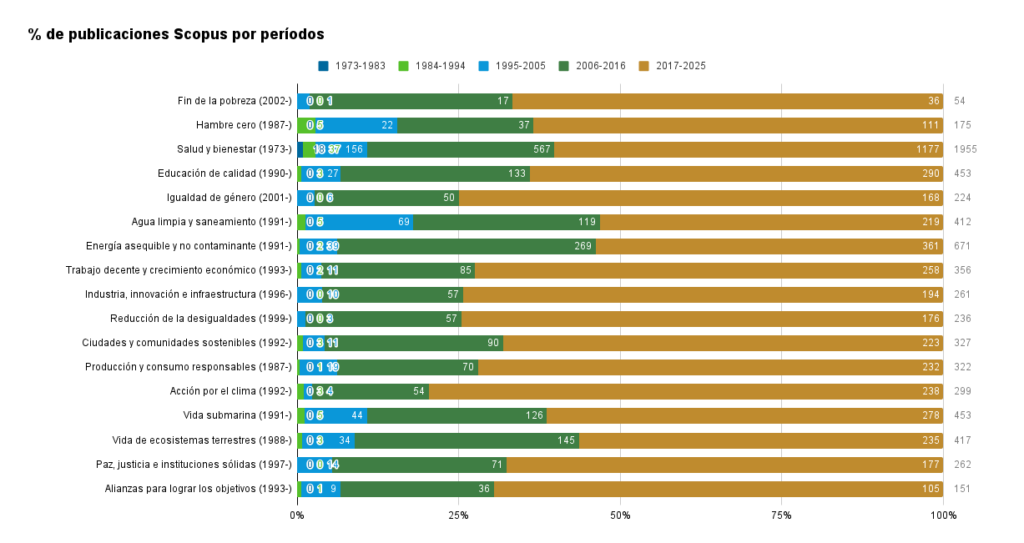
These graphs show how the research of the ULL teaching and research staff contributes to each of the SDG objectives, based on the data provided by Scopus, updated to April 2025.