Government Pavilion, C/ Padre Herrera s/n
P.O. Box 456
38200, San Cristóbal de La Laguna
Santa Cruz de Tenerife - Spain
Switchboard Tel.: (+34) 922 31 90 00
Hours: Mon-Fri, 8:00 a.m. to 9:00 p.m.
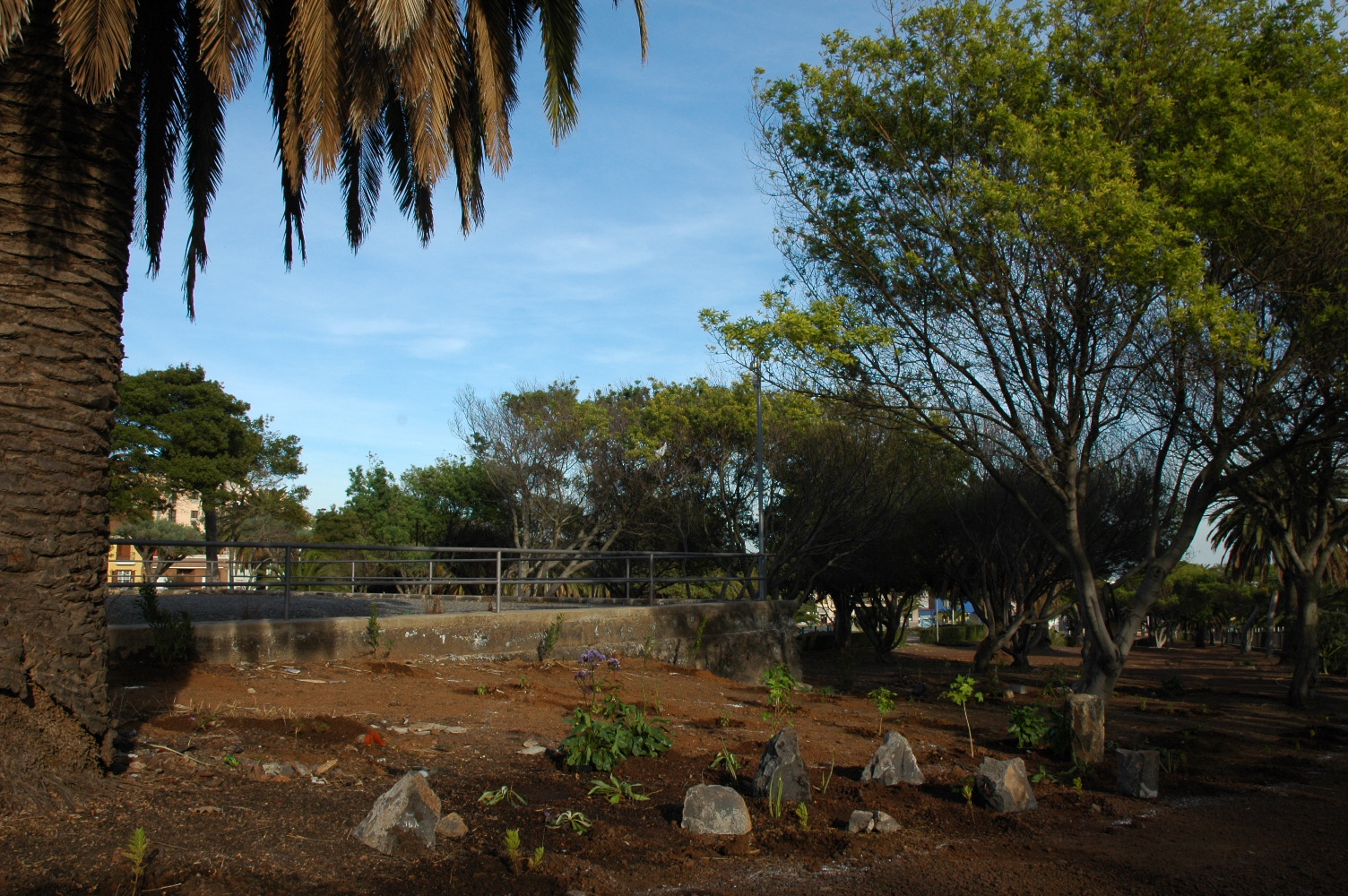
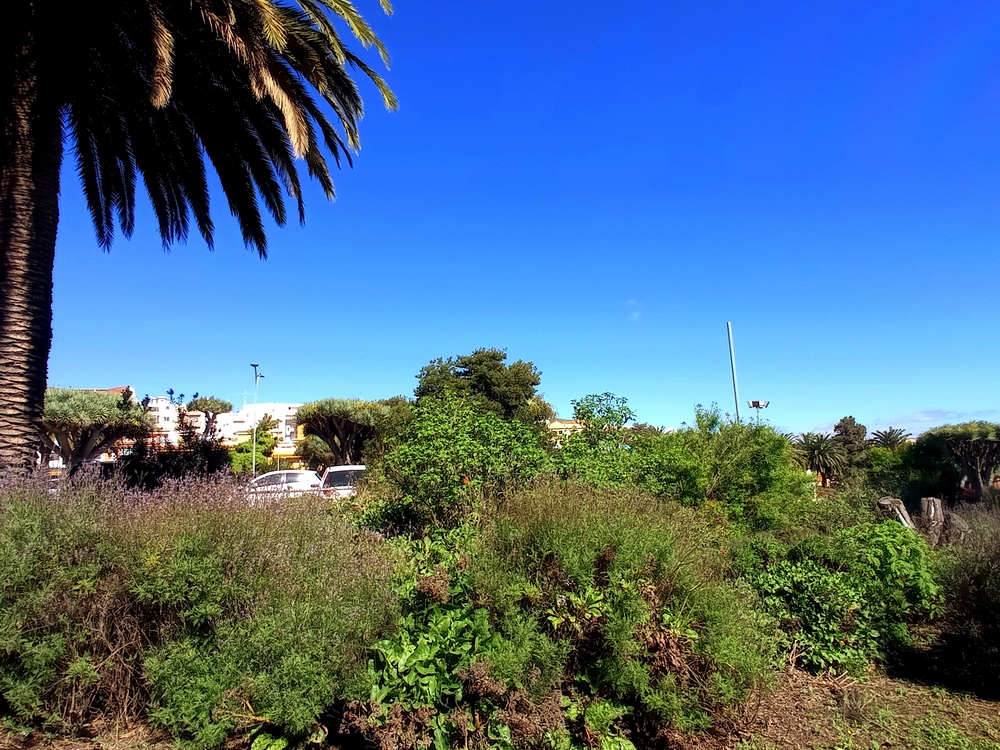
This section of the garden was planted in January 2013. The presence of a large palm tree led to its selection as a site for showcasing species typical of the thermophilous sclerophyllous forest. The proximity to the parking area, which generates noise, was mitigated by planting faya trees to create a barrier and bring some tranquility to the area. This was made possible by the introduction of several specimens of the endemic Tenerife species. Navaea phonicea The red rock mallow, a species frequented by certain birds in search of its sweet nectar, was planted to provide birds with a more peaceful environment for visiting the flowers, and this has been achieved.
The first work on this plot involved planting both tree and herbaceous species. In addition, a lavender hedge was planted.Lavandula canariensisThis hedge, which delimits the plot, is not trimmed after its flowers have dried, as it serves as an essential element for obtaining seeds of this species. This facilitates the colonization of other areas through seed bombs and the generation of seedlings within the plot itself. Therefore, it is necessary to allow the flowers to mature until they complete their life cycle. Once the seeds produced have matured, they are collected and extracted to create a mixture with topsoil. This mixture, once moistened, is then spread in other areas where this species is not present, thus avoiding the need for seedbeds.
Anagyris latifolia Brouss. exWilld.
Arbutus canariensis Veill. inDuhamel
Convolvulus floridus L. f.
Echium simplex DC.
Gonospermum fruticosum (Buch) Less.
Hypericum canariense L.
Lavandula canariensis Mill.
Limonium arboreum (Willd.) Erben, A. Santos & Reyes-Bet.
Morella faya (Aiton) Wilbur
Navaea phoenicea (Vent.) Webb & Berthel.
Phoenix canariensis H. Wildpret
Pterocephalus dumetorus (Brouss. exWilld.) Coult.
Teucrium heterophyllum L`Hér. subsp. brevipilosum Gaisberg
Government Pavilion, C/ Padre Herrera s/n
P.O. Box 456
38200, San Cristóbal de La Laguna
Santa Cruz de Tenerife - Spain
Switchboard Tel.: (+34) 922 31 90 00
Hours: Mon-Fri, 8:00 a.m. to 9:00 p.m.
