Pabellón de Gobierno, C/ Padre Herrera s/n
Apartado Postal 456
38200, San Cristóbal de La Laguna
Santa Cruz de Tenerife - España
Tel. Centralita: (+34) 922 31 90 00
Horario: L-V, 8:00 a 21:00 h

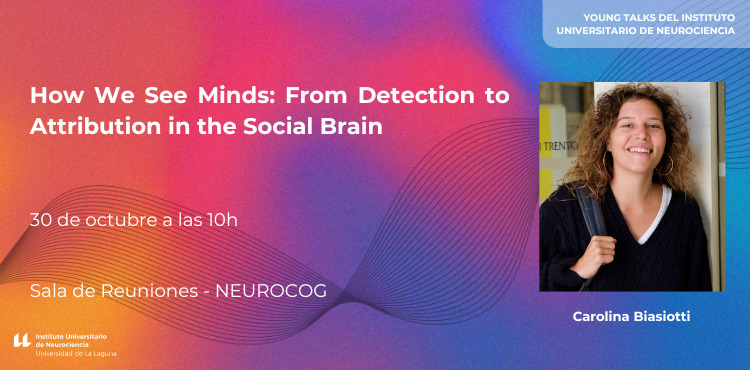
El Instituto Universitario de Neurociencia celebra a una nueva sesión del programa Young Talks que tendrá lugar el jueves 30 de octubre a las 10:00 h en la sala de reuniones del NEUROCOG. En esta ocasión asistirá Carolina Biasiotti, investigadora predoctoral en la Universidad de Trento, que impartirá la charla titulada “How We See Minds: From Detection to Attribution in the Social Brain».
A continuación, se incluye un breve resumen de la charla: Mentalizing—the capacity to infer others’ thoughts, intentions, and emotions—is a core function of social cognition. Yet, how this process
unfolds over time—from the detection of a mind to the attribution of internal states—remains unclear. In an initial EEG study, participants viewed faces varying in perceptual (human vs. doll-like) and contextual (ingroup vs. outgroup) cues. Early event-related potentials (ERPs) differentiated human from non-human faces, reflecting rapid mind detection, while later components indexed selective mind attribution, particularly enhanced for ingroup members. Building on these findings, a follow-up experiment—currently in preparation—adopts a refined paradigm designed to disentangle mind detection and attribution without the constraints of traditional oddball designs. By combining ERP measures with time–frequency analyses, this study aims to capture how perceived humanity and group membership modulate the unfolding of mentalizing in real time. Together, these studies advance a dynamic understanding of how the brain detects, attributes, and sometimes withholds minds from others—bridging the gap between perceptual encoding and higher-order social inference.
| L | M | X | J | V | S | D |
|---|---|---|---|---|---|---|
Pabellón de Gobierno, C/ Padre Herrera s/n
Apartado Postal 456
38200, San Cristóbal de La Laguna
Santa Cruz de Tenerife - España
Tel. Centralita: (+34) 922 31 90 00
Horario: L-V, 8:00 a 21:00 h
