CALL FOR PAPERS FORTVNATAE 44
2026-05-02
We open the deadline for submitting articles for number 44 (2026.2) of Fortunatae (December 2026 publication). Deadline 15th September.
Read more about CALL FOR PAPERS FORTVNATAE 44

We open the deadline for submitting articles for number 44 (2026.2) of Fortunatae (December 2026 publication). Deadline 15th September.
Read more about CALL FOR PAPERS FORTVNATAE 44
The present issue of the journal Fortunatae comprises ten peer-reviewed articles and one book review.
In “M. Licinio Craso en la Hispania Ulterior,” Luis Amela Valverde examines the circumstances surrounding Crassus' presence in the southern Iberian Peninsula, his relationship with Vibius Paciecus, and the historical veracity of the sack of Malaca.
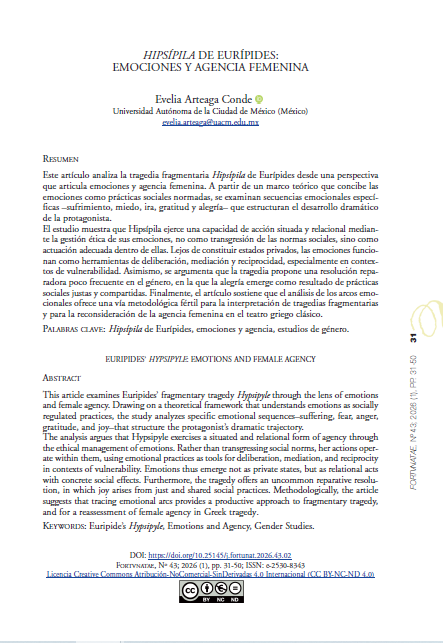
Evelia Arteaga Conde, in “Hipsípila de Eurípides: emociones y agencia femenina,” analyzes this fragmentary tragedy. Utilizing a theoretical framework that conceptualizes emotions as regulated social practices, the author examines specific emotional sequences that structure the protagonist's dramatic development.
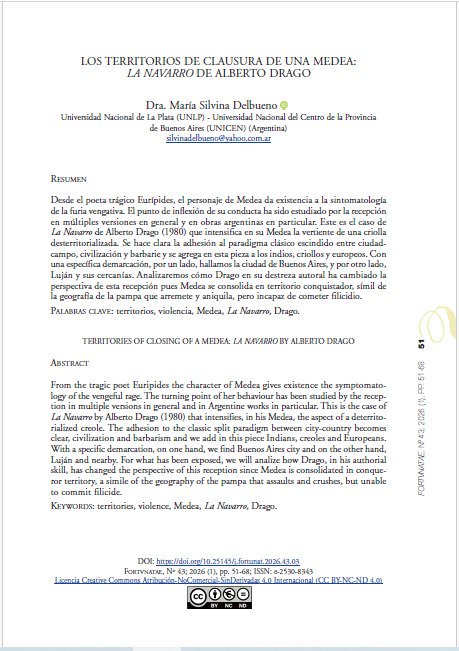
In “Los territorios de clausura de una Medea: La Navarro de Alberto Drago,” María Silvina Delbueno addresses the adaptation of the myth of Medea into a deterritorialized Argentine criolla. The study highlights the character's adherence to the classical paradigm divided between city and countryside, civilization and barbarism, while expertly integrating Indigenous populations, criollos, and Europeans—a synthesis that shifts the paradigm of classical reception.
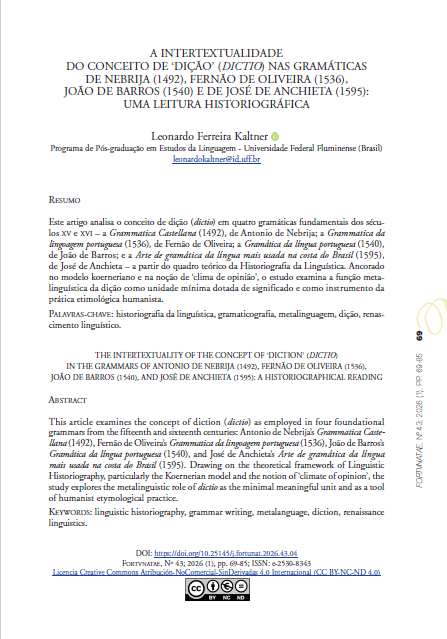
Leonardo Ferreira Kaltner’s contribution, “A intertextualidade do conceito de ‘dição’ (dictio) nas gramáticas de Nebrija (1492), Fernão de Oliveira (1536), João de Barros (1540) e de José de Anchieta (1595): uma leitura historiográfica,” explores the concept of speech (dictio) across four foundational grammars of the 15th and 16th centuries, framing the analysis within the historiography of linguistics.
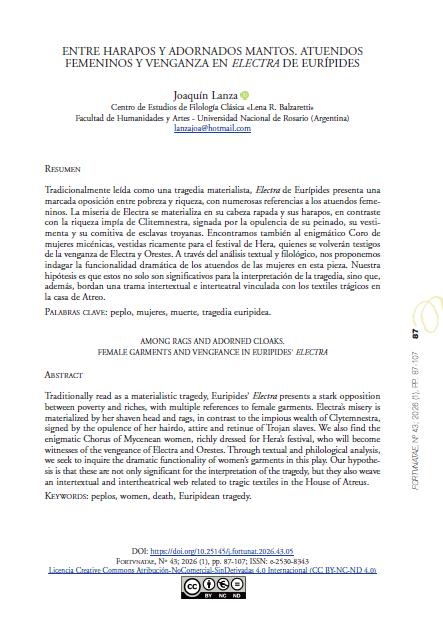
In “Entre harapos y adornados mantos. Atuendos femeninos y venganza en Electra de Eurípides,” Joaquín Lanza investigates the stark contrast between poverty and wealth within the tragedy. Specifically, the paper examines the frequent references to female attire and their thematic significance throughout the play.
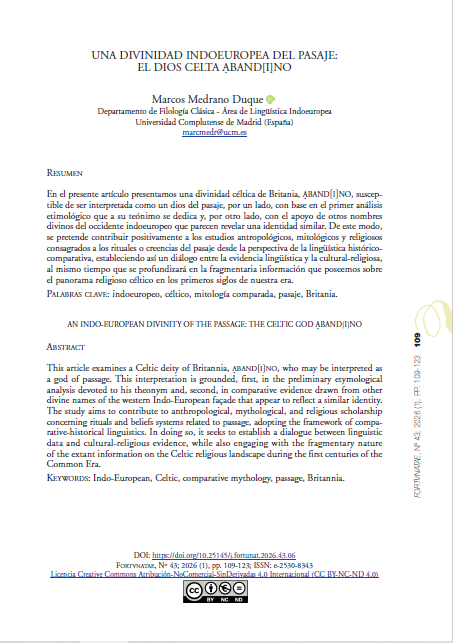
Marcos Medrano Duque, in “Una divinidad indoeuropea del pasaje: el dios celta A?BAND[I]NO,” seeks to contribute to anthropological, mythological, and religious scholarship on rites of passage, approaching the subject from the perspective of historical-comparative linguistics.
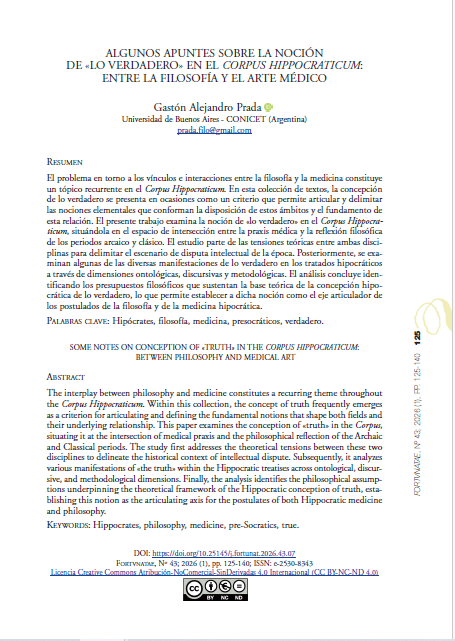
In “Algunos apuntes sobre la noción de «lo verdadero» en el corpus hippocraticum: entre la filosofía y el arte médico,” Gastón Alejandro Prada situates the notion of "the true" at the intersection of medical praxis and philosophical reflection during the Archaic and Classical periods.
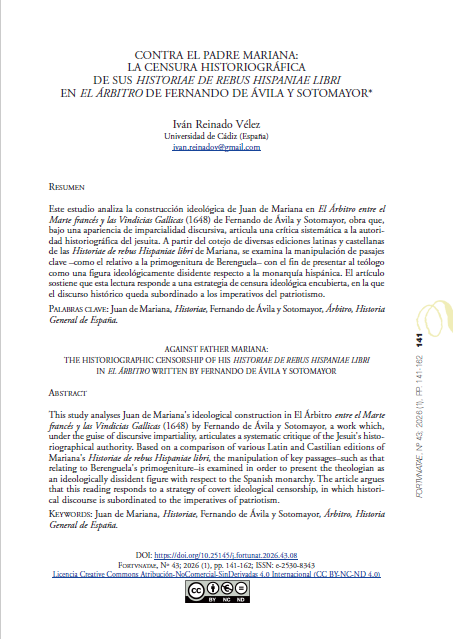
Iván Reinado Vélez, in “Contra el Padre Mariana: la censura historiográfica de sus Historiae de rebus hispaniae libri en El Árbitro de Fernando de Ávila y Sotomayor,” analyzes the ideological deconstruction of Juan de Mariana within Fernando de Ávila y Sotomayor’s El Árbitro entre el Marte francés y las Vindicias Gallicas (1648). The author argues that beneath an veneer of discursive impartiality, the work articulates a systematic critique of the Jesuit's historiographical authority.
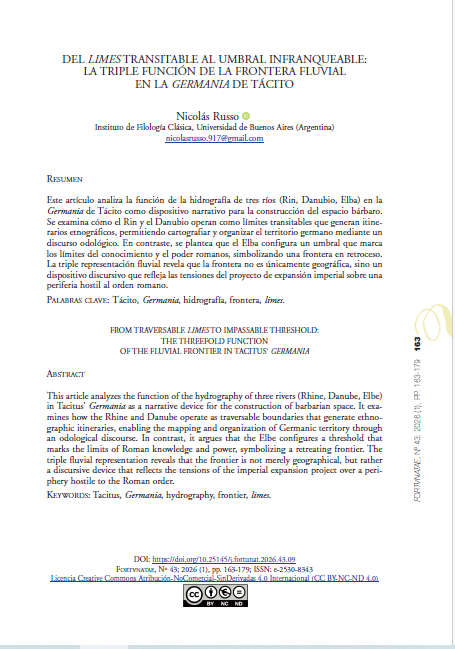
In “Del limes transitable al umbral infranqueable: la triple función de la frontera fluvial en la Germania de Tácito,” Nicolás Russo assesses the hydrography of three rivers (the Rhine, the Danube, and the Elbe) as a narrative device for the construction of barbarian space. The study concludes that while the Rhine and the Danube operate as permeable boundaries, the Elbe constitutes an impassable threshold that demarcates the limits of Roman knowledge and hegemony.
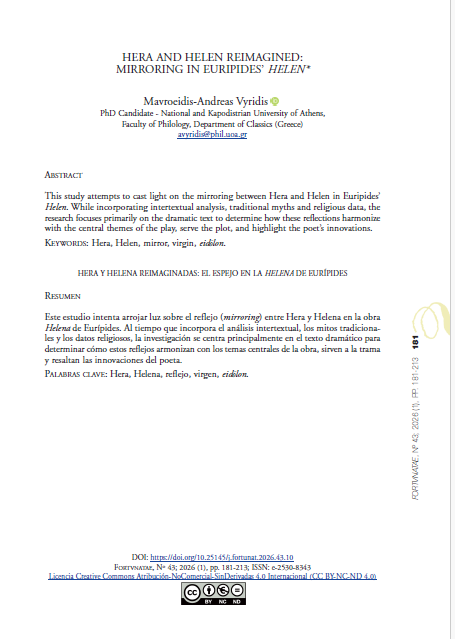
Finally, Mavroeidis-Andreas Vyridis, in “Hera and Helen reimagined: mirroring in Euripides’ Helen,” elucidates the mirroring effect between Hera and Helen in Euripides' Helen, determining how these reflections align with the central themes of the play, advance the plot, and underscore the playwright's innovations.
The Department of Filología Clásica, Francesa, Árabe y Románica at Universidad de La Laguna (Tenerife, Canaries, Spain) holds the academic journal Fortunatae. It is published online, free of charges and free accessed. It is devoted to the research of the different disciplines attached to Ancient Philology and Ancient Studies. It aspires to reach not only scholars but also readers interested in these fields of study.
Since its foundation in 1991, it has welcomed original and unpublished research and studies by national and international authors. The journal has a broad focus and receives articles and reviews on the different literary events and new research objects that have emerged within the field of classical studies and their survival.

Indexed in:




This work is licensed under CC BY-NC-ND 4.0