

September 22, 2026, marks the 50th anniversary of the assassination of Bartolomé García Lorenzo (1955-1976), one of the victims of police repression during the...

Seminar: Numerical integration on the unit circle based on interpolation and regression
Taught by: Ruymán Cruz Barroso (ULL)
In person at the Calabaza Building. Anchieta Campus. Classroom 2.3
Time: 12:00 – 13:00 h.
Summary:
Let mu be a positive Borel measure defined on [-pi,pi). In this talk we will consider the problem of estimating numerically and efficiently integrals of the form
The well-known Szegö quadrature formulas represent, on the unit circle, the rules of numerical integration analogous to the classical Gaussian quadrature formulas for estimating integrals with respect to measures supported on subsets of the real line. Szegö's formulas are interpolatory in nature, with the function F in (formula 1) being a Riemann-Stieltjes function integrable with respect to μ, and taking as nodes the zeros of polynomials para-orthogonal with respect to μ, which lie on the unit circle.
In many scientific contexts, the function F is not explicitly known but is derived from values obtained by devices or various types of experimental measurements. For this reason, new numerical integration techniques have recently been introduced with respect to measurements supported on the real axis, taking advantage of the available discrete information of the integrand and employing a hybrid technique combining interpolation and regression.
The aim of this talk is to introduce, for the first time in the literature, a mixed technique of a similar nature for estimating integrals on the unit circle, thus presenting a numerical alternative to Szegö quadrature formulas. Its content is based on work [2], in collaboration with Professor Lidia Fernández (University of Granada) and Francisco Marcellán (Carlos III University of Madrid). At the end, the general ideas of recent works [1] and [3] will also be discussed.
[1] R. Cruz-Barroso, L. Daruis and F. Marcellán, A connection between mock-Chebyshev least squares quadrature formulas on the interval and on the unit circle. In progress, 2026.
[2] R. Cruz-Barroso, L. Fernández and F. Marcellán, A mixed interpolation-regression method for numerical integration on the unit circle using zeros of para-orthogonal polynomials. Submitted, 2026.
[3] R. Cruz-Barroso, L. Fernández, F. Marcellán and JA Villegas, A mixed interpolation-regression method for function approximation on certain planar domains. Submitted, 2026.
Seminar: Integration of artificial intelligence for the design of mathematical modeling tasks
Taught by: Carolina Guerrero Ortiz (Pontifical Catholic University of Valparaíso, Chile)
In person at the Calabaza Building. Anchieta Campus. Classroom 2.3
Time: 12:00 – 13:00 h.
Summary:
This paper presents preliminary results from a teacher training program focused on designing mathematical modeling tasks with and without the support of artificial intelligence tools. The aim of this intervention is to understand how future mathematics teachers integrate these tools into their design processes and what characteristics the resulting tasks exhibit.
The findings suggest that the quality of designed tasks depends not only on the use of artificial intelligence, but also on the ability of future teachers to critically evaluate the responses generated by these tools. Specifically, the development of higher-quality modeling tasks is linked to the participants' pedagogical and subject-matter knowledge of the characteristics of a good modeling task, as well as to the pedagogical decisions they make regarding its adaptation and implementation in the classroom. These results reinforce the importance of promoting the critical and reflective integration of AI in initial teacher training.
Seminar: Weighted holomorphic approximation in the complex plane
Taught by: Franck Wielonsky (U. Aix-Marseille, France)
In person at the Calabaza Building. Anchieta Campus. Classroom 2.3
Time: 12:00 – 13:00 h.
Summary:
We consider pairs (G,W), G an open set in the complex plane and W a holomorphic function in G, having the property that any function f holomorphic in G can be locally uniformly approximated in G by weighted polynomials of the form W^n p_n, with deg(p_n) less than or equal to n. Such pairs were characterized, in terms of potential theory, by Pritsker and Varga in the 90's.
We will describe a quantitative version of this result in the spirit of the Bernstein-Walsh theorem. We will also consider in more details the case when G is a lemniscate, leading to an analogy of the famous Szegö curve related to the zeros of the normalized partial sums of the exponential function.
Seminar: Nilpotent Lie Groups and Ultra-Hyperbolic Differential Operators
Taught by: Irina Markina (U. Bergen, Norway)
In person at the Calabaza Building. Anchieta Campus. Classroom 2.3
Time: 13:00 – 14:00 h.
Summary:
In this talk, we introduce a special class of nilpotent Lie groups called Heisenberg-type groups. We will also discuss the difference between elliptic and hyperbolic operators on Euclidean space and their analogues on Lie groups.
Finally, we will define a natural differential operator on Heisenberg type Lie groups. We will discuss the fundamental solution of this operator, as well as related results found in the literature.
This is the joint work with Wolfram Bauer and Andre Froehly, Leibniz University Hannover, Germany.
Seminar: Metric projections and shift invariant subspaces in $H^p$
Taught by: Chris Felder (U. South Florida, USA)
In person at the Calabaza Building. Anchieta Campus. Classroom 2.3
Time: 12:00 – 13:00 h.
Summary:
In a normed linear space, it is often of interest to consider the distance between a given point and a given subspace. In particular, can one determine the distance between the point and the subspace, and can one find a point in the subspace which is closest to the given point? A nearest point may fail to be unique or even exist at all. However, in Hilbert space, an orthogonal projection provides the solution to this problem. In suitable Banach spaces, metric projections, which are non-linear analogues of orthogonal projections, produces the minimizer. We will consider such projections on the classical Hardy spaces on the unit disk. In particular, after motivation coming from Beurling's Theorem, we will discuss projections of the unit constant function onto shift-invariant subspaces. Joint work with C. Bénéteau, R. Cheng, D. Khavinson, M. Manolaki, and K. Maronikolakis.
Seminar: Wasserstein Limits for Empirical Measures of Markov Processes
Taught by: Fengyu Wang (Tianjin University, China)
In person at the Calabaza Building. Anchieta Campus. Classroom 2.3
Time: 12:00 – 12:00 h.
Summary:
In this talk we summarize some recent progress on limit theorems for the Wasserstein distance of empirical measures of Markov processes. For symmetric diffusion processes on Riemannian manifold, the sharp convergence rate is derived with renormalization limit formulated by using the spectrum of the generator. Furthermore, a general framework is established to estimate the convergence rate in Wasserstein distance of empirical measures for ergodic Markov processes.
Seminar: Non-locality in Stochastic Fluid PDEs — Pseudo-differential Noise and Mean-Field
Taught by: Hao Tang (Tianjin University, China)
In person at the Calabaza Building. Anchieta Campus. Classroom 2.3
Time: 12:15 – 13:15 h.
Summary:
In this talk, I will discuss SPDEs of fluid type featuring pseudo-differential noise (non-local in the spatial variable) and mean-field (non-local in the sample variable), respectively. In the case of pseudo-differential noise, we have uncovered certain cancellation properties inherent to pseudo-differential operators, which play pivotal roles in establishing the existence of solutions. Concerning mean-field dynamics, unlike classical SDEs/SPDEs, relying solely on stopping time techniques does not guarantee uniqueness. We have identified a new localized topology on measures that enables us to address this issue. Additionally, we have established abstract frameworks for each of these scenarios. To conclude, I will discuss some recent results and open problems in this field.
Seminar: New results in Old Topic: holomorphic self-maps in the hyperbolic geometry of the unit disk
Taught by: Pavel Gumenyuk (Politecnico di Milano, Italy)
In person at the Calabaza Building. Anchieta Campus. Classroom 2.3
Time: 12:00 – 13:00 h.
Summary:
The talk is based on joint results with Iason Efraimidis, Universidad Autónoma de Madrid, Spain (the first block) and with Maria Kourou, Annika Moucha, and Oliver Roth, University of Würzburg, Germany (the second block).
In the first block, we extend a remarkable result of A.Solynin (conjectured by D.Mejía and Ch.Pommerenke). The classical Schwarz Lemma states that the absolute value of a holomorphic self-map of the unit disk does not exceed |z| provided that the self-map fixes the origin. Solynin proved that if the latter condition does not hold, then the set of points at which the inequality in the Schwarz Lemma fails is convex in the hyperbolic geometry of the unit disk (with straight segments replaced by segments of hyperbolic geodesics). We extend this result to a one-parameter family of sets generated by a given holomorphic self-map.
The second block is related to the Schwarz-Pick Lemma, according to which the hyperbolic distortion of a holomorphic self-map – ie the hyperbolic norm of the derivative – cannot exceed 1, and the equality occurs only for conformal automorphisms. We study how the boundary behavior of the hyperbolic distortion is related to that of the self-map itself. In particular, we show that conformality at a boundary point is equivalent to a certain kind of asymptotic equality in the Schwarz-Pick Lemma.
Seminar: Optimization of material cutting problems in industry
Taught by: Juan Felipe Medina Mendieta (Pontifical Catholic University of Valparaíso, Chile)
In person at the Calabaza Building. Anchieta Campus. Classroom 2.3
Time: 12:00 – 13:00 h.
Summary:
Cutting and packing (C&P) problems are classified as NP-hard problems due to their complexity and the fact that, to date, there is no algorithm that can find the optimal solution in a reasonable time in real-world situations. For this reason, heuristic methods currently prevail for addressing these problems in practice. This presentation aims to introduce a line of research (spanning more than 15 years) developed by a group of researchers at the University of Cienfuegos, Cuba, to optimize the material cutting process in industry.
Consolidated results are presented for the optimization of material cutting in the 1D case, along with promising results for the 2D case. The problem is approached using integer linear programming (ILP), acknowledging that this modeling method has presented (and continues to present) the following drawbacks: the lack of an algorithm to generate cutting variations; and the resulting ILP model with a large number of variables and significant computational resource and/or processing time requirements. However, current computational advancements allow for reduced processing time and increased computational resources.
An alternative PLE modeling approach is presented that reduces the number of variables in the model, along with a computer program, OPTIVACOMULTI, created specifically for this purpose. OPTIVACOMULTI integrates: the generation of 1D and 2D cross-sectional variants; the shaping of the PLE model; the computational processing of the model using the Branch and Bound method; and the interpretation of the results through a report understandable to users involved in this task. Results applied to real-world problems are presented, demonstrating that:
Seminar: A Bekollé-Bonami class of weights on radial trees
Taught by: Elena Rizzo (U. Milano Statale, Italy)
In person at the Calabaza Building. Anchieta Campus. Classroom 2.3
Time: 12:00 – 13:00 h.
Abstract:
We consider a tree endowed with its natural Bergman measures, which generate Bergman spaces of harmonic functions and give rise to the associated Bergman projector P. By exploiting a suitable dyadic structure, sparse domination for P is obtained in both the doubling and nondoubling settings arising on radial trees. A new class of Bekollé–Bonami weights is then introduced, with a particular focus on the nontrivial nondoubling case. This leads to one- and two-weight inequalities for P and, as a consequence, to weighted boundedness results for Toeplitz operators.
Based on joint works with J. Conde Alonso, F. De Mari, M. Monti and M. Vallarino.
Seminar: On the stability of non-autonomous Schrödinger equations and applications to Quantum Control
Taught by: Juan Manuel Pérez Pardo (Carlos III University of Madrid)
In person at the Calabaza Building. Anchieta Campus. Classroom 2.3
Time: 12:00 – 13:00 h.
Abstract:
I will present a stability result of the non-autonomous Schrödinger equation for Hamiltonians with constant form domain. The sharp estimates obtained improve previous results in the literature and establish the well-posedness for general families of non-autonomous first order evolution problems in Hilbert spaces. As an application I will show how one can provide some approximate controllability results for infinite-dimensional quantum control problems.
Seminar: Efficient numerical methods for multidimensional reaction-diffusion PDEs
Taught by: Samira Iscaro (University of Salerno, Italy)
In person at the Calabaza Building. Anchieta Campus. Classroom 2.3
Time: 12:00 – 13:00 h.
Abstract:
Several real-world evolutionary processes, as eg electrodeposition phenomena, combustion processes, vegetation growth, or metallic corrosion, can be described by reaction–diffusion PDEs. Solving these problems numerically, however, can be challenging, as it requires efficient, stable, and accurate time integrators, in combination with appropriate spatial discretizations.
Thus, this talk is centered on two complementary objectives. First, we focus on splitting methods, such as AMF (Approximate Matrix Factorization), and matrix-oriented techniques, combined with W-type time integrators of order up to four [1,4,6], with the goal of improving their efficiency. By taking advantage of the structure of the matrices arising from the spatial discretization of the diffusion operator, these approaches significantly reduce computational cost while preserving the desired stability and accuracy properties [2].
Second, within the AMF framework, we address reaction–diffusion PDEs with time-dependent boundary conditions, which frequently arise in practical applications. In such cases, AMF schemes may suffer from order reduction. Motivated by recent results for Dirichlet boundary conditions [5], we introduce new boundary correction techniques for problems with Neumann, Robin, or mixed boundary conditions in multiple space dimensions, which preserve the theoretical order of accuracy of the underlying methods [3].
This is a joint work with Dajana Conte (University of Salerno), Severiano González-Pinto (University of La Laguna), Domingo Hernández-Abreu (University of La Laguna), and Giovanni Pagano (University of Naples Federico II).
References
[1] D. Conte, S. González-Pinto, D. Hernández-Abreu, and G. Pagano. On approximate matrix factorization and TASE W-methods for the time integration of parabolic partial differential equations. J. Sci. Comput. 100(2), 34. 2024.
[2] D. Conte, S. Iscaro, G. Pagano. On Matrix-Oriented and AMF-W Methods for advection-reaction-diffusion Partial Differential Equations. In preparation.
[3] S. González-Pinto, D. Hernández-Abreu, S. Iscaro. On the treatment of boundary conditions for AMF-W methods in diffusion-reaction PDEs. In preparation.
[4] S. González-Pinto, D. Hernández-Abreu, S. Pérez-Rodríguez. W-methods to stabilize standard explicit Runge–Kutta methods in the time integration of advection – diffusion – reaction PDEs. J. Comput. Appl. Math. 316.4, pp. 143–160. 2017.
[5] González-Pinto, S., Hernández-Abreu, D. Boundary corrections for splitting methods in the time integration of multidimensional parabolic problems. Appl. Number Math., 210: 95-112. 2025.
[6] W. Hundsdorfer, JG Verwer. Numerical solution of time-dependent advection diffusion-reaction equations. Vol. 33. Springer Science and Business Media., 2003.
Seminar: Fourth-order spatial discretizations in finite differences for parabolic PDEs with Dirichlet-type boundary conditions
Taught by: Severiano González-Pinto (ULL)
In person at the Calabaza Building. Anchieta Campus. Classroom 2.3
Time: 12:00 – 13:00 h.
Abstract:
We consider a fourth-order finite-difference spatial discretization for parabolic partial differential equations (PDEs), assuming time-dependent Dirichlet boundary conditions in rectangular domains and an initial condition. The spatial discretization is quite simple to implement, as it uses second-order central differences at points adjacent to the boundary and fourth-order differences for interior points of the spatial domain not adjacent to the boundary. This discretization has been successfully used in [1], where a global fourth-order approximation has been numerically confirmed in both the Euclidean and Maximum norms.
The key point here is to provide a theoretical justification for this global fourth-order approximation, which is somewhat surprising given that a second-order approximation is only used at points near the boundary of the spatial domain. In practice, the fourth-order discretization is quite useful for parabolic problems, as it allows for a very small number of points in the grid for each spatial dimension compared to the grid that must be used to obtain a similar approximation with a spatial grid based on second-order central differences. Some ideas for developing such a discretization and testing the main results are based on the material in Chapters I–IV of [2] and the references included therein.
[1] González-Pinto and Hernández-Abreu, D. Boundary corrections for splitting methods in the time integration of multidimensional parabolic problems. Applied Numerical Mathematics (2025), 210:95-112.
[2] Hundsdorfer, W. and Verwer JG, Numerical Solution of Time-Dependent Advection-Diffusion-Reaction Equations, Springer Series in Computational Mathematics, Springer-Verlag, Berlin, 2003.
Seminar: Effective Dynamics and Blow Up in a "Magnetic Relaxation" Model»
Taught by: Daniel Sánchez-Simón del Pino (University of Bonn, Germany)
In person at the Calabaza Building. Anchieta Campus. Classroom 2.3
Time: 12:00 – 13:00 h.
Abstract:
In the physics community, there is a relative consensus on the hypothesis that, generally speaking, a viscous plasma with very low resistivity tends to "relax" to a static, Beltrami-type regime. This is the so-called "Taylor conjecture," which is far from being well understood mathematically. The main reason for this is the complexity of the Magnetohydrodynamic (MHD) equations used to model this scenario. For this reason, various simplified models have been proposed to describe this phenomenon, with the aim of verifying (or disproving) the Taylor conjecture. In this talk, we will introduce one of these models, proposed by HK Moffat in 2015. The "low resistivity" hypothesis is introduced through a singular perturbation problem, in which we prove the existence of two timescales in the evolution: a first, faster timescale followed by a slower one. We also prove the existence of an effective PDE for this second stage of the evolution and demonstrate that it exhibits a blow-up in finite time. This opens the door to possible new phenomena that were not taken into account when this model was proposed. This talk is based on collaborative work with Dimitri Cobb and Juan JL Velázquez.
Seminar: Electrostatic interpretation of the roots of discrete orthogonal polynomials
Taught by: Joaquín Sánchez-Lara (University of Granada)
In person at the Calabaza Building. Anchieta Campus. Classroom 2.3
Time: 12:00 – 13:00 h.
Abstract:
One of the most fascinating aspects of studying families of orthogonal polynomials lies in the behavior of their zeros. At the end of the 19th century, T. Stieltjes introduced a model that allows for an electrostatic interpretation of the positions of these roots, enabling us to understand the properties of these zero distributions. The Stieltjes model essentially tells us that if a polynomial has simple roots and is a solution to a homogeneous linear differential equation of order 2, then its roots are in a certain electrostatic equilibrium. However, not all orthogonal polynomials are solutions to such a differential equation (i.e., with simple and known coefficients); the so-called discrete orthogonal polynomials satisfy a difference equation that, in a sense, plays the same role as the differential equation. The aim of this talk is to introduce a valid electrostatic model for these discrete orthogonal polynomials and to see how this model reveals properties about the distributions of their zeros.
Seminar: Convergence on the boundary for iterates of holomorphic self-maps of the unit disk
Taught by: Manuel Contreras (University of Seville)
In person at the Calabaza Building. Anchieta Campus. Classroom 2.3
Time: 13:00 – 14:00 h.
Abstract:
The study of iterated functions is fundamental in complex dynamics. For a holomorphic self-map of the unit disk, the Denjoy-Wolff Theorem (1926) establishes a key convergence property: if it is not an elliptic automorphism, then its sequence of iterates converges uniformly on compact subsets to a point of the closed disk, called the Denjoy-Wolff point of the function.
A related question concerns the behavior of these iterates at the boundary. By Fatou's Theorem, all corresponding functions have non-tangential limits at almost every point on the boundary of the unit disk. The behavior of this sequence depends significantly on whether the original function is an inner function or not. When it is an inner function, the behavior of boundary iterates is well-established and can be found in texts by Aaronson or Doering and Mañé.
However, when it is not an inner function, the problem remained open. Previous partial results have been contributed by Bourdon, Matache, and Shapiro; by Poggi-Corradini; and by Contreras, Díaz-Madrigal, and Pommerenke. In this talk, we present the complete: if this is not an inner function, then the sequence of boundary iterates converges to the Denjoy-Wolff point for almost every point on the circle.
Our technique also provides general results on non-autonomous iteration of holomorphic self-maps of the unit disk.
This talk is based on a joint paper with D. Betsakos (Aristotle University of Thessaloniki) and S. Díaz-Madrigal (University of Seville).
Seminar: Spaces of analytic functions and their associated domains: the case of Bergman spaces
Taught by: Francisco Cruz (ULL)
In person at the Calabaza Building. Anchieta Campus. Classroom 2.3
Time: 2:00 PM – 3:00 PM.
Abstract: In this talk we will review the problem of characterizing the X-domains: planar domains Ω such that every holomorphic map f: D → Ω belongs to a given space Pommerenke, 1978), the Smirnov class (Ahern, Cohn, 1983), and a Hardy space (Hansen, 1970).
We will also report on our recent progress for the case in which X is a (weighted) Bergman space. More specifically, we will determine the so-called Bergman number of a domain in terms of its hyperbolic distance. This result was first obtained by Karafyllia and Karamanlis in 2023 for simply connected domains. However, the ideas for our generalization are completely different: the result is obtained by working with growth spaces.
This is a joint work with Manuel D. Contreras and Luis Rodríguez-Piazza from the University of Seville.
Seminar: On the analytical continuation of Dirichlet series
Taught by: Athanasios Kouroupis (KU Leuven, Belgium)
In person at the Calabaza Building. Anchieta Campus. Classroom 2.3
Time: 13:00 – 14:00 h.
Abstract: This talk concerns the behavior of Dirichlet series in the regions where they can be extended as analytical functions. We will begin with an introduction to the theory of Dirichlet series from a classical and a functional analytical point of view. We will present results of Bohr and Titchmarsh, and then examine modern generalizations, studying when such an analytic continuation can be represented by a convergent Dirichlet series.
The talk is based on joint work with Ole Fredrik Brevig.
Seminar: How do interface-type boundary conditions affect species behavior?
Taught by: Cristina Brändle Cerqueira (U. Carlos III of Madrid)
In person at the Calabaza Building. Anchieta Campus. Classroom 2.3
Time: 13:00 – 14:00 h.
Abstract: In this seminar, we will present examples of population models in which two species live in two different regions of the same habitat separated by a permeable membrane and only come into contact through it. In this context, the membrane acts as a geographic barrier, and the exchange of information across it is modeled using the so-called Kedem-Katchalsky conditions. We analyze the existence and uniqueness of positive solutions as a function of the parameters involved in the system.
Seminar: A fast and memoryless numerical method for solving fractional differential equations
Taught by: Ernest Hairer (U. Geneva, Switzerland)
In person at the Calabaza Building. Anchieta Campus. Classroom 2.3
Time: 13:00 – 14:00 h.
Abstract: A fractional differential equation is a generalization of an integer order differential equation. The (local) integer derivative operator is replaced by a (non-local) fractional derivative. With the help of the Riemann-Liouville fractional integral such problems are transformed into Volterra integro-differential equations.
The content of this talk is a follow-up of the authors approach for the solution of differential equations with distributed delays. The main idea is to approximate the fractional kernel by a sum of exponential functions, and then to transform the fractional integral (of convolution type) into a set of ordinary differential equations. Solving the resulting (stiff) differential equation by a numerical time integrator gives a memoryless numerical method.
It is explained how the code RADAU5 can be used for solving fractional differential equations. Numerical experiments illustrate the accuracy and efficiency of the proposed method.
This talk is based on joint-work with Nicola Guglielmi at the GSSI, L'Aquila.
This seminar is funded by the Vice-Rectorate for Research and Transfer of the University of La Laguna.
Seminar: Towards a spectral characterization of cyclic functions in weighted Hardy spaces?
Taught by: Miguel Monsalve (Complutense University of Madrid)
In person at the Calabaza Building. Anchieta Campus. Classroom 2.3
Time: 13:00 – 14:00 h.
Abstract:
In this work, we study the extent to which it is possible to characterize the cyclicity (with respect to the shift operator) of a function $f$ belonging to a Hardy space with weight $H^2_omega$, based on the spectral properties of the associated operator $V_f = M_f^* M_f$. To do this, we describe several properties of the spectra that hold in a wide class of spaces and then focus on particular cases of Bergman-type spaces, for which we describe the spectrum of these operators and find their eigenfunctions.
This work has been done in collaboration with Daniel Seco.
This seminar is funded by the Vice-Rectorate for Research and Transfer of the University of La Laguna.
Seminar: Spectral properties, vector holomorphism, and asymptotic behavior of operators
Taught by: Oliver Navío (ULL)
In person at the Calabaza Building. Anchieta Campus. Classroom 2.3
Time: 13:10 – 14:00 h.
Abstract: Due to classical results from Dunford and Lin, it is known that if X is a Banach space and T is a linear, continuous operator on X such that lim||Tn||/n = 0, then T is uniformly ergodic if and only if either 1 is not in the spectrum of T, or 1 is a pole of the resolvent map given by r → (rI − T)^{−1}. This paper aims to provide a sufficiently accessible theory to state and prove these classical results. Furthermore, it explores situations where the condition that 1 is a pole of the resolvent can be replaced by the fact that 1 is isolated in the spectrum of T.
Seminar: Water wave radiation by a submerged disc
Taught by: Juliana Sartori Ziebell (U. Federal do Rio Grande do Sul, Brazil)
In person at the Calabaza Building. Anchieta Campus. Classroom 2.3
Time: 13:10 – 14:00 h.
Abstract: The interaction between water waves and objects is of great importance for the study of structures used in offshore and coastal engineering. In this talk, a thin plate is submerged below the free surface of deep water. The problem is reduced to a hypersingular integral equation of the second kind over the surface of a unit disc. This problem will be analyzed for particular cases. Numerical results will be presented for the heave added mass and damping coefficients.
Seminar: The Dirichlet problem for the Riesz p-Laplacian: regularity results
Taught by: Leandro del Pezzo (University of the Republic, Uruguay)
In person at the Calabaza Building. Anchieta Campus. Classroom 2.3
Time: 14:45 – 15:35 h.
Abstract: In this talk, we will study the Dirichlet problem for a class of fractional p-Laplacian equations defined through the fractional Riesz gradient, which differs from the fractional p-Laplacian. We develop new tools that allow us to adapt Savaré's method to this non-local framework, thereby obtaining global regularity estimates in Besov spaces for the solutions to the Dirichlet problem, with results that are accurate depending on the range of the exponent p. The results presented in this talk are in collaboration with Juan Pablo Borthagaray and Camilo Rueda.
Seminar: The difference quotient operator on model spaces
Taught by: Eugenio Dellepiane (Polytechnic University of Turin)
In person at the Calabaza Building. Anchieta Campus. Classroom 2.3
Time: 13:00 – 14:00 h.
Abstract:Given a point in the complex unit disk w in D, it is well known that the associated difference quotient operator defines a bounded operator on the Hardy space. The same construction no longer makes sense for boundary points.
In this talk, we restrict to a special class of closed subspaces of the Hardy space: the so-called model K_u, and we spaces show that in this context a difference quotient operator for certain boundary points exists. We discuss spectral properties of this operator, we give estimates on the norm and we show some applications that motivate our analysis. This talk is based on joint work with Carlo Bellavita and Javad Mashreghi.
Seminar: Spectra of Hausdorff matrices in BMOA and Bloch spaces
Taught by: Alejandro Mahíllo (University of Valencia)
In person at the Calabaza Building. Anchieta Campus. Classroom 2.3
Time: 13:00 – 14:00 h.
Abstract: Hausdorff matrices appear as a natural generalization of the Cesàro operator in holomorphic function spaces on disk. In 2006, P. Galanopoulos and M. Papadimitrakis characterized these Hausdorff matrices.
They defined bounded operators in various holomorphic function spaces on disk, such as Hardy Hp spaces, Bergman Ap spaces, BMOA space, and Bloch space, among others. More recently, L. Abadías and J. Oliva-Maza studied the spectral properties of Hausdorff matrices in Hardy and Bergman spaces, using their representation as operators subordinated to composition semigroups. However, these techniques are not applicable in BMOA and Bloch spaces.
In this talk, we will present a collaborative work with A. Siskakis, P. Galanopoulos, and J. Oliva-Maza in which, using predual operators and appropriate integral representations, it is possible to describe the spectrum, point spectrum, and essential spectrum of Hausdorff matrices in BMOA and Bloch. Furthermore, we will discuss concrete examples that illustrate these results.
Seminar: Approximation of peaked functions on the sphere: Neural networks, compressive sensing and superresolution
Taught by: Juan Antonio Villegas Recio (Granada)
In person at the Calabaza Building. Anchieta Campus. Classroom 2.3
Time: 13:00 – 14:00 h.
Let's imagine an even function defined on the 2-dimensional sphere with a certain peculiarity: it is characterized by having sharp peaks in a finite set of points.
Suppose we only know the function for a finite sample of points, and we want to retrieve information about the function's parameters to approximate it. This problem can be approached with different methods. One possibility is to take advantage of the form of the function's expression and the set of points where the function is known to create and train a neural network whose parameters provide information about the points and their associated coefficients. Another option is to use Compressive Sensing, a methodology that, starting from a large sample of points uniformly distributed across the sphere, searches for those that can, in some way, act as possible substitutes for the points where the peaks occur. These two options are viable and work, but they have several limitations. In this talk, a new methodology based on superresolution will be proposed, a technique from the field of computer vision used to recognize the most important elements of an image. From the information we know about the function, we construct a peak indicator function and, once identified, adjust the coefficients using a least-squares fit. The difference and main advantage of this method is that it does not require an iterative optimization process or training, which can be tedious. Finally, we will illustrate some numerical examples of these three methodologies, as well as possible practical applications of this problem.
Seminar: Maximal regularity at the endpoint for the discrete parabolic Cauchy problem and other prior estimates for nonlocal operators in discrete Besov spaces
Taught by: Marta de León (ULL)
In person at the Calabaza Building. Anchieta Campus. Classroom 2.3
Time: 13:00 – 14:00 h.
In the study of differential equations, it is desirable to obtain regularity results for the differential operators involved, as well as a priori estimates of the solutions. In particular, it is often interesting to know for which differential operators the phenomenon of "loss of regularity" does not occur, or, in other words, when an operator possesses the property of maximal regularity. In this talk we will prove that, thanks to the language of semigroups, in the case of the discrete Laplacian operator we can obtain maximal regularity at the endpoint in discrete Besov spaces, as well as other regularity properties for fractional powers of this operator.
The content of this talk is based on joint work with L. Abadias and A. Mahillo, see [1].
References
[1] L. Abadias, M. De Le´on-Contreras, and A. Mahillo, End-point maximal regularity for the discrete para bolic Cauchy problem and regularity of non-local operators in discrete Besov spaces, Journal of Differential Equations, 440 (2025), 113465.
Seminar: From Stirling to Hardy-Ramanujan and Beyond
Taught by: José Luis Fernández Pérez (Autonomous University of Madrid)
In person at the Calabaza Building. Anchieta Campus. Classroom 2.3
Time: 13:00 – 14:00 h.
The first colloquium of the Institute of Mathematics and Applications of the University of La Laguna for the 2025-2026 academic year will consist of a brief address by the Secretary of the Institute, Hipólito Hernández-Pérez, followed by a discussion led by Professor José Luis Fernández Pérez (Autonomous University of Madrid).
|
Monday
|
Tuesday
|
Wednesday
|
Thursday
|
Friday
|
Saturday
|
Sunday
|
|---|---|---|---|---|---|---|
10 events,
September 22, 2026, marks the 50th anniversary of the assassination of Bartolomé García Lorenzo (1955-1976), one of the victims of police repression during the... 
From October 7th to 30th, you can visit the photographic exhibition "Gaza, the unsilenced gaze. A call to not look away..." at the General and Humanities Library. 
The fifth edition of Campus América is coming, from October 19th to 30th, a space for evaluating and promoting the internationalization efforts of the University of La Laguna... 
The Canary Islands Institute of Hemodonation and Hemotherapy is carrying out its annual blood donation campaign among the university community. This year, the campaign will be... 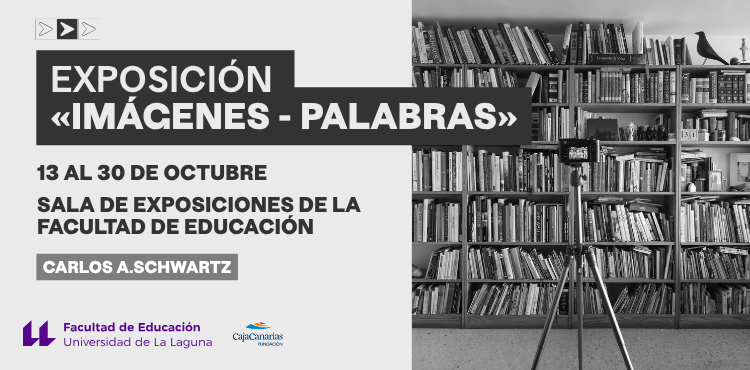
The Exhibition Hall of the Faculty of Education at the University of La Laguna will host, from October 13th to 30th, the exhibition 'Images - Words', a project by... 
The fifth edition of Campus América is coming, from October 19th to 30th, a space for evaluating and promoting the internationalization efforts of the University of La Laguna... 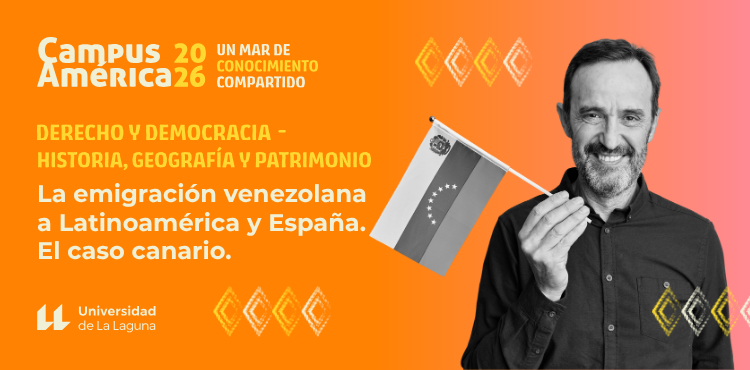
The fifth edition of Campus América is coming, from October 19th to 30th, a space for evaluating and promoting the internationalization efforts of the University of La Laguna...
-
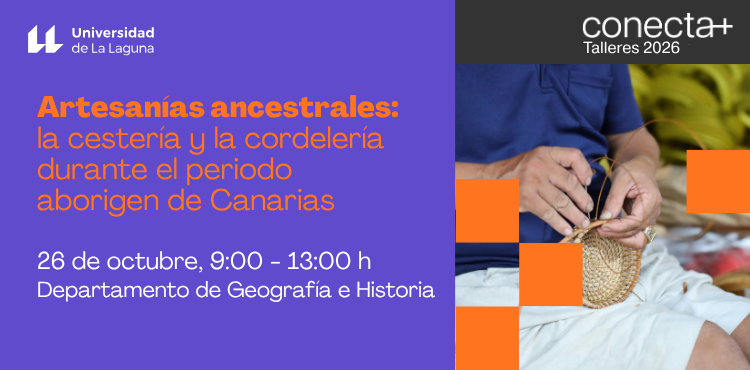
The workshop "Ancestral Crafts: Basketry and Rope Making during the Aboriginal Period of the Canary Islands" is part of the 2026 University Extension Workshops program "Connect+ Workshops". It will be held...
-
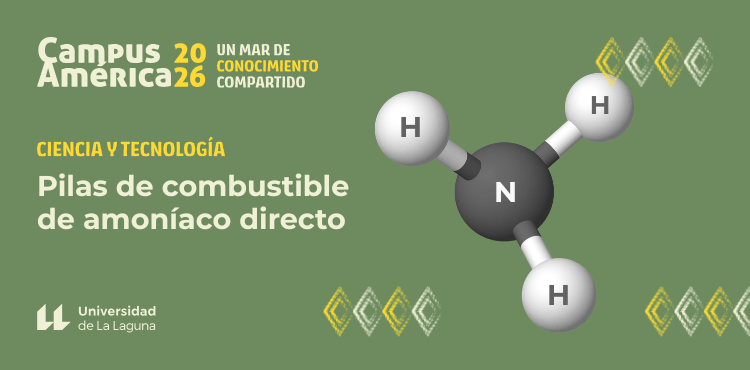
The fifth edition of Campus América is coming, from October 19th to 30th, a space for evaluating and promoting the internationalization efforts of the University of La Laguna...
-

The workshop "Let's Graft Fruit Trees" is part of the 2026 University Extension Workshops program, "Connect+ Workshops." It will be held in the Agricultural Engineering Department on Monday the 26th... |
15 events,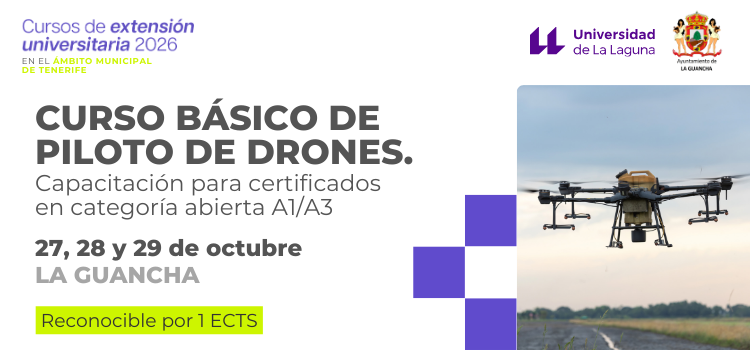
La Guancha hosts the course "Basic Drone Pilot Course. Training for open category A1/A3 certifications", jointly organized by the Vice-Rectorate for Culture and University Extension and the City Council... 
The Faculty of Law at the University of La Laguna will host the exhibition “Only Six. The Story of Salimata Sangare” throughout the month of November in its facilities... 
The fifth edition of Campus América is coming, from October 19th to 30th, a space for evaluating and promoting the internationalization efforts of the University of La Laguna...
-

The fifth edition of Campus América is coming, from October 19th to 30th, a space for evaluating and promoting the internationalization efforts of the University of La Laguna...
-
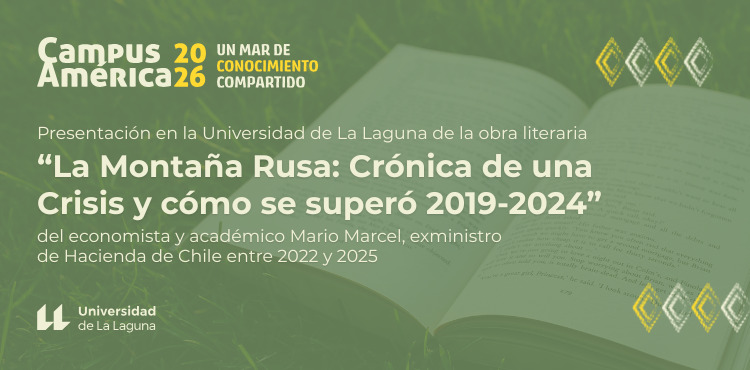
The fifth edition of Campus América is coming, from October 19th to 30th, a space for evaluating and promoting the internationalization efforts of the University of La Laguna...
-
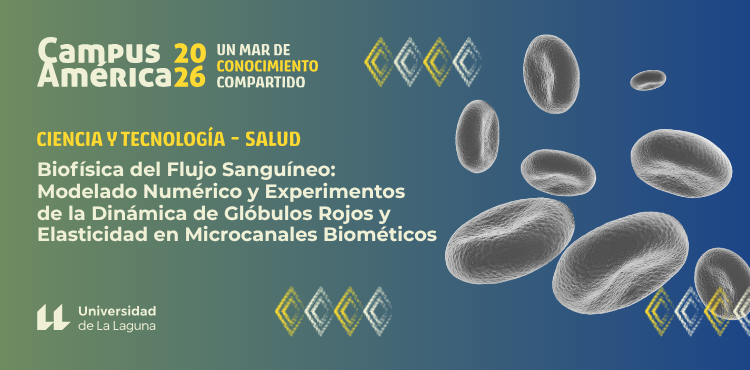
The fifth edition of Campus América is coming, from October 19th to 30th, a space for evaluating and promoting the internationalization efforts of the University of La Laguna... |
17 events,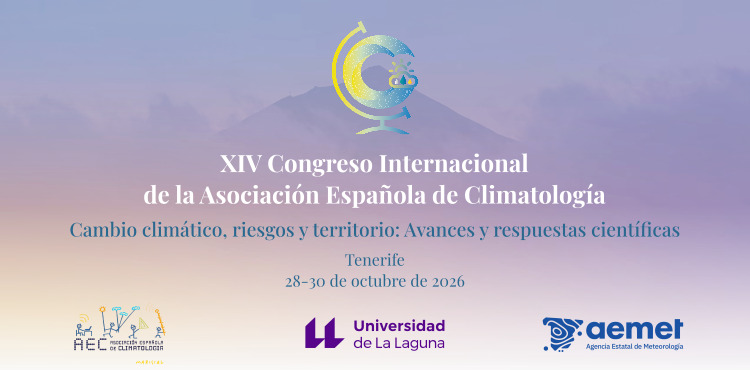
The Spanish Association of Climatology (AEC) was founded in 1998 to bring together those interested in climate science. Every two years... 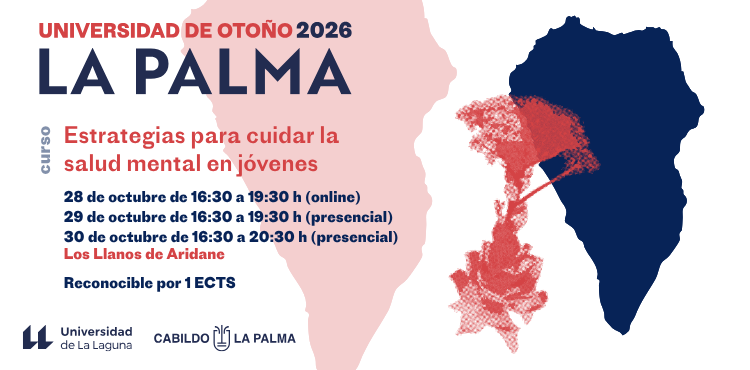
Los Llanos de Aridane hosts the University Extension course "Strategies for caring for the mental health of young people", which will be held on October 28, 29 and 30... 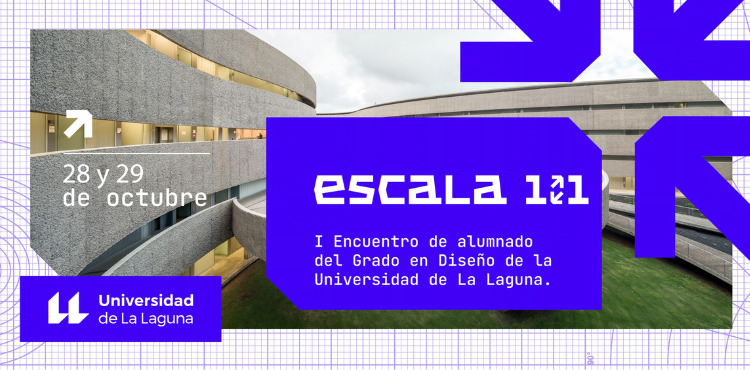
The Cultural Design Classroom is organizing this meeting which will be held at the Guajara Campus on October 28 and 29, 2026 from 4:30 pm to 7:00 pm... 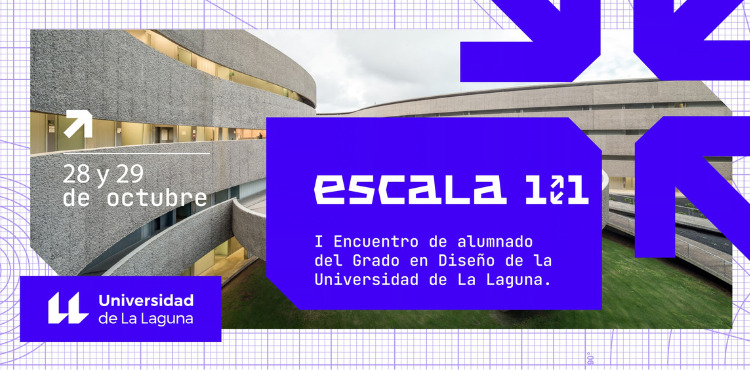
The Cultural Design Classroom is organizing this meeting which will be held at the Guajara Campus on October 28 and 29, 2026 from 4:30 pm to 7:00 pm...
-
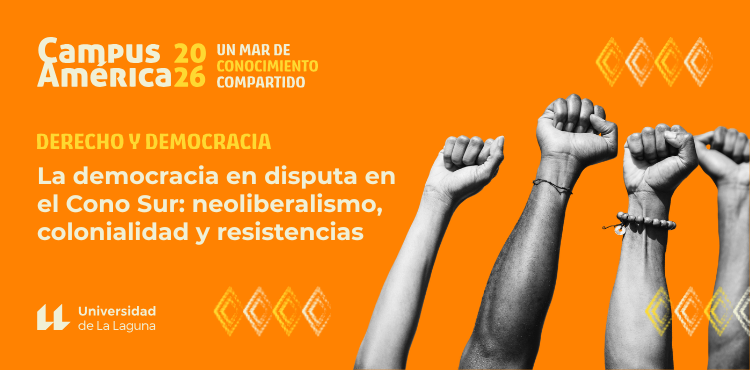
The fifth edition of Campus América is coming, from October 19th to 30th, a space for evaluating and promoting the internationalization efforts of the University of La Laguna...
-
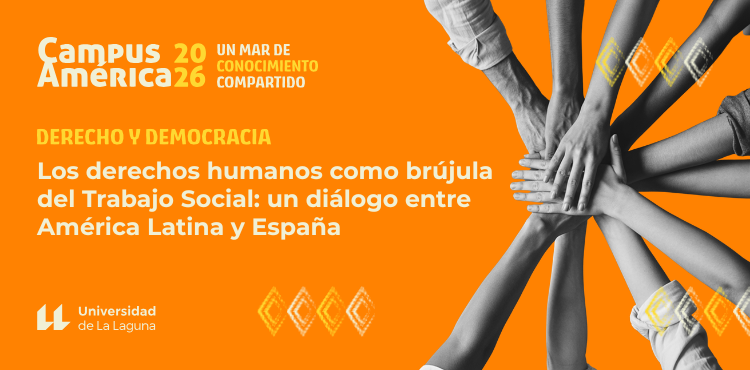
The fifth edition of Campus América is coming, from October 19th to 30th, a space for evaluating and promoting the internationalization efforts of the University of La Laguna...
-
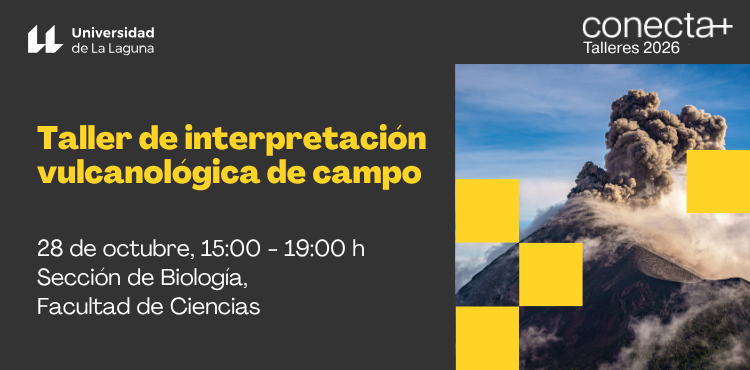
The "Field Volcanological Interpretation Workshop" is part of the 2026 University Extension Workshops program, "Connect+ Workshops." It will be held on Wednesday, October 28th... |
18 events,
The Scientific Conference is conceived as an “Open Laboratory” focused on advances in international research on Human Rights and Social Work. It aims to broaden and bring the content closer... 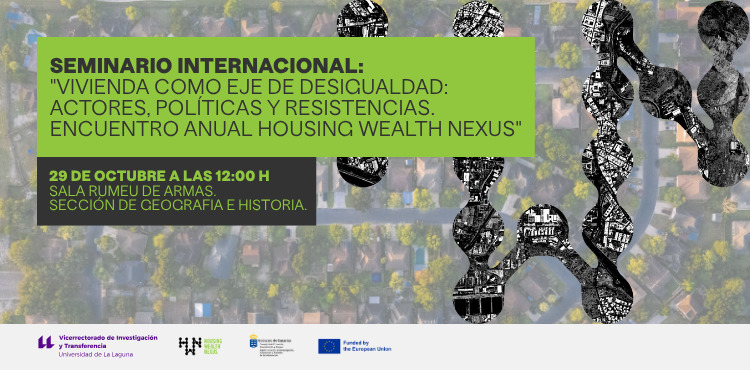
The international seminar "Housing as an axis of inequality: actors, policies and resistance. Housing Wealth Nexus Annual Meeting" will take place on October 29 and 30 at the University of... 
The orientation meeting in Tenerife will take place on October 29th in the Blas Cabrera Felipe Auditorium, in the Physics and Mathematics Building of the Faculty of... 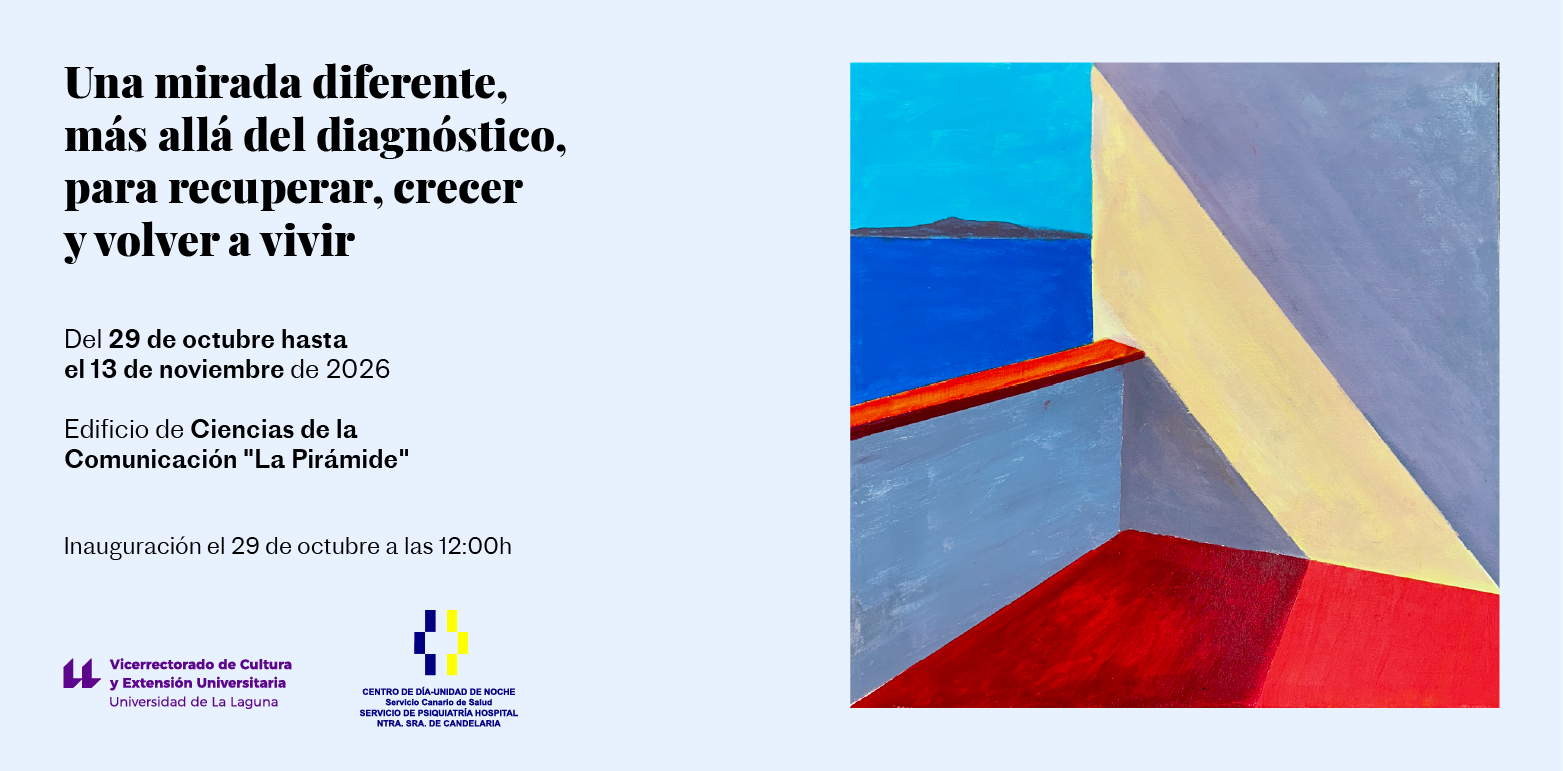
As a parallel activity to the upcoming ULL Debates: Our Mental Health, scheduled for October 29th at the Faculty of Social Sciences and Information, we will have...
-

The workshop "Voice Care: Experiential Training and Prevention for Everyday Life" is part of the 2026 University Extension Workshops program "Connect+ Workshops". It...
-

Mental health is a broad phenomenon that affects multiple aspects of our society; therefore, the public university stands as a space for the everyday expression of...
-

The fifth edition of Campus América is coming, from October 19th to 30th, a space for evaluating and promoting the internationalization efforts of the University of La Laguna... |
16 events,
-
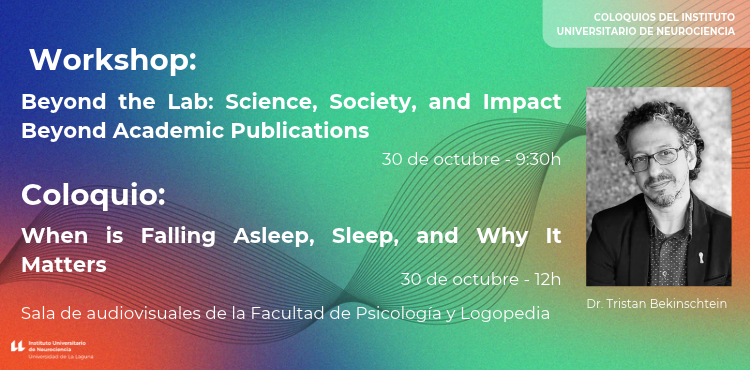
The University Institute of Neuroscience (IUNE) is organizing a conference next Friday, October 30th, with Dr. Tristan Bekinschtein, a researcher in the Department of Psychology at the University of Cambridge,...
-

The European Documentation Centres of the ULL and the ULPGC, together with the Canary Islands Council of the European Movement, Eurodesk Spain, Europe Direct Canarias and the Parliament of the Canary Islands, are organizing a...
-
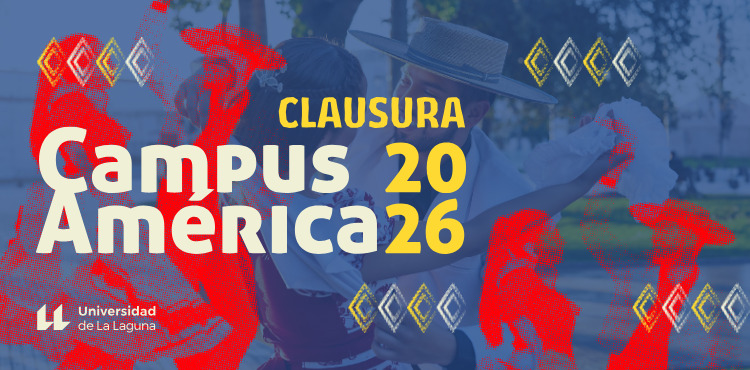
The closing ceremony for the fifth edition of Campus América will take place on Friday, October 30th. This year's event runs from October 19th to 30th. Campus América is... |
6 events,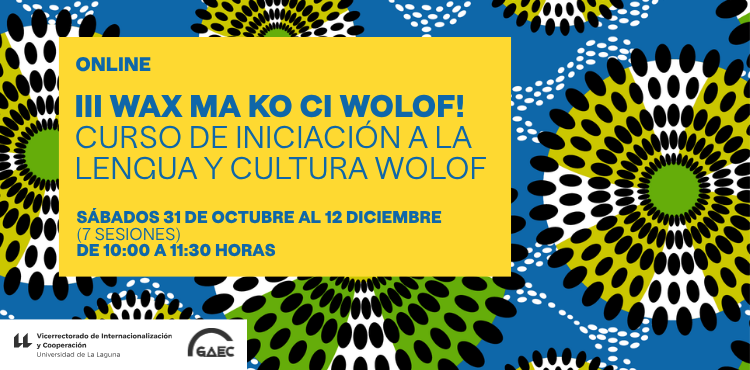
Following the excellent reception of the first two editions, the Directorate of Cooperation and Mobility with Africa and Latin America of the University of La Laguna, in collaboration with the laboratory...
-
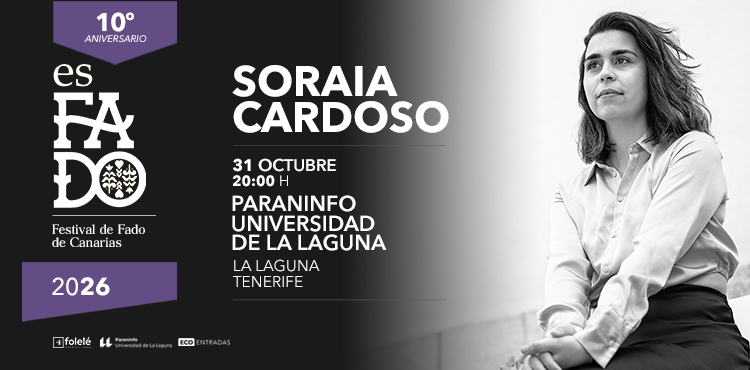
Soraia Cardoso is one of Portugal's rising fado singers. In 2018, she was a contestant on the television program The Voice Portugal, where she finished in third place. She was the first fado singer... |
5 events, |
6 events,
The course "Lifestyle Medicine: Prescribing Habits to Improve Health" is part of the 2026 University Extension Courses program "Connect+ Expand Your Knowledge". It... |
11 events,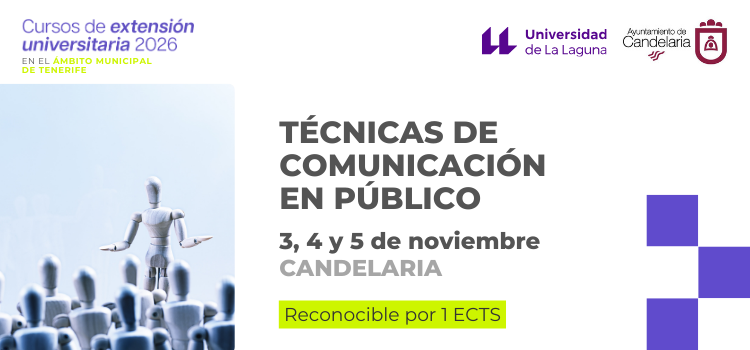
Candelaria hosts the course "Public Speaking Techniques", organized jointly by the Vice-Rectorate for Culture and University Extension and the Candelaria City Council, as part of the Courses program... 
The Directorate of Cooperation and Mobility with Africa and Latin America of the Vice-Rectorate for Internationalization and Cooperation launches the second edition of the interdisciplinary workshop "Stories from the Global South: other voices, other... 
The Javier Muguerza Carpintier Cultural Chair is organizing an Ibero-American seminar with Mexican and Spanish thinkers on Ecojustice, Borders, and Inequalities. Mexican professors and researchers from the Benemérita Universidad Autónoma de San Juan will participate. 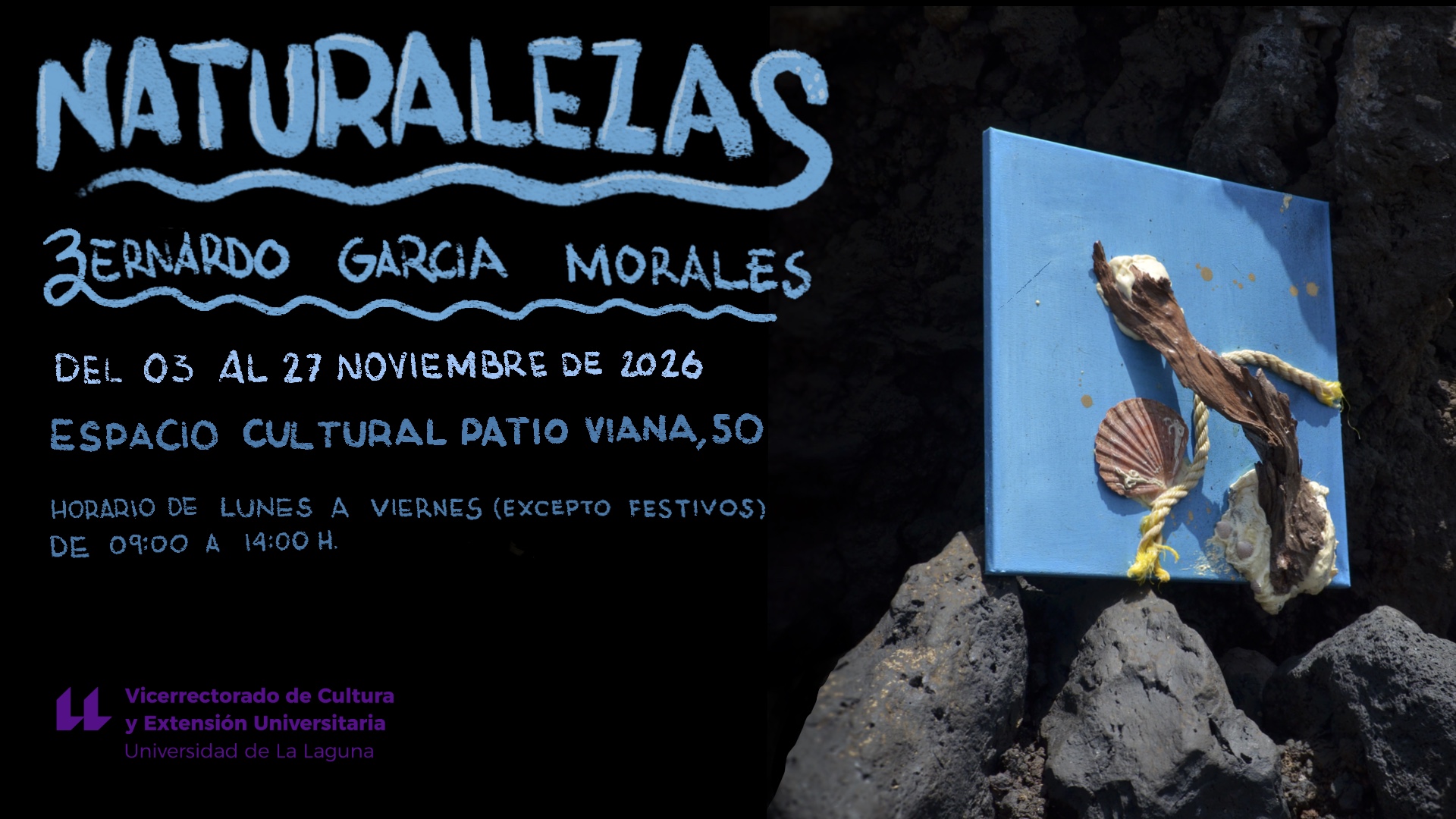
Bernardo García Morales's paintings explore the intrinsic beauty of natural materials and their capacity to become landscapes. His work is close to informalism and linked to tradition...
-
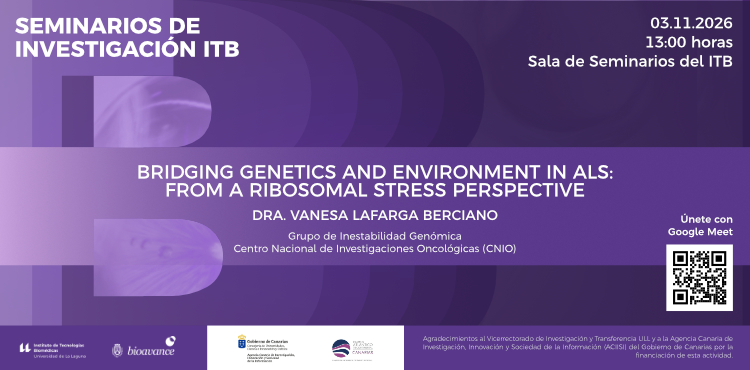
The ITB 2026 Research Seminars program continues on Tuesday, November 3rd at 1:00 pm with a seminar by Dr. Vanesa Lafarga, who will give a talk entitled "Bridging...
-
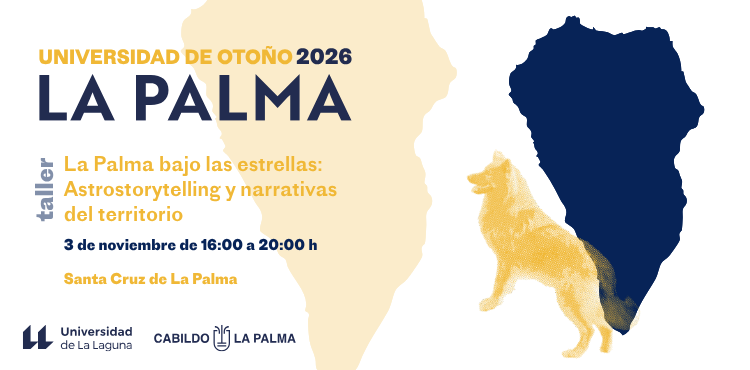
Santa Cruz de La Palma hosts the University Extension workshop "La Palma under the stars: Astrostorytelling and narratives of the territory", which will be held on November 3, 2026...
-

The International Ballet Company, one of Europe's finest classical ballet companies, comprised of soloists and dancers from England, France, Ukraine, Spain, and Italy, among other countries, presents us... |
14 events,
In August 2025, the University of Costa Rica held the First International and Interdisciplinary Congress 'Unlivable Lives: Masculinities in Ibero-America'. This meeting addressed... 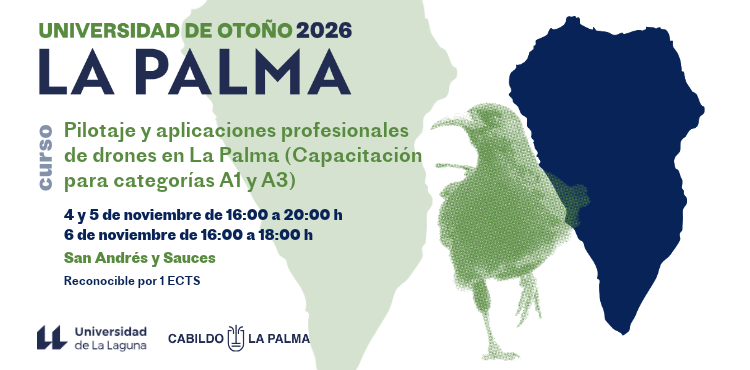
San Andrés y Sauces hosts the University Extension course "Drone Piloting and Professional Applications in La Palma (Training for categories A1 and A3)," which will be held on... 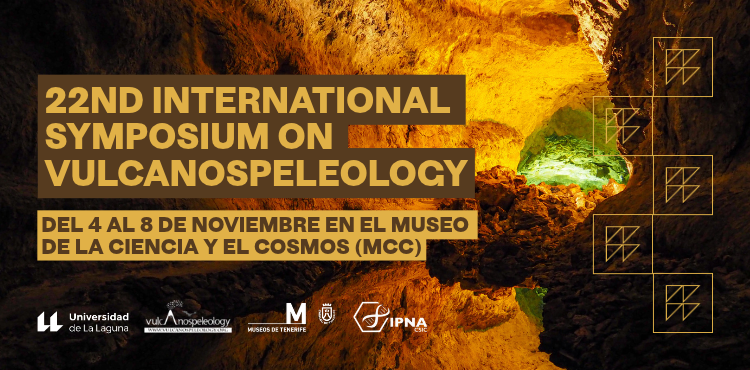
The 22nd International Symposium on Volcanospeleology (ISV22) is the world's leading meeting dedicated to the study of lava tubes and cavities, structuring its program... 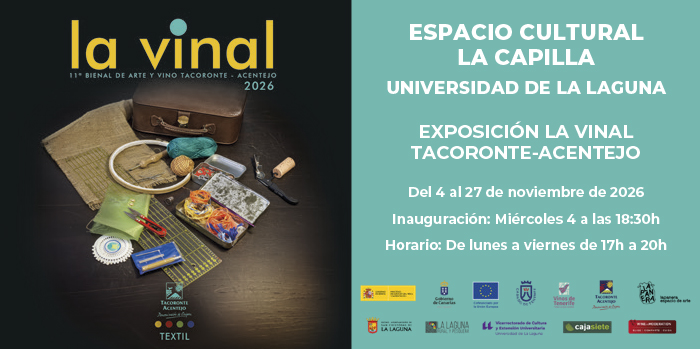
La Vinal. The Tacoronte-Acentejo Art and Wine Biennial is a project that, since 2006, has fostered a dialogue between contemporary artistic practices and the wine culture of the region. Each edition...
-
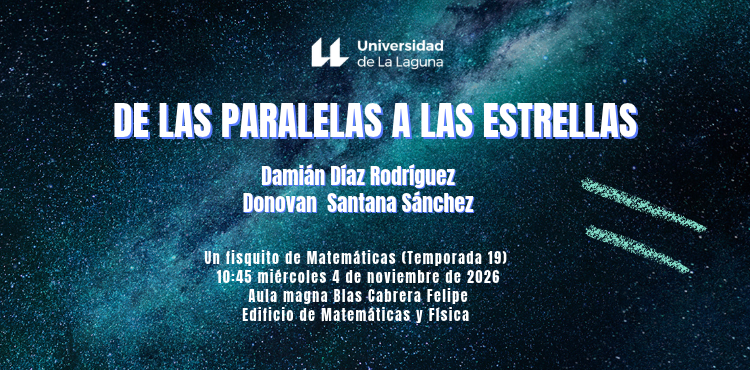
On Wednesday, October 14th, the 19th season of a new mathematical physics show continues in the Blas Cabrera Auditorium of the Physics and Mathematics Building at the University of...
-

The Institute of Canarian Studies is hosting this art workshop, "Ecology and Collage: Recreating the Canary Islands," which will be held on November 4, 2026, from 5:00 p.m. to 7:30 p.m.
-
The International Ballet Company, one of Europe's finest classical ballet companies, comprised of soloists and dancers from England, France, Ukraine, Spain, and Italy, among other countries, presents us... |
13 events,
-
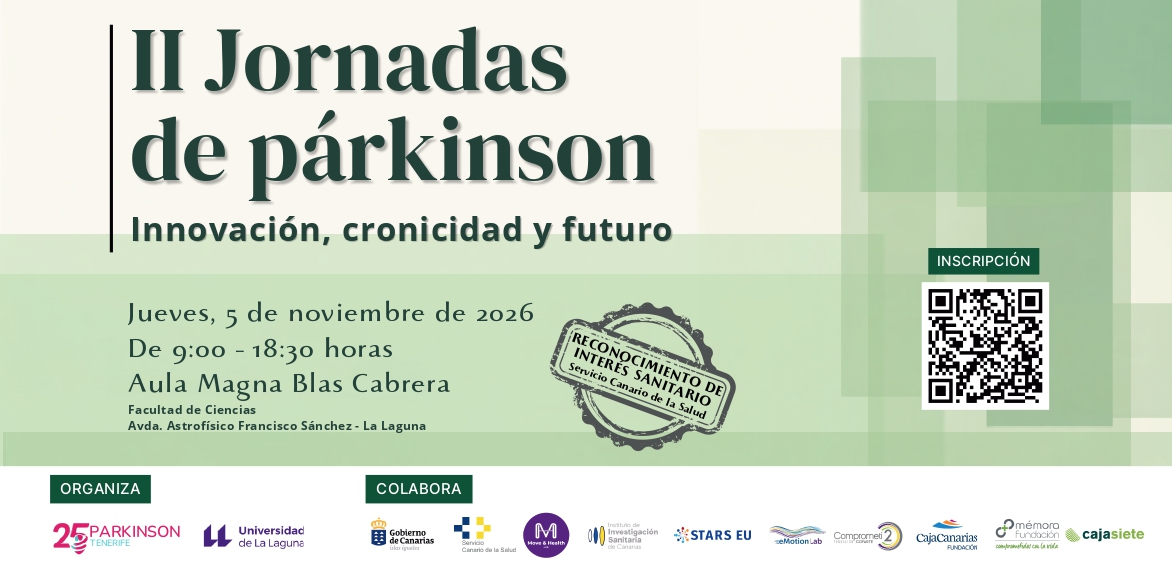
The 'II Parkinson's Conference: Innovation, Chronicity and Future' is presented as a space for meeting, training and knowledge exchange to delve deeper into the comprehensive approach to the disease...
-
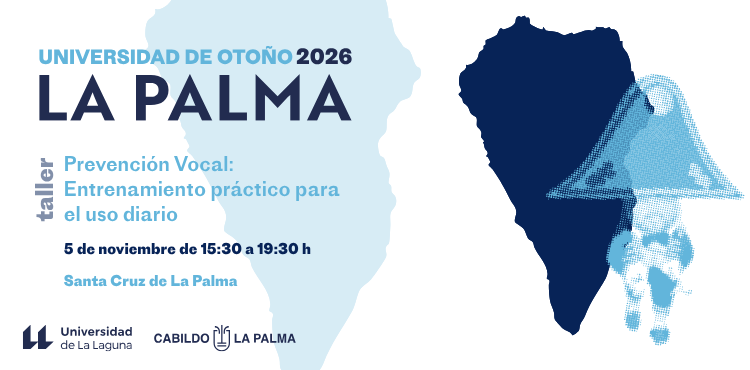
Santa Cruz de La Palma will host the University Extension workshop "Vocal Prevention: Practical Training for Daily Use," which will be held on November 5, 2026, at...
-

The International Ballet Company, an acclaimed company comprised of soloists from Ukraine, France, Moldova, Spain, and Italy, among other countries, invites us to enjoy its 2026 Winter Tour... |
14 events,
Nothing is what it seems, the new show by Dakris, The Invisible Magician, winner of the First National Magic Prize, a television creative and winner of the award for best magician...
-
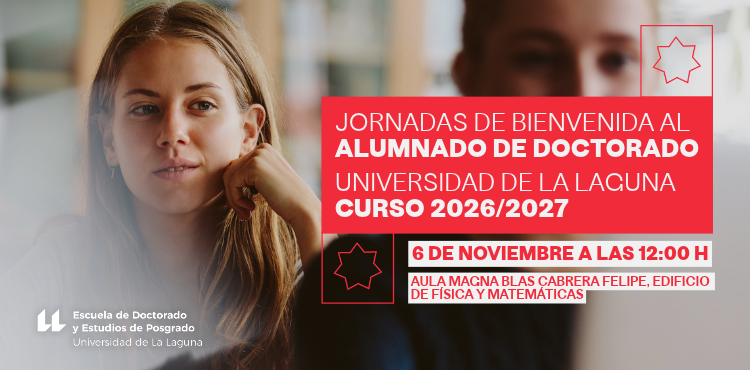
The Blas Cabrera Felipe Auditorium, located in the Physics and Mathematics Building of the University of La Laguna, will host an event on Friday, November 6th, starting at...
-
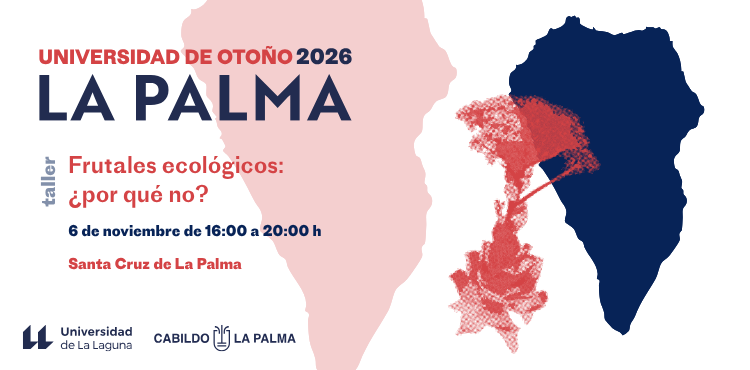
Santa Cruz de La Palma hosts the University Extension workshop "Organic fruit trees, why not?", which will be held on November 6, 2026 from 4:00 pm to 8:00 pm...
-

In the depths of the ocean, where light barely penetrates and conditions are extreme, marine mammals like the sperm whale have developed amazing survival skills, using sound as... |
10 events, |
10 events, |
10 events,
-

The University of La Laguna and the STARS EU community are organizing the presentation of the Circular Economy Living Lab, which will take place next Monday, November 9th...
-

The Cultural Classroom of Contemporary Artistic Thought is organizing this event, which will be held at the La Limonera Cultural Association on Monday, November 9th, from 5:00 PM to 10:00 PM... |
15 events,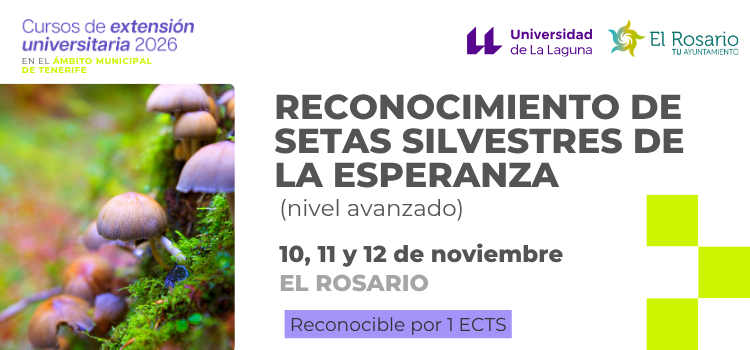
El Rosario hosts the course "Identification of wild mushrooms of La Esperanza (advanced level)", jointly organized by the Vice-Rectorate for Culture and University Extension and the Illustrious City Council of El Rosario,... 
The 1st International Conference on Renewable Energy will take place on the island of El Hierro from November 10th to 13th, 2026. El Hierro is not just the setting... 
The Research Group: Law, Person and Family, is organizing these conferences which will be held at the Faculty of Law on Tuesdays, November 10 and 17, 2026, at the following times...
-

The 2nd Conference "Take Care of Your Sexuality: Young Women, Disabilities and Prevention of Sexual Violence" is an initiative promoted within the framework of collaboration between the General Directorate of...
-
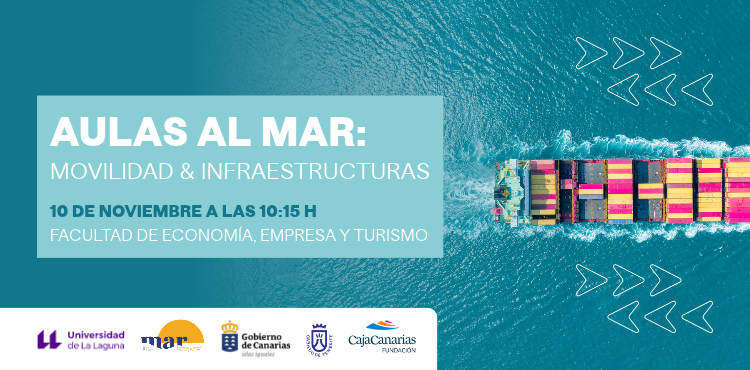
On Tuesday, November 10th at 10:15 am, the "Classrooms to the Sea" event will take place at the Faculty of Economics, Business and Tourism of the University of La Laguna.
-

The Faculty of Social Sciences and Communication's Board Room will host the presentation of the book: "Western Sahara 1975. The End of Francoist Colonialism," which will take place... |
10 events,
-

The work of a psychomotor therapist with children cannot be separated from the child's family reality. Involving the family in the therapeutic process entails...
-

Every time Petite Lorena moves across the stage, she effortlessly traverses the precipice that separates political correctness from incorrectness, a precipice that is, incidentally, more slippery than ever now.... |
16 events,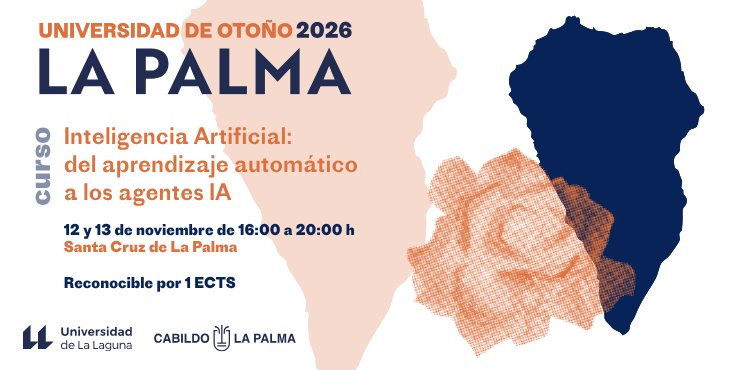
Santa Cruz de La Palma hosts the University Extension course "Artificial Intelligence: from machine learning to AI agents", which will be held on November 12 and 13... 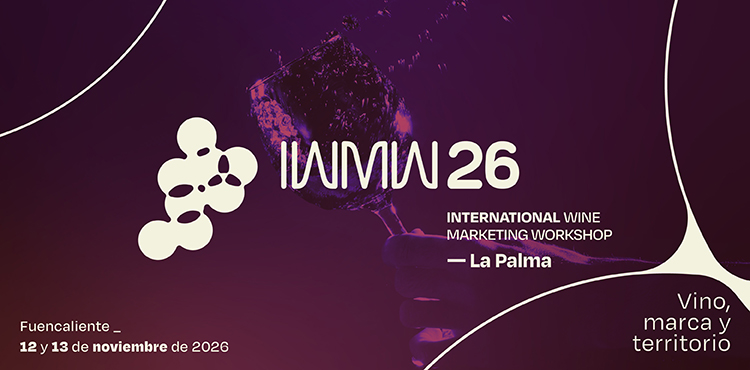
The "1st International Wine Marketing Workshop. La Palma 2026" will be held at the San Antonio Volcano Visitor Centre in the municipality of Fuencaliente on the 12th and 13th... 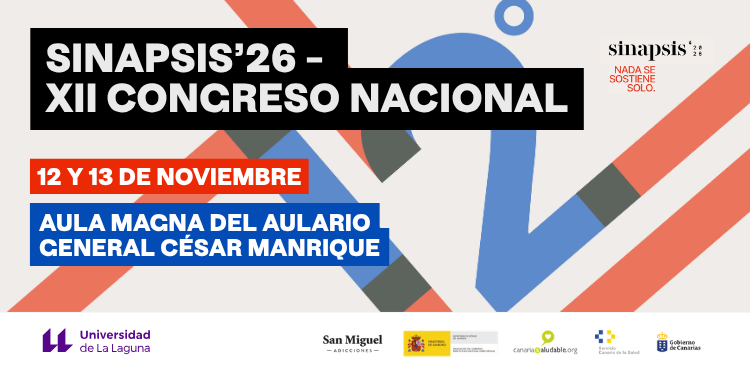
The twelfth edition of Sinapsis will be held on November 12th and 13th in the Aula Magna of the César Manrique General Lecture Hall at the University of La Laguna. This... 
The 3rd International Technical Conference on Sustainable Viticulture will be held on the island of La Gomera on November 12, 13 and 14, 2026. This event,...
-
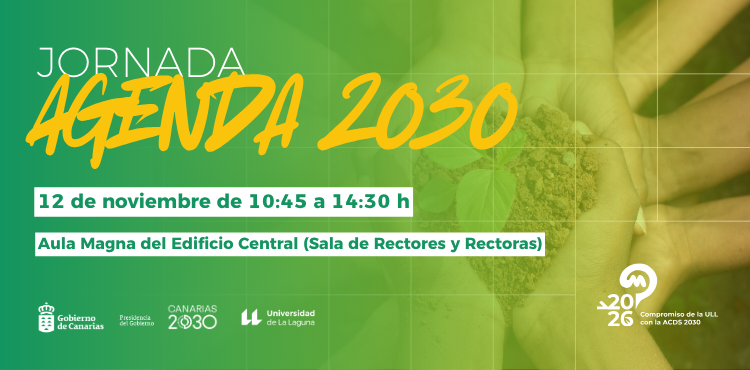
The University of La Laguna will present the projects developed in the... next Thursday, November 12, at 10:45 a.m., in the Aula Magna of the Central Building (Rector's Hall).
-

Historical routes are currently being debated between their status as a strategic resource and their potential for sustainable use by communities that have recognized their potential...
-
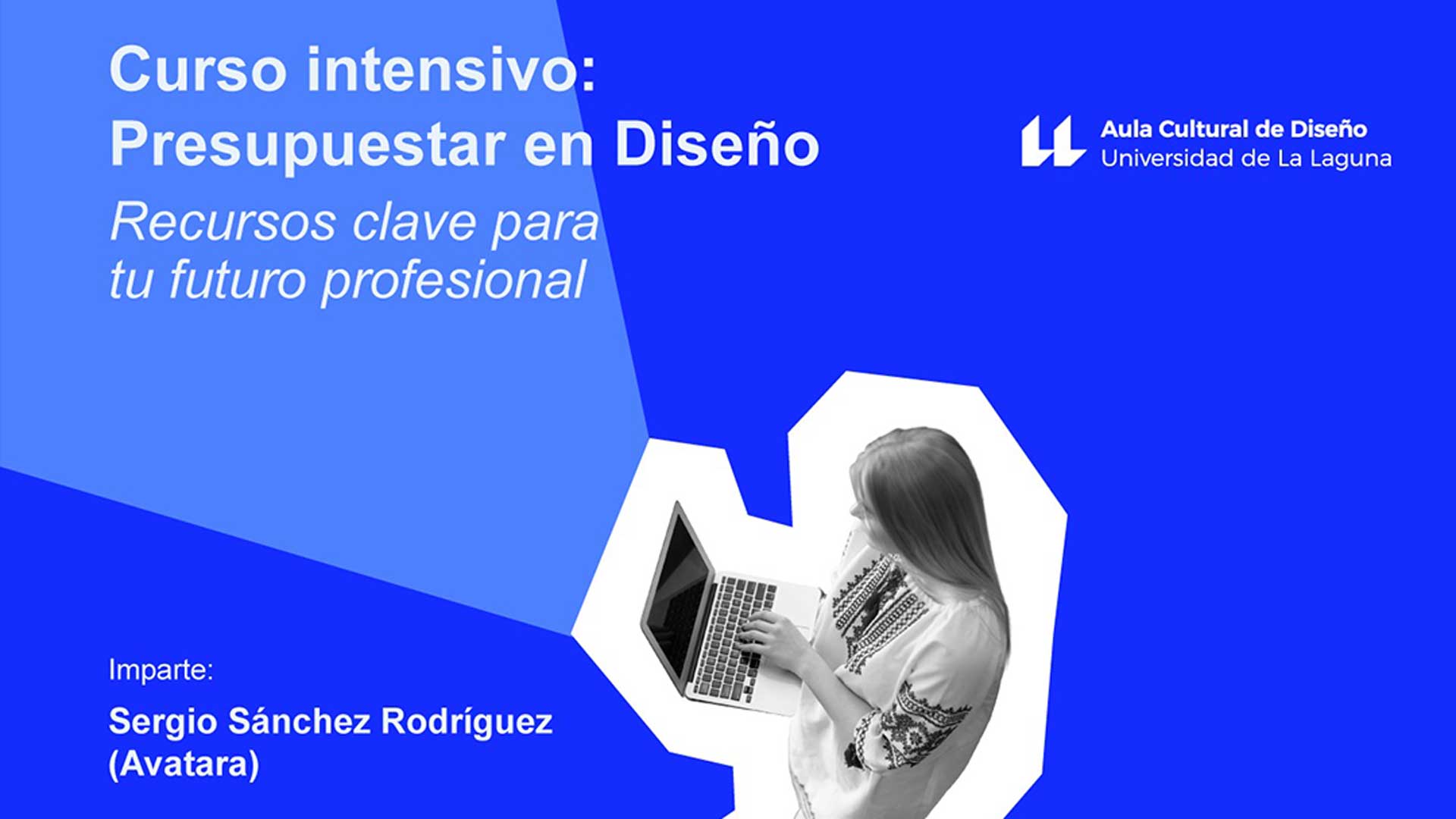
Do you know the true value of your work as a creative designer? Budgeting a creative project goes far beyond simply assigning a price. It involves knowing how to value your work, manage projects, and defend your position... |
13 events,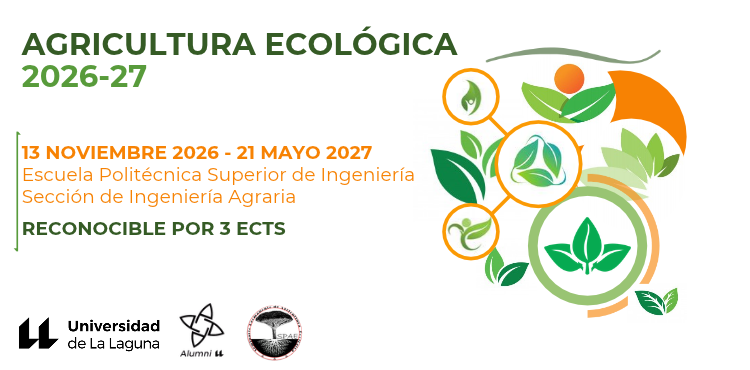
The Permanent Seminar on Organic Agriculture (SPAE) and the Association of Former Students and Friends of the University of La Laguna (Alumni ULL), with the collaboration of the Section of...
-
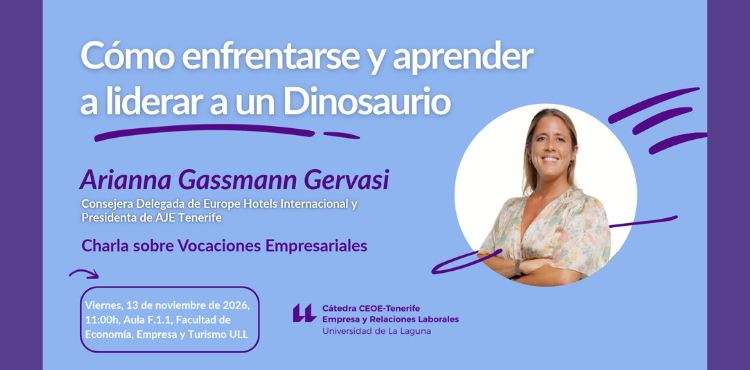
The CEOE-Tenerife Chair of Business and Labor Relations is organizing this talk, which will be held on Friday, November 13, 2026, from 11:00 a.m. to 1:00 p.m. in the Faculty of Economics,...
-

The Cultural Center for Scientific Outreach is organizing this seminar, which will be held online on November 13, 2026, from 4:30 p.m. to 6:30 p.m. Literary routes...
-

The Binter Institutional Chair of Cybersecurity at the University of La Laguna (ULL) will hold its official annual awards ceremony next Friday, November 13th... |
9 events,
-
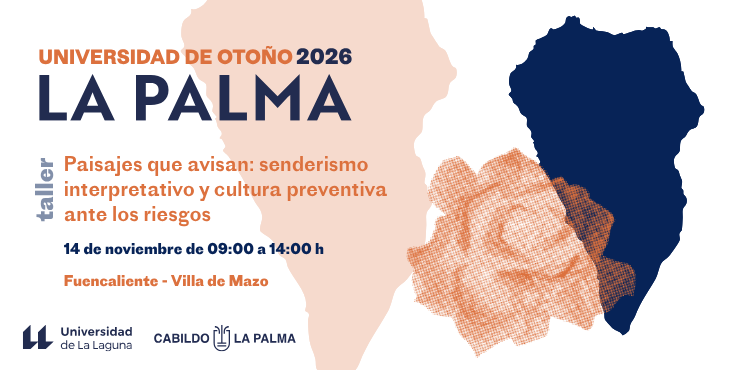
The University Extension workshop "Landscapes that warn: interpretive hiking and preventive culture in the face of risks" will be held on November 14, 2026 from 9:00 a.m. to 2:00 p.m.
-

The Sports Service is organizing the "Train with Strategy" workshop, taught by instructors Guillermo Maldonado de Diego, a Senior Technician in Teaching and Socio-sports Activities and a student of the Degree in...
-
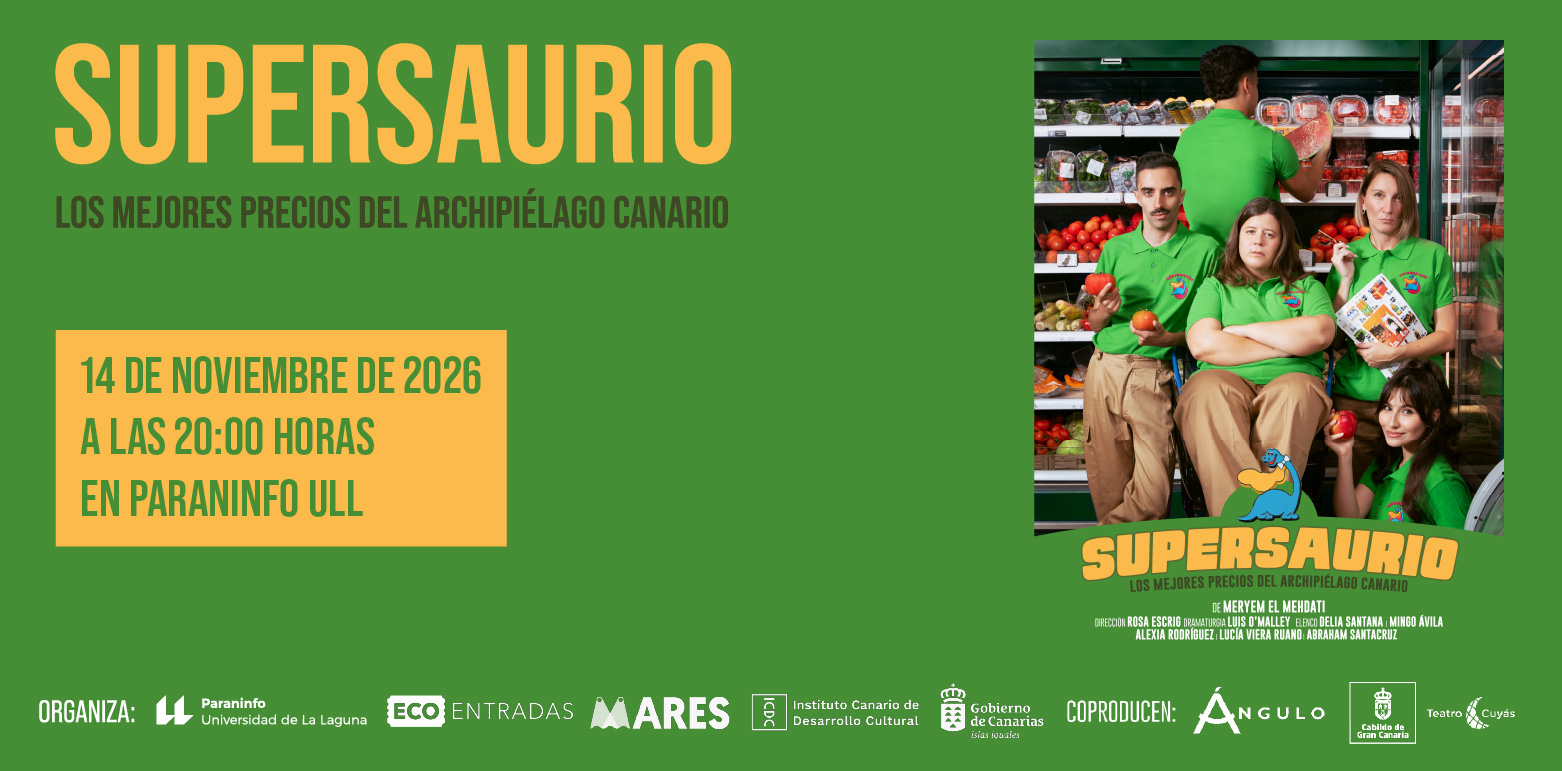
In an archipelago where opportunities seem to pass as slowly as Route 91, Meryem, a 25-year-old, tries to find her place amidst work at Supersaurio, the... |
5 events, |
10 events,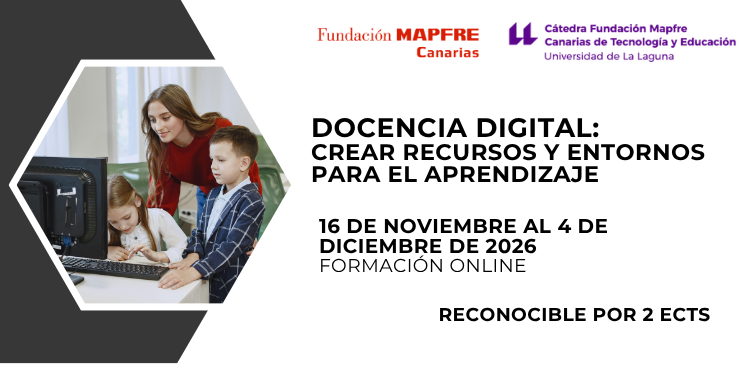
The Mapfre Canarias Foundation Chair of Technology and Education, in collaboration with the EDULLAB Research and Innovation Group (Laboratory of Education and New Technologies of the ULL), is organizing this...
-

The Institutional Chair of Childhood and Adolescence at the University of La Laguna will hold its third annual awards ceremony on Monday, November 16, 2026...
-

Within the framework of the structural project "Book Days: A Year to Inhabit the Word," the Vice-Rectorate for Culture and University Extension, in collaboration with the Cultural Center...
-

Its aim is to provide a partial but sufficient understanding of the universe and life to facilitate changes in our ideas and behaviors. It uses scientific data updated to 2026,... |
11 events,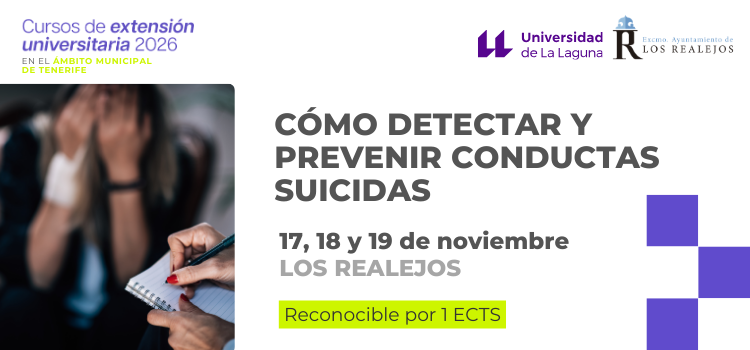
Los Realejos hosts the course "How to detect and prevent suicidal behavior," jointly organized by the Vice-Rectorate for Culture and University Extension and the Los Realejos City Council, within the framework of... 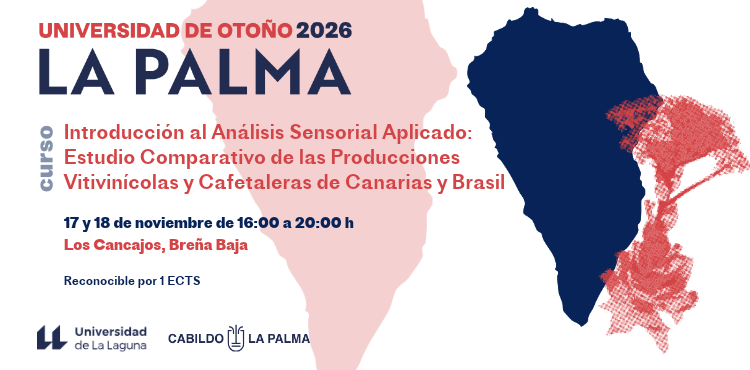
Breña Baja hosts the University Extension course "Introduction to Applied Sensory Analysis: Comparative Study of Wine and Coffee Production in the Canary Islands and Brazil," which will be held on...
-
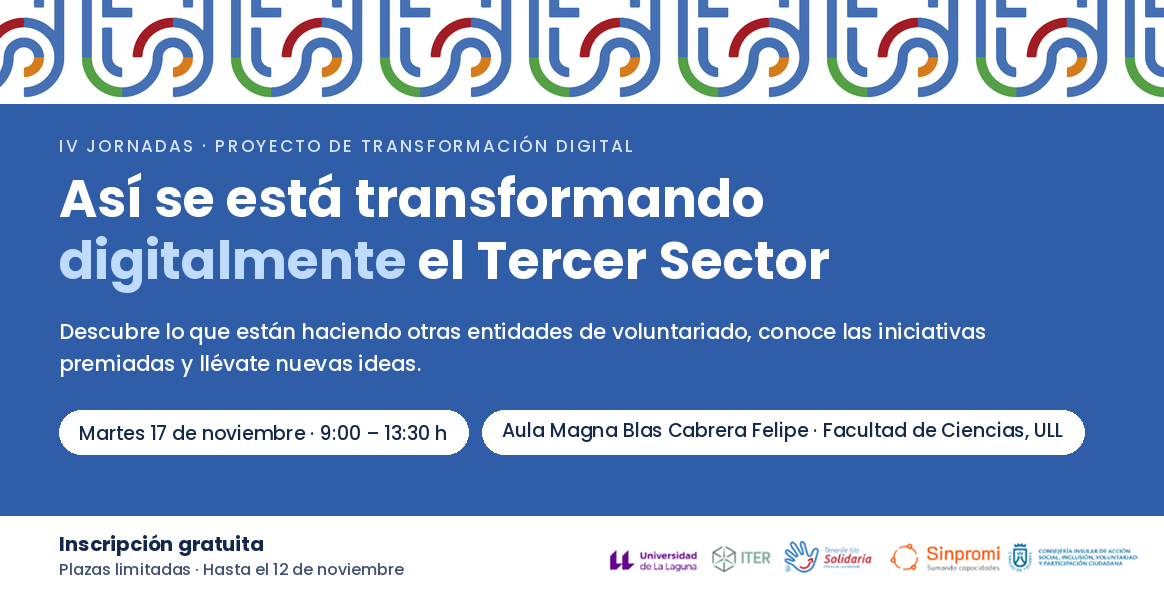
The Tenerife Isla Solidaria Program is organizing the 4th Digital Transformation Project Conference, which will be held on November 17th at the University of La Laguna. We encourage you to...
-
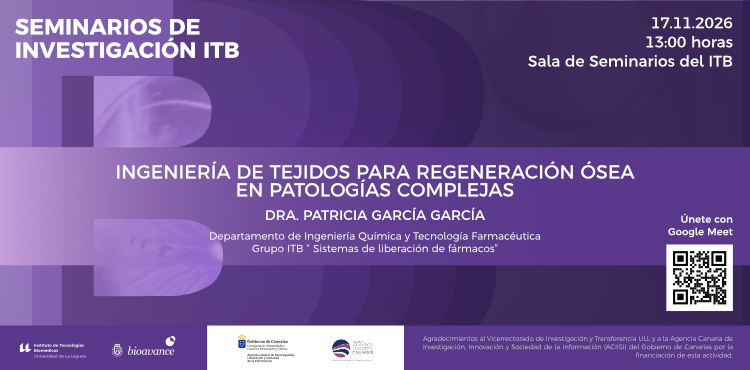
The ITB 2026 Research Seminars program continues on Tuesday, November 17th at 1:00 PM with a seminar by Dr. Patricia García García, who will give a talk...
-

The "Historical Press Workshop" is part of the 2026 University Extension Workshops program, "Connect+ Workshops." It will be held in the Geography and History Building on Tuesday... |
12 events,
Between November 18 and 20, 2026, the Spanish University Network for Environmental History (RUEDHA) will hold its 5th Congress at the University of La Laguna. This Fourth... 
The DARC Market is a space for meeting and showcasing university creative talent, where students and artists can present and sell their products and creations. Through... 
Porto will host the 11th World Congress on Childhood and Youth, a unique forum for reflection and dialogue on the challenges and opportunities facing children and young people in...
-
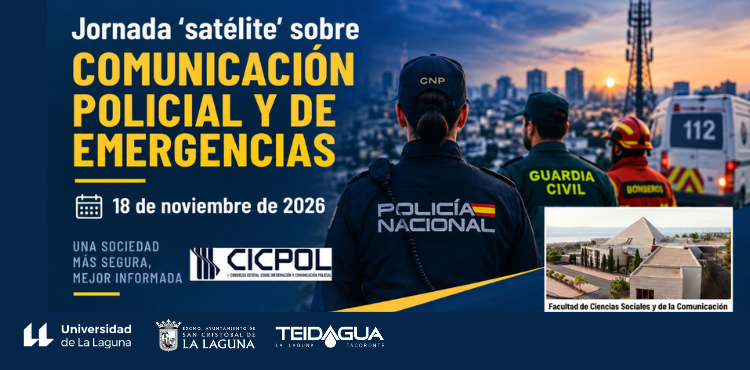
The La Laguna City Council and the University of La Laguna are organizing the "Police and Emergency Communication" conference, which will take place on Wednesday, November 18th in the building... 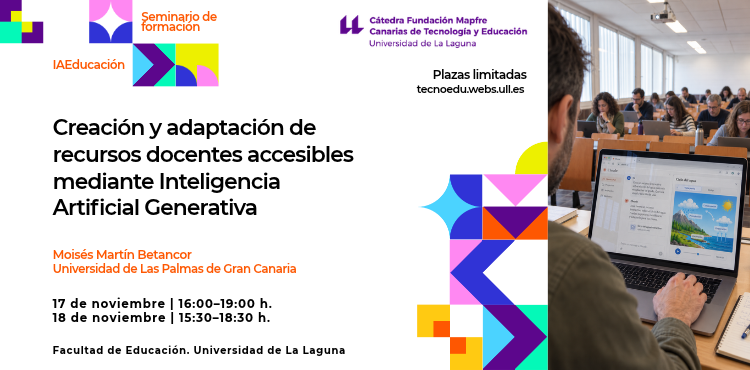
The MAPFRE Canarias Foundation Chair of Technology and Education (TECNOEDU) at the University of La Laguna is organizing the seminar-workshop “Creation and adaptation of accessible teaching resources through generative artificial intelligence”....
-
The "Law, Person and Family" Research Group of the University of La Laguna and the Institutional Chair of Childhood and Adolescence of the University of La Laguna are organizing the... |
15 events,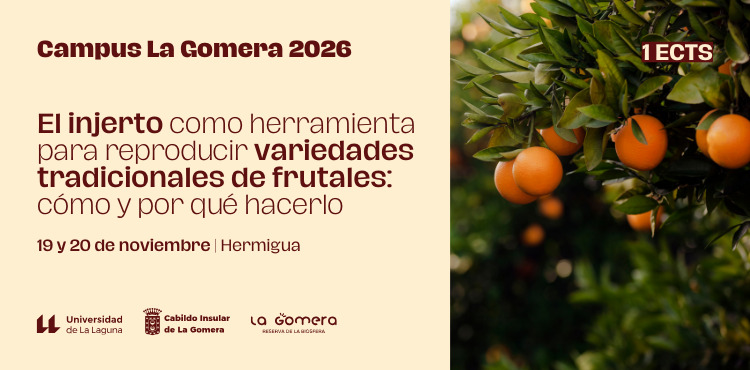
Hermigua hosts the University Extension course "Grafting as a tool to reproduce traditional fruit varieties: how and why to do it", which will be held on the 19th and 20th... 
The Education and Youth Department of the Granadilla de Abona City Council and the University of La Laguna, through its Scientific Culture and Innovation Unit...
-

To mark World Philosophy Day 2026, a commemoration promoted by UNESCO, the Philosophy Department of the Faculty of Humanities at the University of La Laguna is organizing...
-

""A Meeting with Arantxa Rufo," part of the activities of the 9th Crime Fiction Book Club. This meeting is made possible by the Writers at the University program of the Association...
-
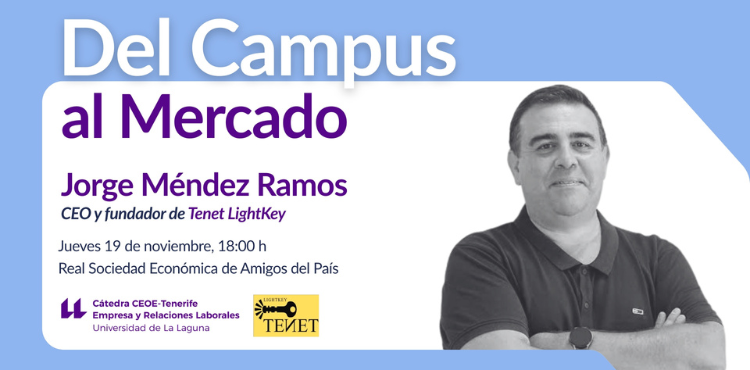
The CEOE-Tenerife Chair of Business and Labor Relations is organizing this event, which will be held on Thursday, November 19, 2026, from 6:00 p.m. to 8:00 p.m. at the headquarters of... |
17 events,
The 8th World Congress on Children and Adolescents, to be held online from November 20-27, 2026, constitutes an international space for meeting, reflection and...
-
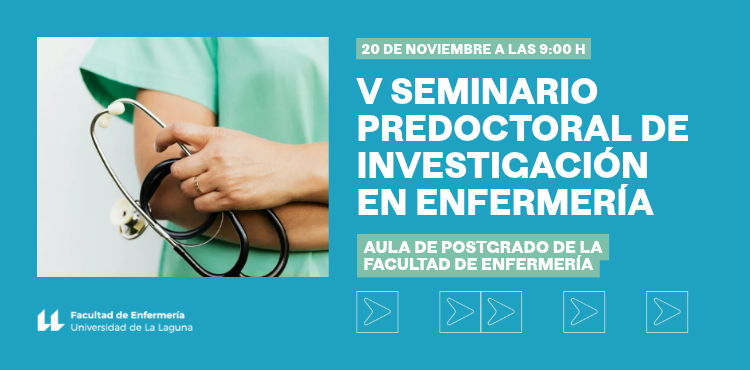
The Faculty of Nursing at the University of La Laguna will host the 5th Predoctoral Seminar on Nursing Research on Friday, November 20, 2026, organized by...
-
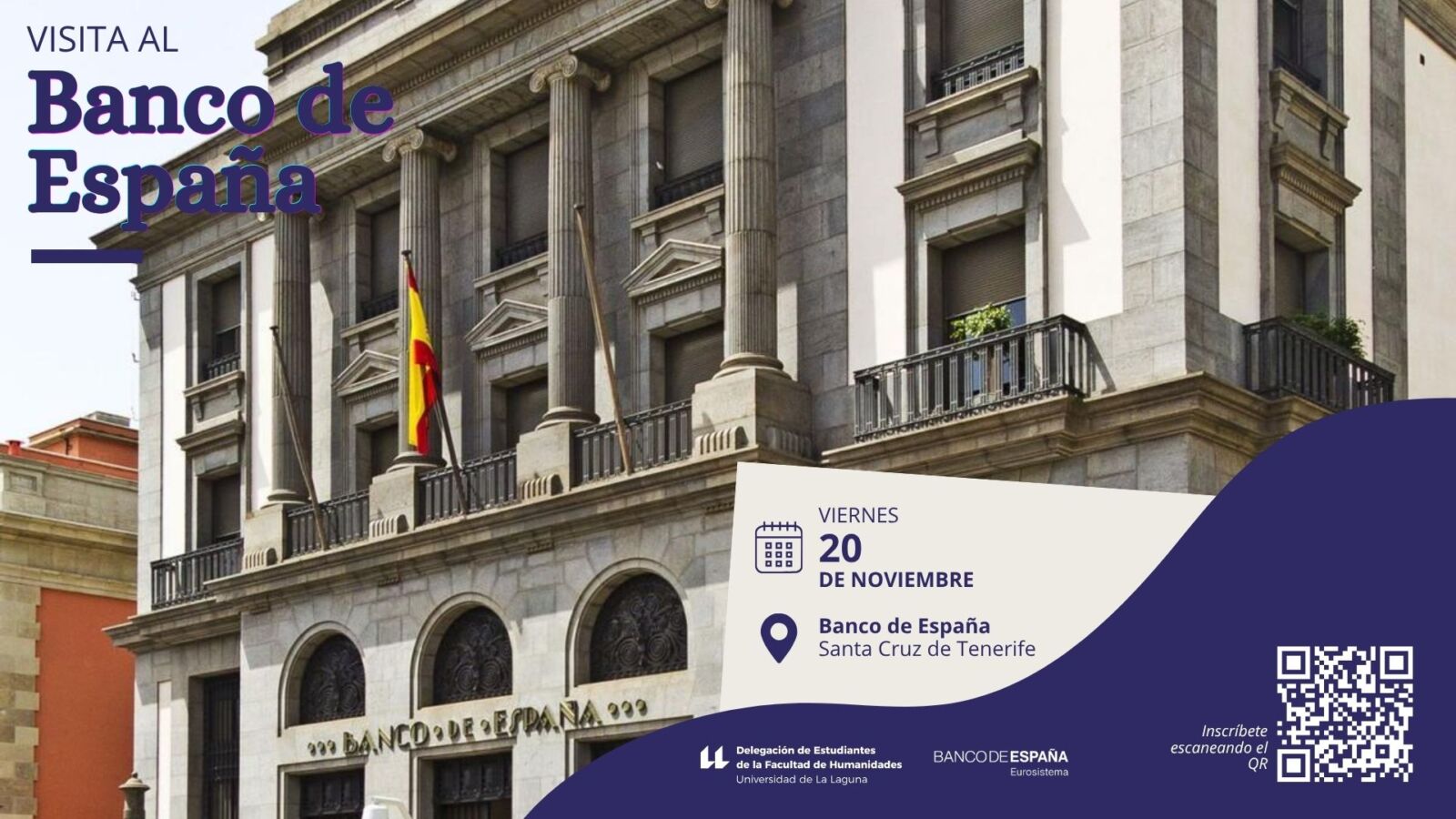
The Student Delegation of the Faculty of Humanities at the University of La Laguna is organizing a cultural visit to the Bank of... on October 20th at 10:00 am.
-
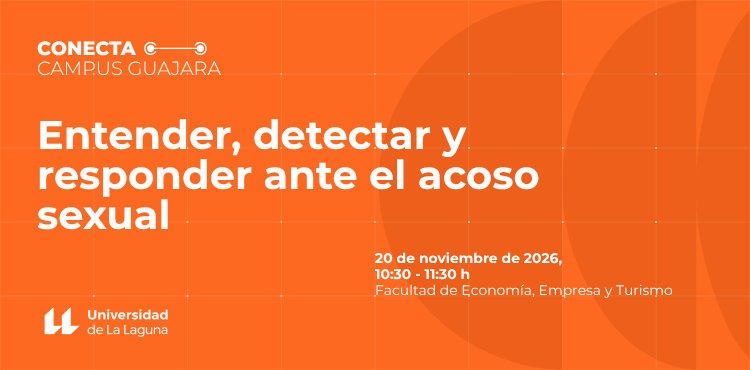
The Faculty of Economics, Business and Tourism, within the framework of CONECTA CAMPUS GUAJARA, is organizing this event which will be held at the Faculty of Economics, Business and Tourism on Friday... |
11 events,
-
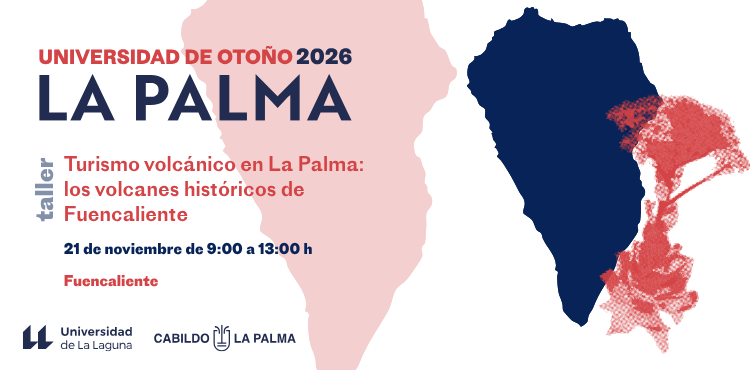
The University Extension workshop "Volcanic Tourism in La Palma: The Historical Volcanoes of Fuencaliente" will be held on November 21, 2026, from 9:00 a.m. to 1:00 p.m. at...
-

Is your mind racing? Are you constantly stressed? Discover how mindfulness meditation can help! Take advantage of the workshop that the Sports Department has scheduled for Saturday, the 21st...
-
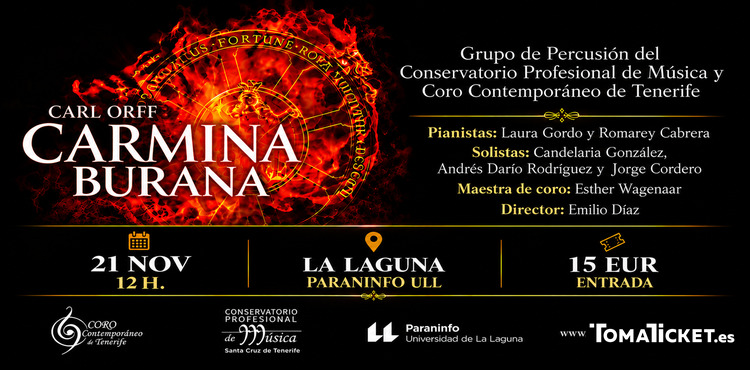
The Paraninfo of the University of La Laguna hosts Carmina Burana, the masterpiece by composer Carl Orff that has marked the history of music, one of the... |
8 events,
-
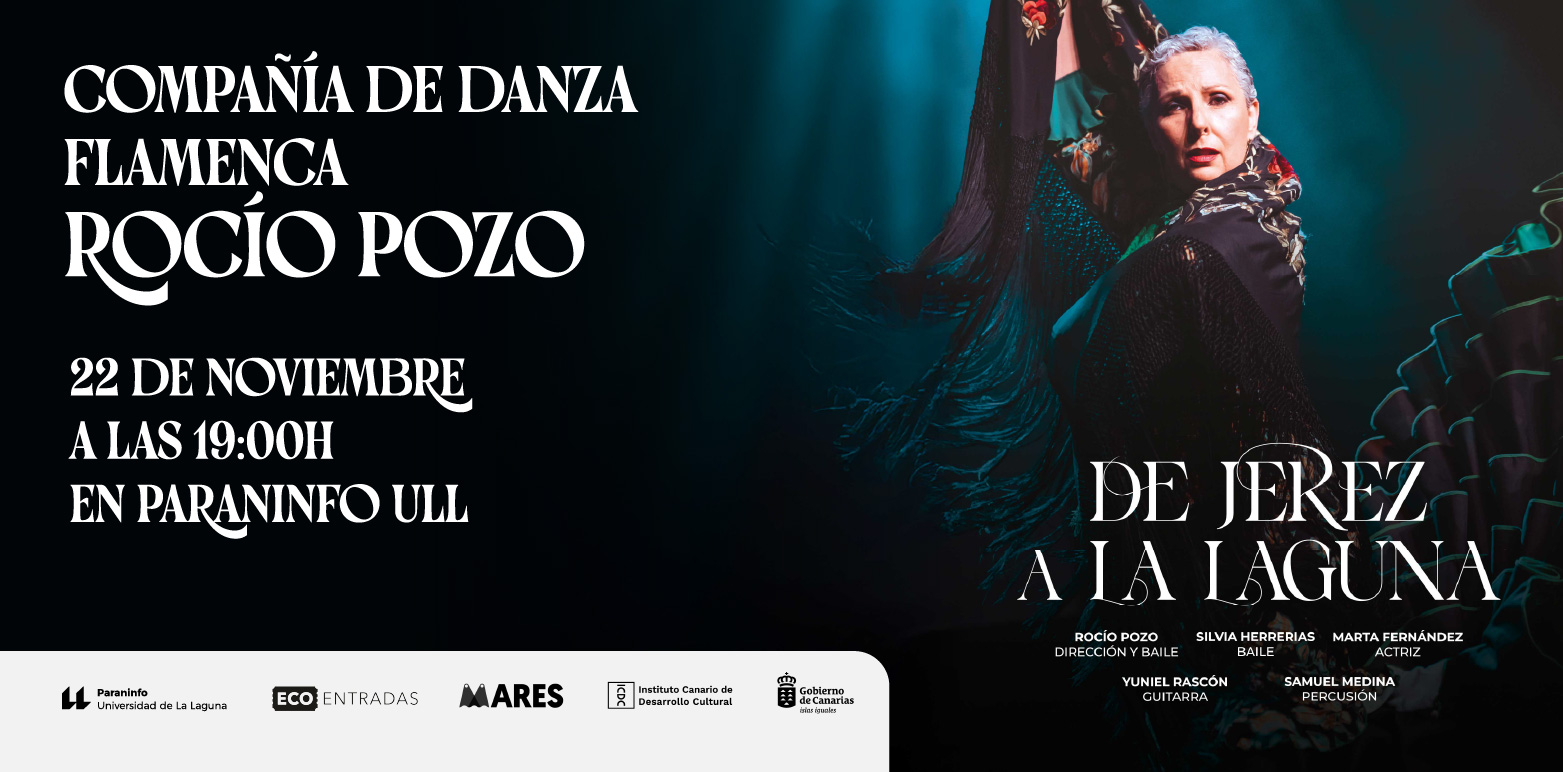
In this proposal, we explore the life and impact of an iconic figure in flamenco and a clear example of female empowerment, alongside other great women of her time.... |
11 events,
The BREFEM International Congress: Poetics of Brevity and Feminine Spirituality will take place virtually on November 23, 24 and 25, 2026, with the final day coinciding... 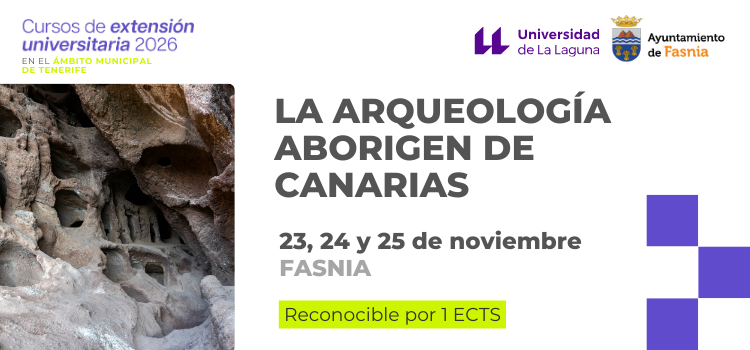
Fasnia hosts the course "The Aboriginal Archaeology of the Canary Islands", organized jointly by the Vice-Rectorate for Culture and University Extension and the Fasnia City Council, within the framework of the Courses program... 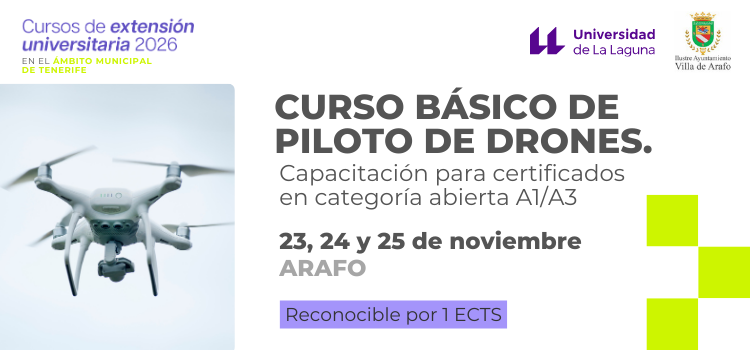
Arafo hosts the course "Basic Drone Pilot Course. Training for open category A1/A3 certificates", jointly organized by the Vice-Rectorate for Culture and University Extension and the Illustrious City Council... 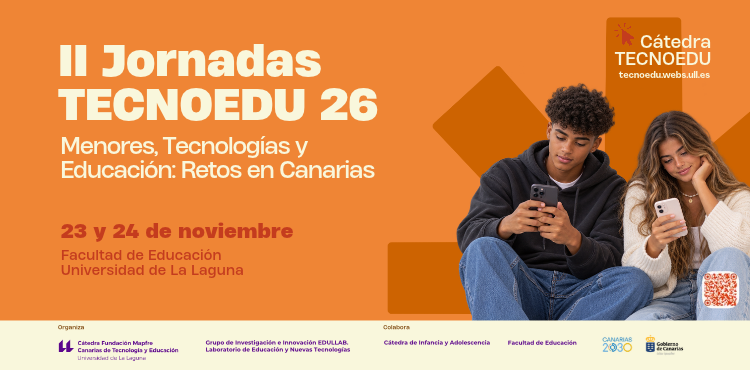
The 2nd TECNOEDU Conference will bring together specialists on November 23rd and 24th to address children's rights, the use of mobile phones in schools, and... |
14 events,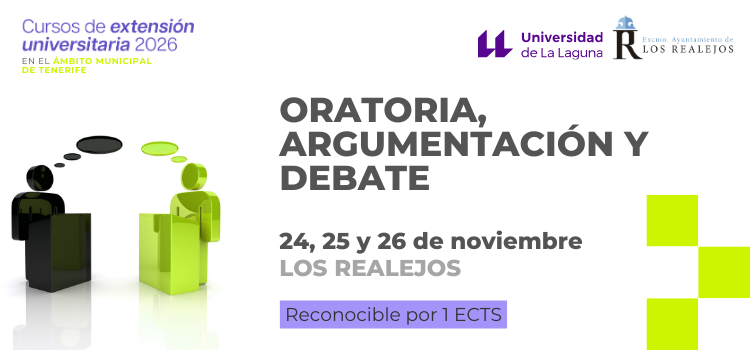
Los Realejos hosts the course "Public Speaking, Argumentation and Debate", jointly organized by the Vice-Rectorate for Culture and University Extension and the Los Realejos City Council, as part of the program of... 
The lecture hall of the César Manrique General Building will host a European meeting of the Erasmus+ Sacred project, organized by the Faculty of..., from November 24th to 26th. 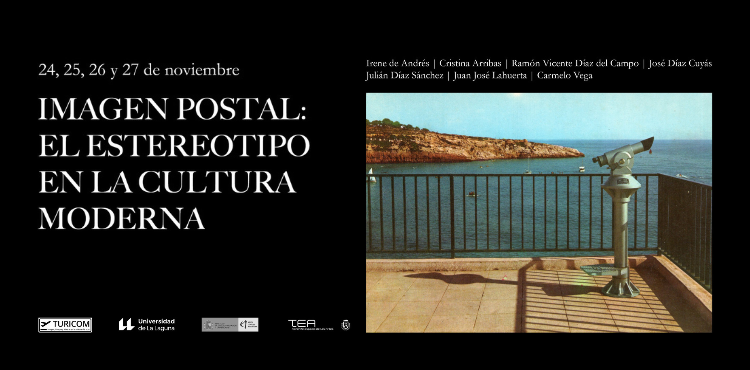
The TEA Tenerife Espacio de las Artes museum is hosting the seminar "Postcard Image: The Stereotype in Modern Culture" from Tuesday, November 24th to Friday, November 27th, a series of...
-

Film Club Talks and Multicines Tenerife, in collaboration with the Film Department of the University of La Laguna, are organizing a screening of "Fried Green Tomatoes," the modern classic set in...
-
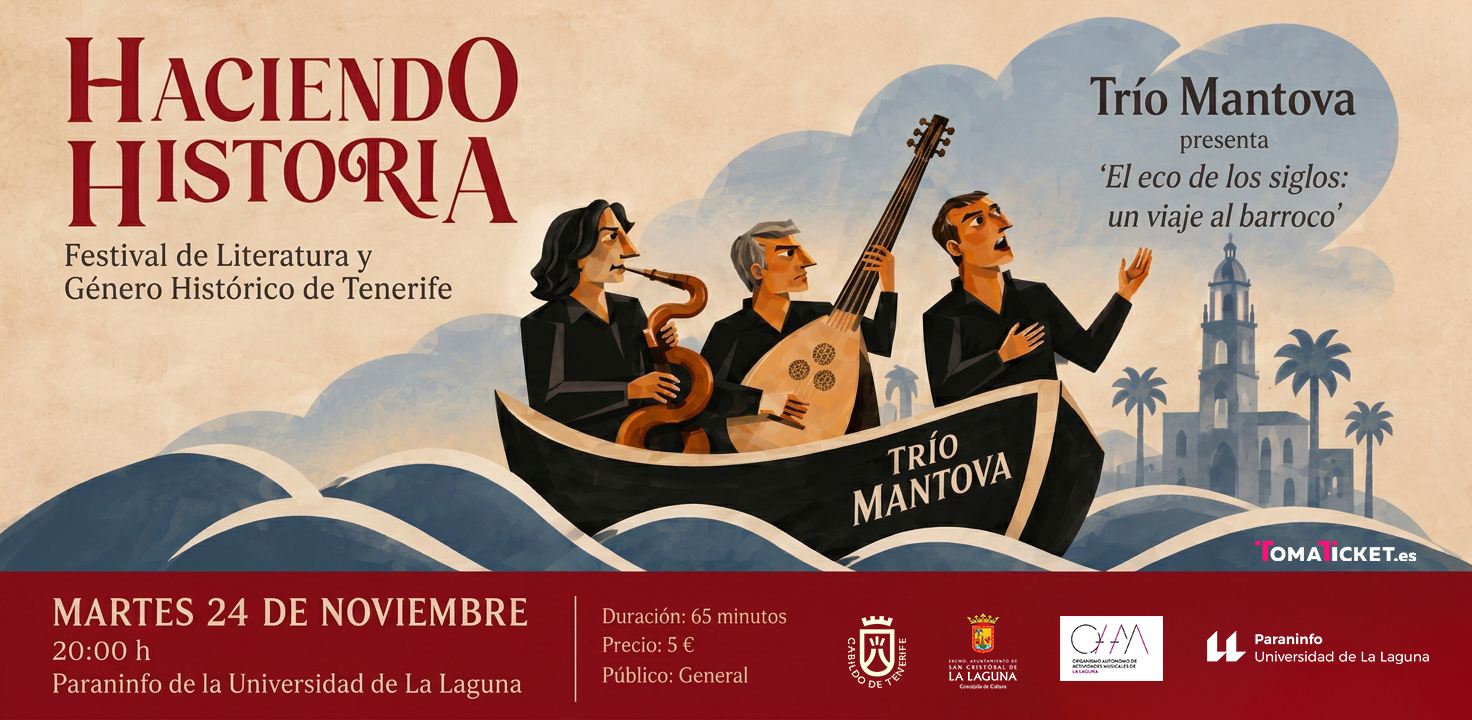
Music preserves the memory of its time. Its melodies resonate with the passions, longings, and contradictions of those who lived in other eras; its silences hold the stories that... |
19 events,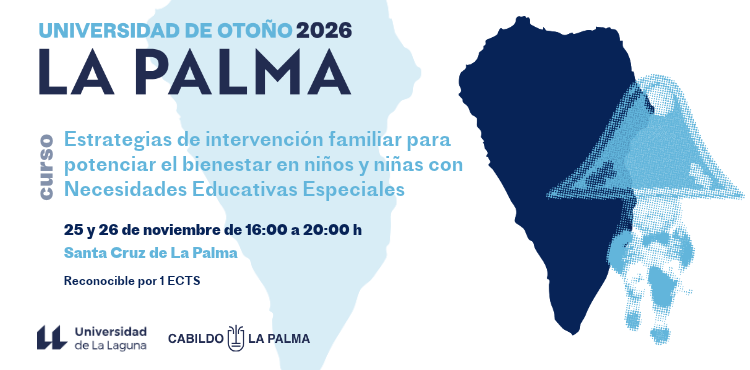
Santa Cruz de La Palma will host the University Extension course "Family Intervention Strategies to Enhance Well-being in Children with Special Educational Needs"... 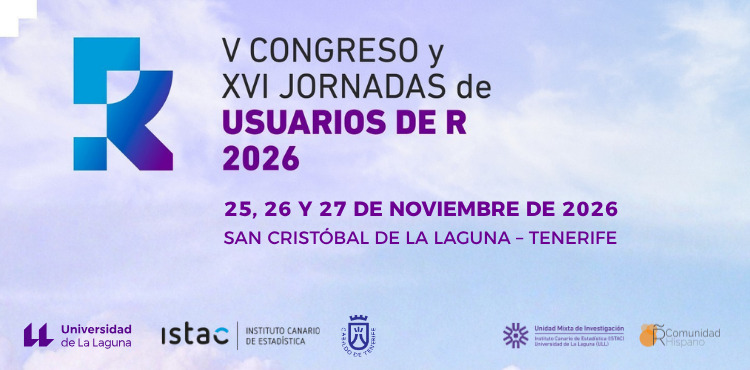
The 5th Congress and 16th R Users' Conference 2026 will bring together the Spanish-speaking community interested in the use of R, a free and open-source software programming language...
-

The work of a psychomotor therapist with children cannot be separated from the child's family reality. Involving the family in the therapeutic process entails...
-
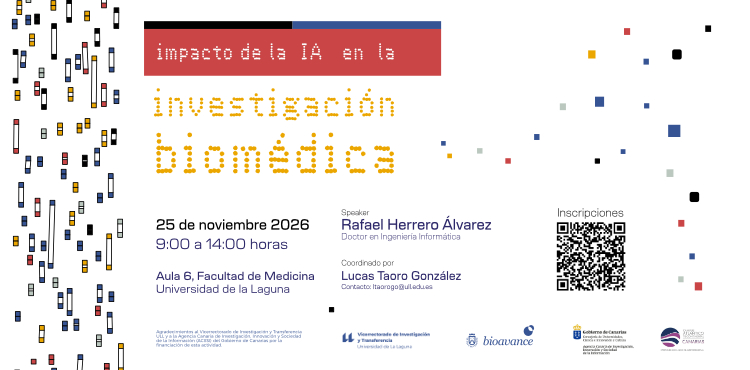
The Institute of Biomedical Technologies at the University of La Laguna will host a scientific workshop entitled "Impact of AI..." on Wednesday, November 25, 2026.
-

To mark November 25th, the International Day for the Elimination of Violence against Women, the University Institute for Women's Studies (IUEM) of the University of... |
21 events,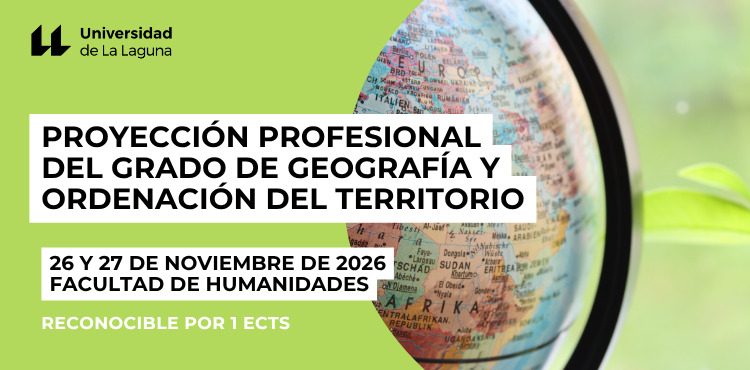
The knowledge acquired in a Geography degree, aimed at understanding the spatial component of the social and natural sciences, has gradually acquired a more focused approach... 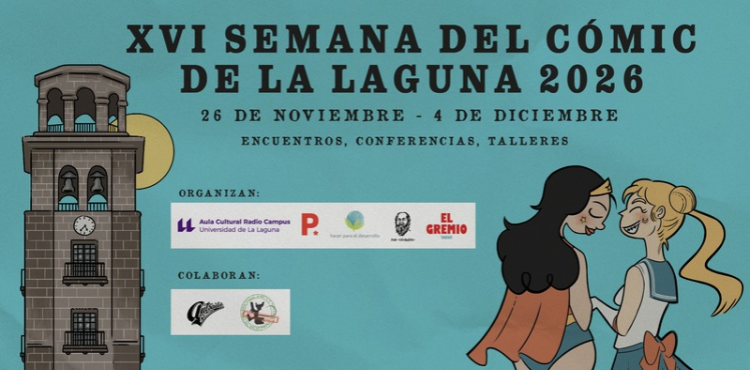
The sixteenth edition of the university event in the Laguna region dedicated to the ninth art will feature a wide variety of conferences, workshops, and seminars aimed at the general public... 
The César Manrique General Lecture Hall will host the series "Three lectures on the Black presence in Cuban literature from the..." on November 26, 30 and December 1. 
On the afternoon of Thursday, November 26th, and the morning of Friday, November 27th, 2026, the Ecotopia and Action Conference will be held. A sensitive vision between art, science, and...
-
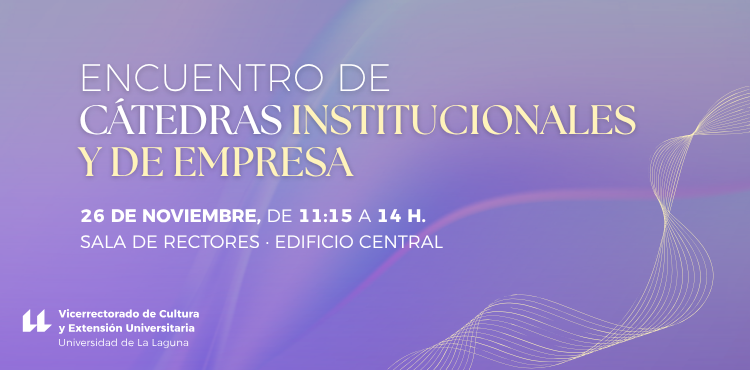
The meeting aims to be a close-knit, participatory, and collaborative space that will strengthen relationships between the ULL's academic chairs, share experiences, identify synergies, and promote initiatives and...
-
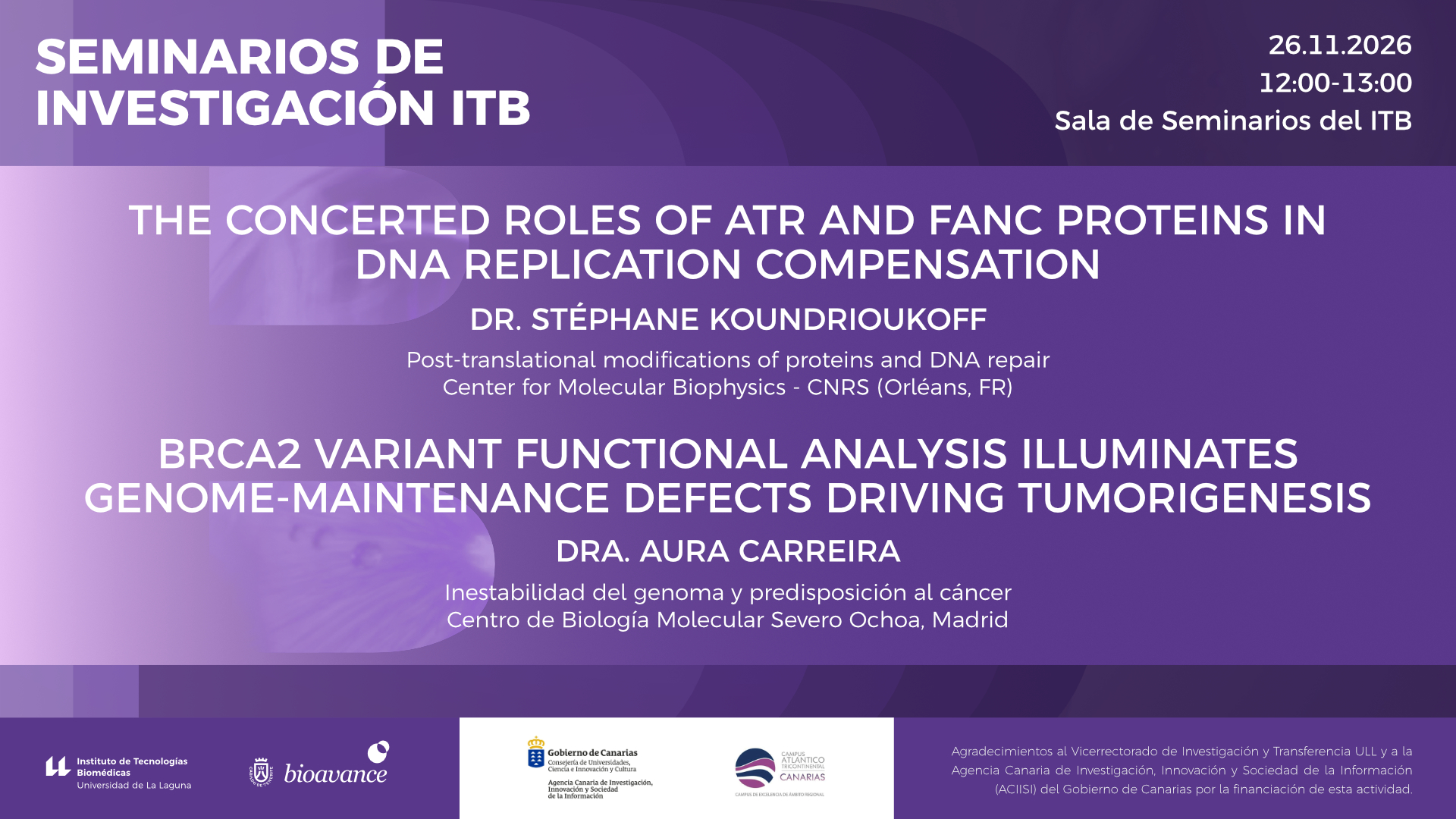
The ITB 2026 Research Seminars program continues on Thursday, November 26, from 12:00 to 13:00 with a double seminar by Dr. Stéphane Koundrioukoff, who...
-
The Department of Mathematical Analysis and the Institute of Mathematics and Applications at the University of La Laguna organize weekly seminars on Mathematical Analysis and Applied Mathematics. 26... |
15 events,
-
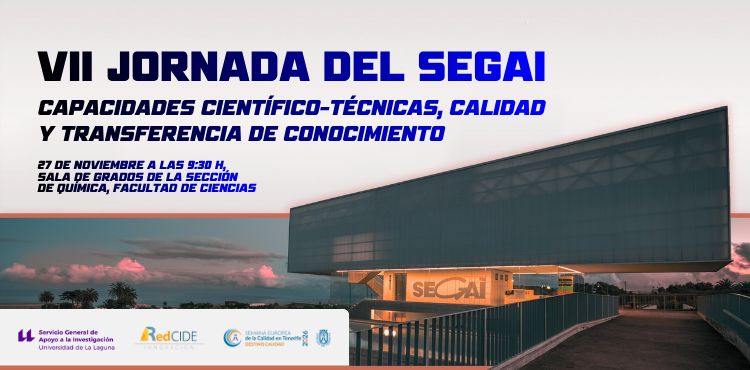
The General Research Support Service (SEGAI) of the University of La Laguna will hold its 7th SEGAI Conference on November 27, 2026, a meeting...
-

Healthcare systems must make decisions about the adoption and funding of new technologies in a context of limited resources, uncertainty, and growing health needs. How do they determine which interventions...
-

Film Club Talks and Multicines Tenerife, in collaboration with the Film Department of the University of La Laguna, are organizing the screening of the short film "Nasija" and the feature film... |
6 events,
-

The Sports Service is organizing the "Your Routine, Your Choice" workshop for the university community. This workshop is a practical and educational program to be held in the fitness room... |
6 events,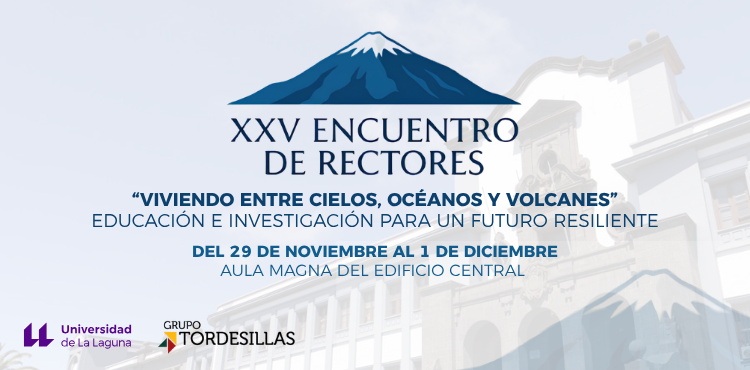
From November 29th to December 1st, the University of La Laguna will host the 25th Rectors' Meeting, entitled this year "Living between skies, oceans and volcanoes. Education...". |
10 events,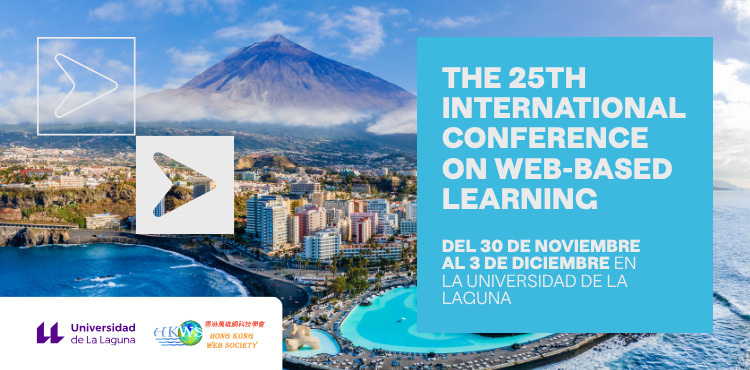
The 25th International Conference on Web-Based Learning (ICWL 2026) and the 11th International Symposium on Emerging Technologies for Education (SETE 2026) are two scientific conferences... 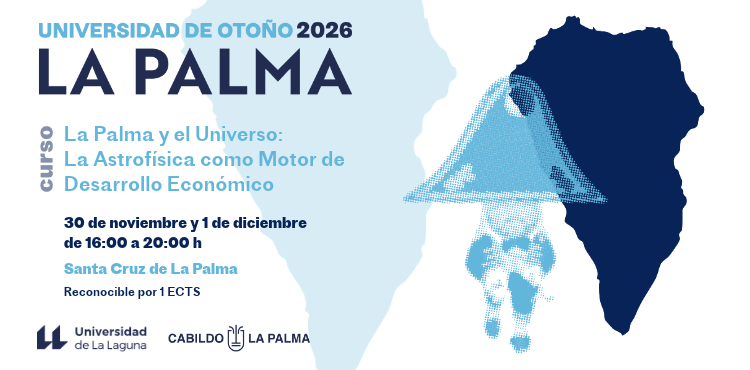
Santa Cruz de La Palma hosts the University Extension course "La Palma and the Universe: Astrophysics as an Engine of Economic Development", which will be held on November 30th... 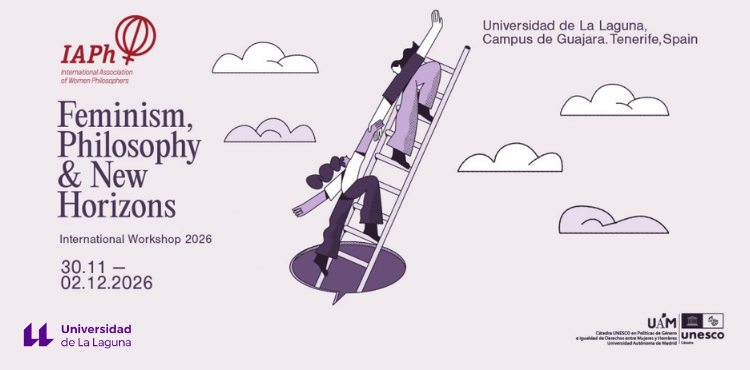
In an era of profound social, political, technological, and epistemic transformations, feminist philosophy offers critical resources for questioning established frameworks of knowledge, power, and justice. «Feminism, Philosophy, and…”.
-

Film Club talks and Multicines Tenerife, in collaboration with the Film Department of the University of La Laguna, are organizing a screening of Suspicion, the romance film... |
13 events,
The University of La Laguna, through its Scientific Culture and Innovation Unit (Cienci@ULL), and Cajasiete present the seventh edition of the Scientific Suitcases School Competition... 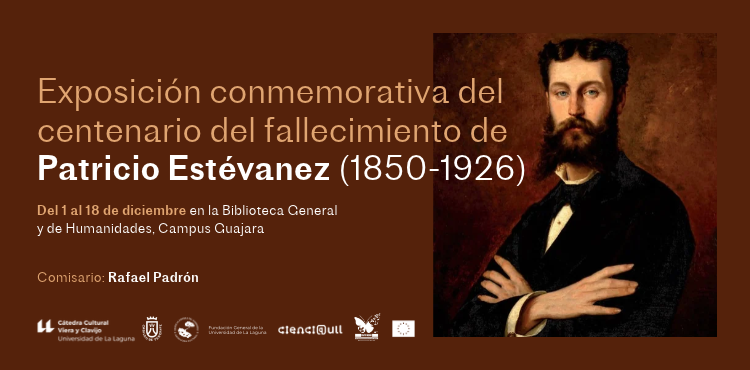
2026 marks the centenary of the death of Patricio Estévanez Murphy (1850-1926), an illustrious writer and politician, considered the patriarch and mentor of journalists on the island of Tenerife. Born... 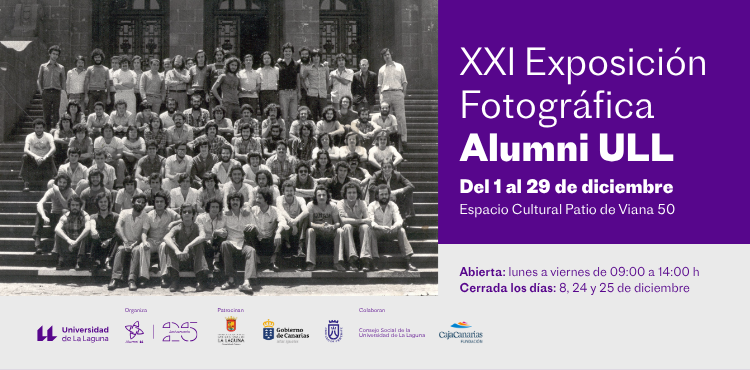
Alumni ULL (Association of Former Students and Friends of the University of La Laguna) presents in this exhibition a selection of 52 photographs and press articles about life... 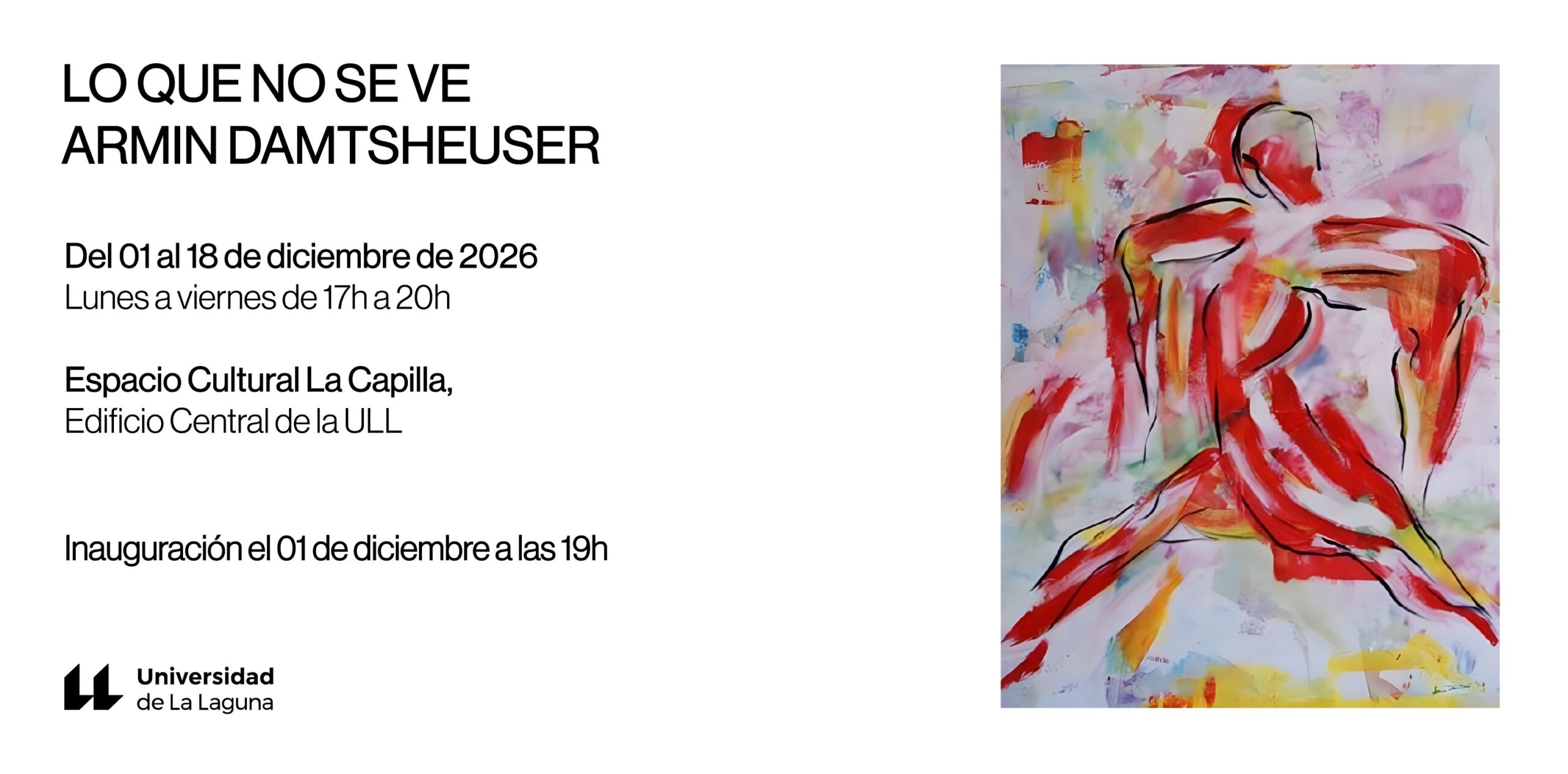
Armin Damtsheuser, a prolific visual artist born in Germany and residing in the Canary Islands, has taught in Tenerife for over 30 years. He is recognized for his extensive body of work... 
The Francisco de Miranda Chair at the University of La Laguna and the Institute of Hispanic Studies of the Canary Islands are organizing an event between December 1st and 3rd, 2026...
-

The 11th Disability Awareness Day is a meeting, awareness-raising, and reflection event organized by students of the Social Work Degree at the University of La... |
12 events,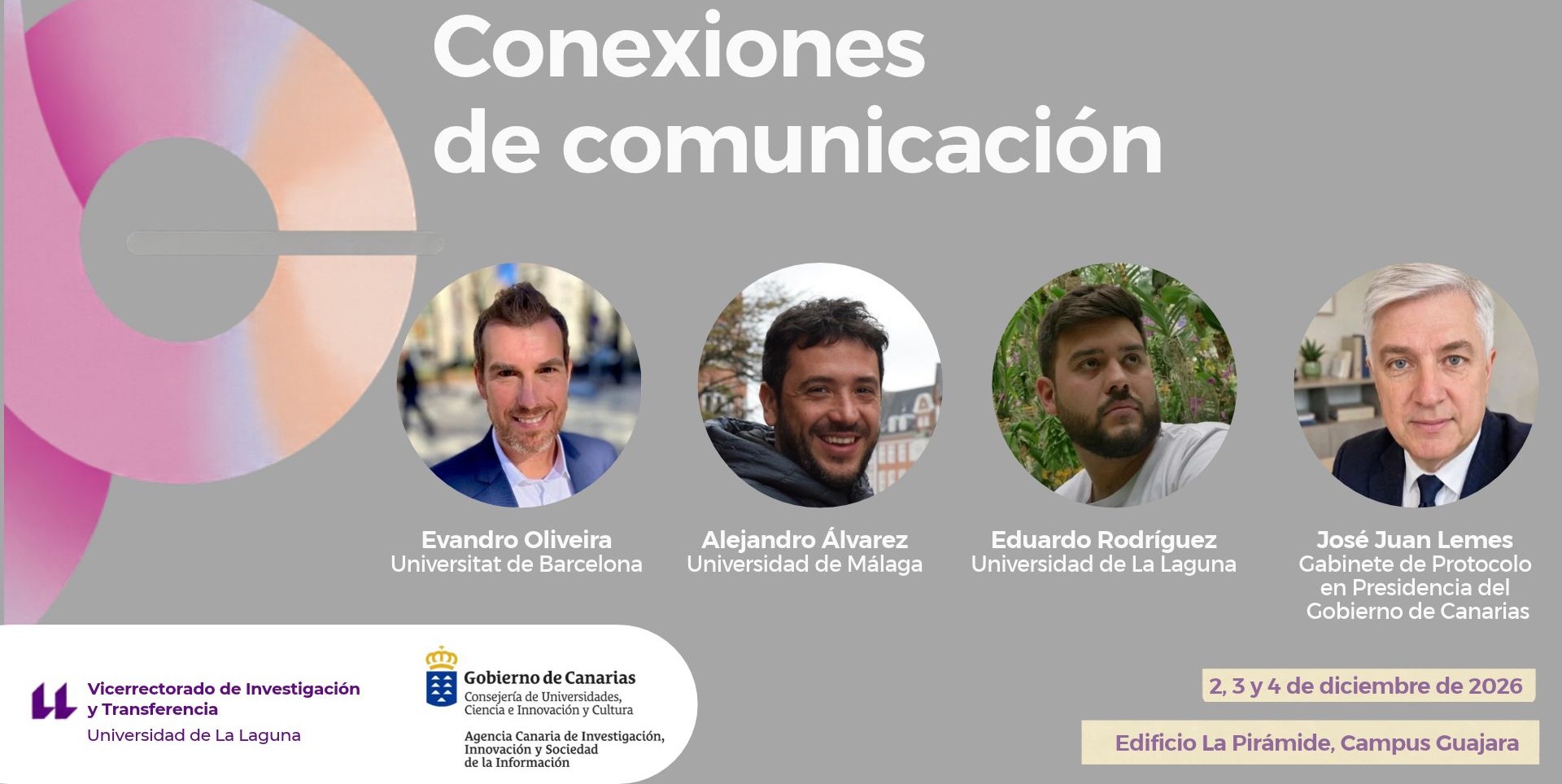
The Communication Connections 2026 seminar is presented as a space for meeting and reflecting on the current and future challenges of organizational communication. Through workshops, presentations...
-
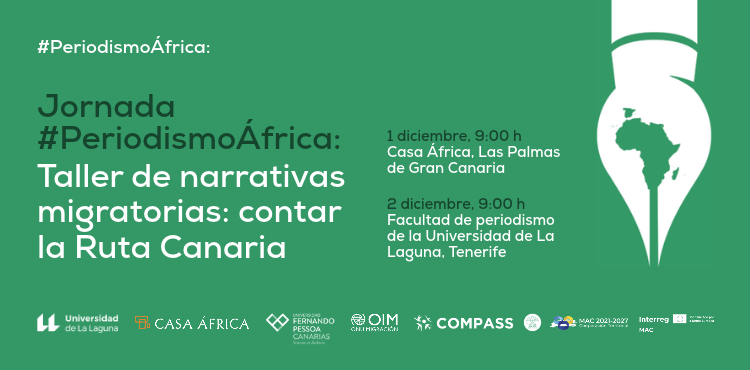
The #PeriodismoÁfrica workshop, "Migration Narratives Workshop: Telling the Canary Route," offers a space for meeting and reflection on the challenges of media coverage of migration, especially... |
18 events,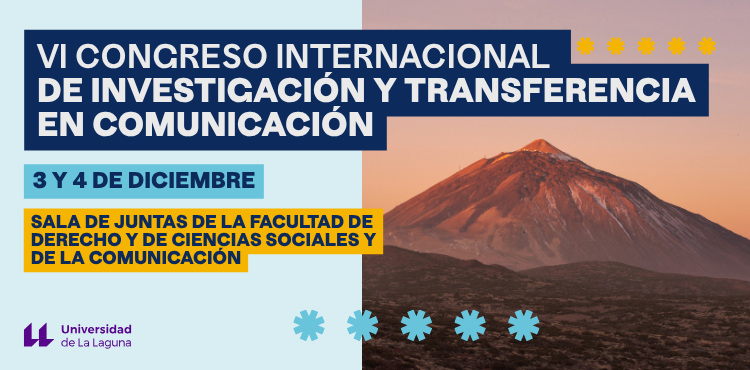
The Faculty of Social Sciences and Communication and the Faculty of Law of the University of La Laguna will host, on December 3 and 4, 2026,...
The Faculty of Social Sciences and Communication and the Faculty of Law of the University of La Laguna will host, on December 3 and 4, 2026,...
-
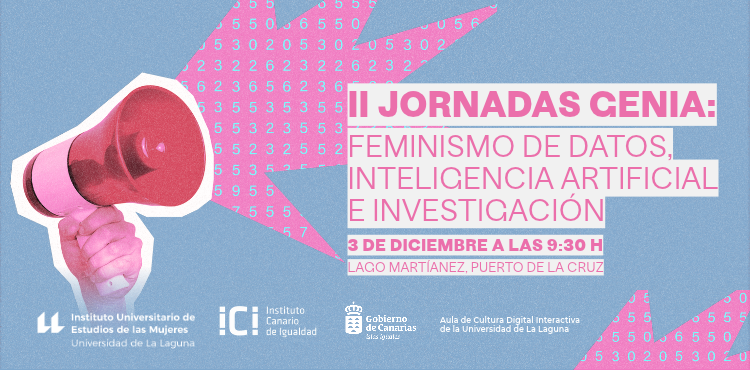
Who decides what data matters? What happens when artificial intelligence learns from information that perpetuates inequalities? How can we incorporate a gender perspective into research and...
-

The Faculty of Economics, Business and Tourism, in collaboration with the CajaCanarias-Cabildo de Tenerife Chair of Economics and Mobility at the University of La Laguna, within the framework of CONECTA CAMPUS...
-
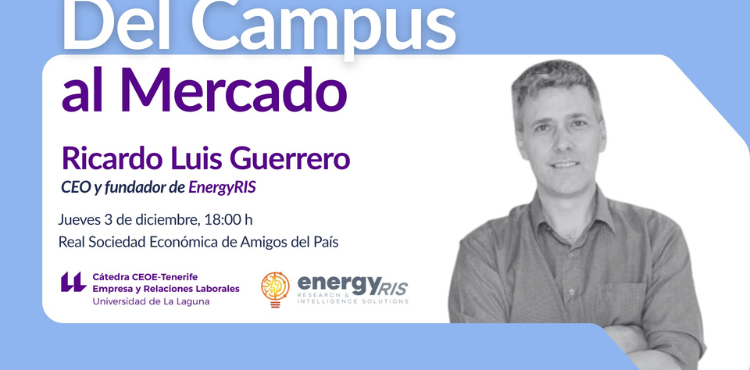
The CEOE-Tenerife Chair of Business and Labor Relations is organizing this event, which will be held on Thursday, December 3, 2026, from 6:00 p.m. to 8:00 p.m. at the headquarters of... |
14 events,
The Guild is a regular event that brings together professionals, creators, artists, and technicians from the audiovisual world in Tenerife and throughout the Canary Islands. It stems from the conviction that...
-
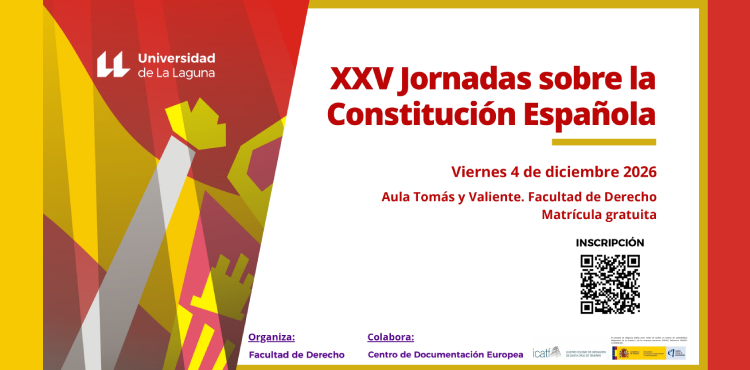
The Faculty of Law at the University of La Laguna will hold the 25th edition of its Conference on the Spanish Constitution on December 4th, a well-established academic event...
-

At 1:00 p.m. on Friday, December 4th, the information session on the SICUE mobility program will take place in room 02.2 of the Faculty of Law...
-

La Partenaire is the daughter of Farsán, a small-time magician whose career ended after a trick went wrong in a show... |
9 events,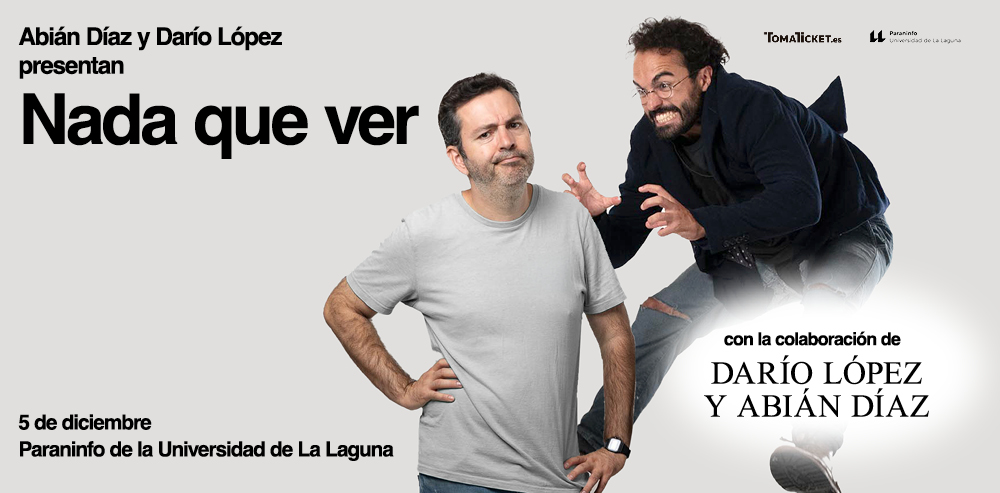
Hello, I'm Abián Díaz. Apparently, Darío López insists that I shouldn't be in charge of the synopsis. And this lack of confidence hurts. I'm convinced I have the ability...
Hello, I'm Abián Díaz. Apparently, Darío López insists that I shouldn't be in charge of the synopsis. And this lack of confidence hurts. I'm convinced I have the ability... |
8 events,
-

A book that keeps changing hands: 'Anna Karenina'. Three women rethink their lives after reading it. Mariana, a museum guard, recognizes herself... |
Government Pavilion, C/ Padre Herrera s/n
P.O. Box 456
38200, San Cristóbal de La Laguna
Santa Cruz de Tenerife - Spain
Switchboard Tel.: (+34) 922 31 90 00
Hours: Mon-Fri, 8:00 a.m. to 9:00 p.m.
