Government Pavilion, C/ Padre Herrera s/n
P.O. Box 456
38200, San Cristóbal de La Laguna
Santa Cruz de Tenerife - Spain
Switchboard Tel.: (+34) 922 31 90 00
Hours: Mon-Fri, 8:00 a.m. to 9:00 p.m.
This section of the garden is dedicated to a very peculiar tree of the Canary Islands flora, the Canary willow, whose scientific name is Salix canariensis C. Sm. ex Link. This tree cannot be associated with any specific vegetation zone in the Canary Islands, although it is usually found mainly associated with the thermophilic sclerophyllous forest, as it has a wide ecological range, being able to inhabit watercourses from the coast to the summit, except in the area where the hygrophilous laurel forest predominates, characterized by the til, whose scientific name is Ocotea foetens (Aiton) Baill., this is because the limiting factors for its development are the presence of light and a constant flow of water, either on the surface or underground.
For all these reasons, the Canary willow is considered a bioindicator species of the presence of water, since wherever it is found there must be a constant watercourse, as occurs in the Barranco de Afur, where it grows up to sea level, or in the streams on the border of the Teide National Park, where its presence is associated with a natural source of water.
Due to this dependence on water, this plot has an irrigation system installed that helps the development of the trees and the sustenance of the willows, ensuring that they do not suffer from a lack of water in the summer.
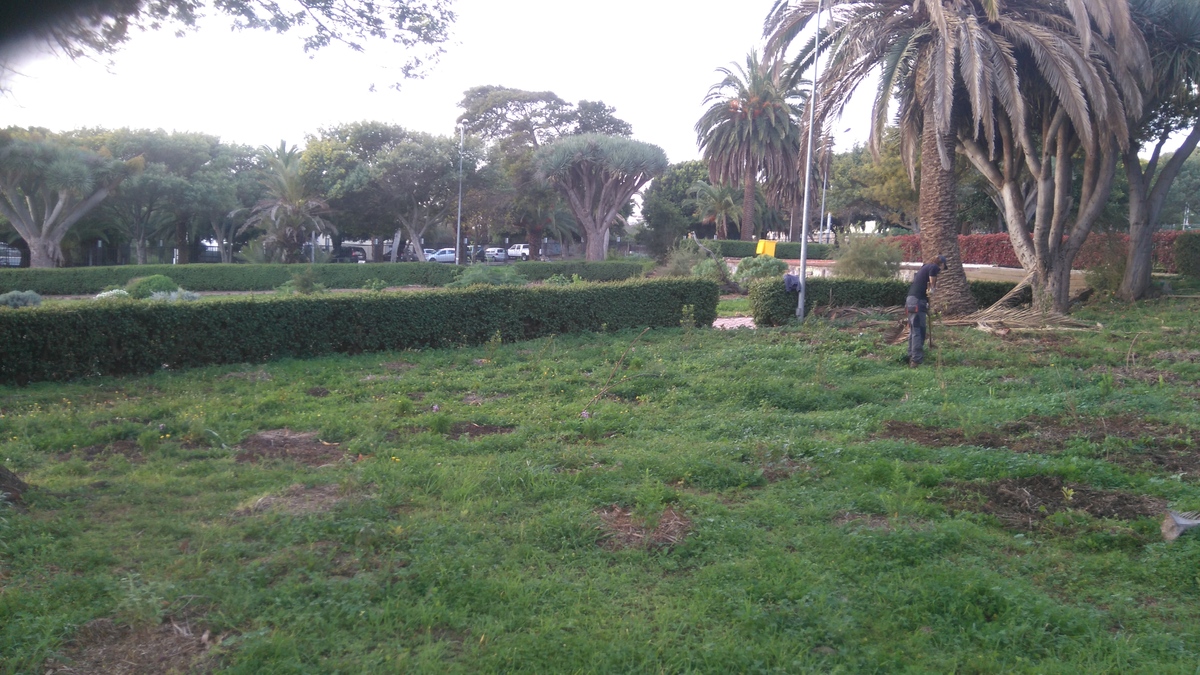
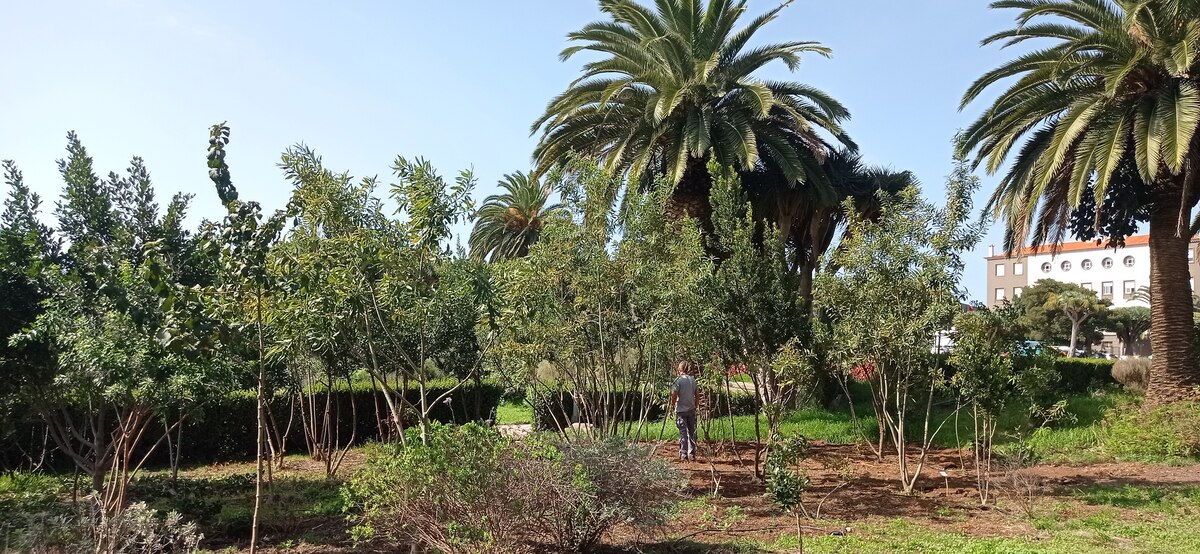
The image on the left was taken in January 2017, and the one on the right in October 2022.
Convolvulus floridus L. f.
Crambe strigosa L`Hér.
Dorycnium spectabile (Choisy ex Ser. in DC.) Webb & Berthel.
Dracaena draco (L.) L. subsp. draco
Echium simplex DC.
Echium strictum L. f. subsp. strictum
Echium virescens DC.
Erysimum virescens (Webb ex Christ) Wettst.
Euphorbia lamarckii Sweet
Euphorbia atropurpurea Brouss. exWilld.
Ferula linkii Webb
Gonospermum fruticosum (Buch) Less.
Gymnosporia cassinoides (L'Hér.) Masf.
Heberdenia excelsa (Aiton) Banks ex DC.
Hypericum canariense L.
Hypericum reflexum L. f.
Jasminum odoratissimum L.
Juniperus cedrus Webb & Berthel. subsp. cedrus
Juniperus turbinata Guss. subsp. canariensis (AP Guyot in Mathou & AP Guyot) Rivas-Mart., Wildpret & P. Pérez
Lavandula buchii Webb
Lavandula canariensis Mill.
Lavatera acerifolia Cav.
Limonium arboreum (Willd.) Erben, A. Santos & Reyes-Bet.
Limonium macrophyllum (Brouss. ex Spreng.) Kuntze
Marceletella moquiniana (Webb & Berthel.) Svent.
Morella faya (Aiton) Wilbur
Myosotis latifolia Poir.
Phoenix canariensis H. Wildpret
Picconia excelsa (Aiton) DC.
Plantago arborescens Poir. subsp. arborescens
Pterocephalus dumetorus (Brouss. ex Willd.) Coult.
Ranunculus cortusifolius Willd.
Rhamnus glandulosa Aiton
Rhamnus crenulata Aiton
Rumex lunaria L.
Salix canariensis C. Sm. former Link
Smilax canariensis Willd.
Solanum vespertilio Aiton subsp. evening
Sonchus acaulis Dum. Cours.
Tamarix canariensis Willd.
Teucrium heterophyllum L`Hér. subsp. brevipilosum Gaisberg
Viburnum rugosum Pers.
Withania aristata (Aiton) Pauquy
Government Pavilion, C/ Padre Herrera s/n
P.O. Box 456
38200, San Cristóbal de La Laguna
Santa Cruz de Tenerife - Spain
Switchboard Tel.: (+34) 922 31 90 00
Hours: Mon-Fri, 8:00 a.m. to 9:00 p.m.
